
Granola is a natural first product for food entrepreneurs: it is shelf-stable, made in batches with simple equipment, easy to package and popular with health-conscious shoppers. Many granola brands begin at farmers markets under cottage food laws, then move into commercial kitchens and grocery stores.
The category is crowded, so success depends on a distinctive product (flavor, ingredients or dietary focus), strong packaging and steady sales. Every state has some form of cottage food program, and 43 states plus D.C. allow cottage food businesses to sell online within the state, according to the Institute for Justice. This guide covers starting small, labels, scaling, pricing, a worked example and a 90-day plan.
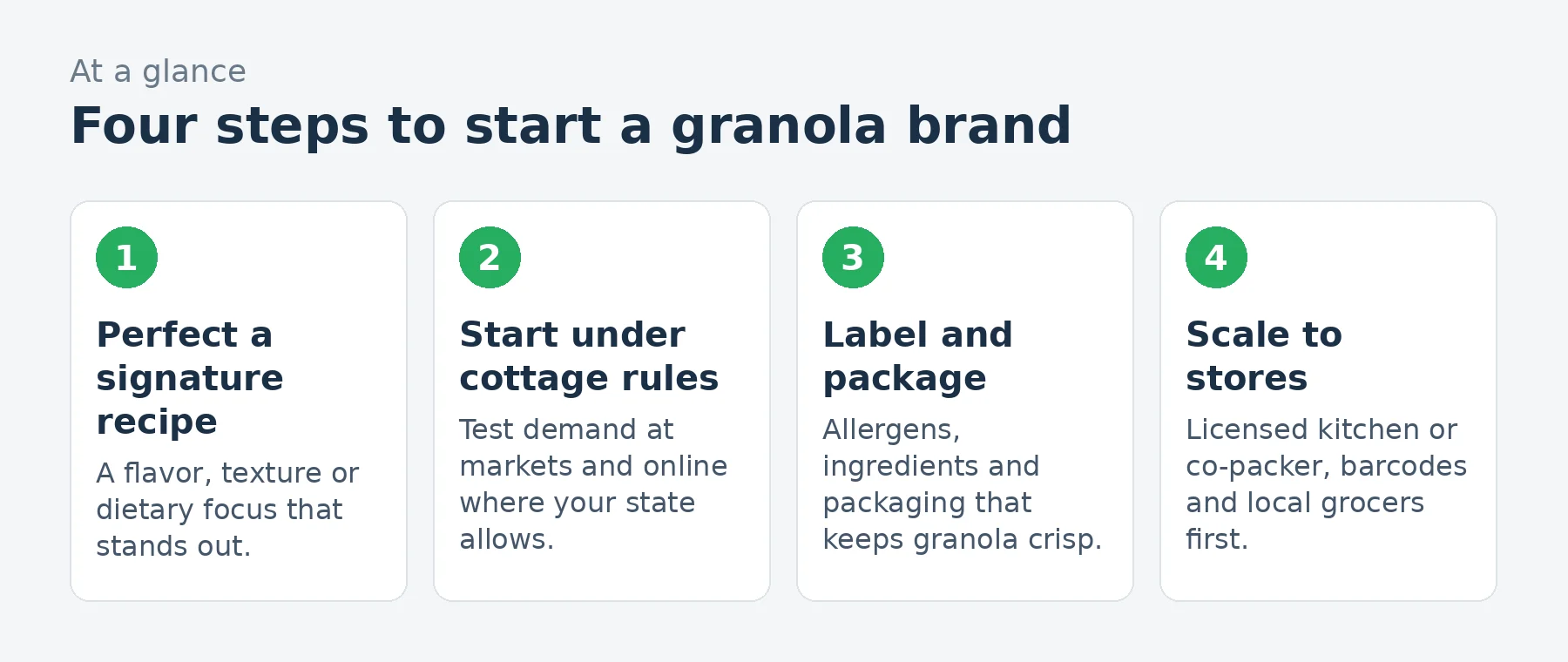
A granola brand at a glance
Table of Contents
| Topic | What to expect |
|---|---|
| Startup cost | Low: ingredients, ovens and sheet pans, packaging, labels and market fees; more for commercial production |
| Licenses | Cottage food rules for home-based direct sales; licensed kitchen, FDA registration and state rules to sell wholesale |
| Key requirements | Ingredient and allergen labels (nuts, wheat, milk and more), shelf-life testing and nutrition facts unless exempt |
| How you sell | Markets, online, cafés, local grocers, then distributors |
| Best for | Founders who want a simple, scalable product and enjoy building a brand |
Who a granola brand suits
It suits founders who enjoy baking at volume, care about ingredients and like selling at markets and to local stores. Granola is forgiving to make but competitive to sell, so branding and consistency matter.
Starting under cottage food laws
Granola is a common cottage food because it is shelf-stable. Depending on your state, you may need registration or a permit, specific label statements and limits on where you sell. Selling to stores, cafés or across state lines usually requires a licensed facility. Check your state’s rules (the Institute for Justice tracks them) before launching.
Recipe and shelf life
- Signature flavors: a few distinctive flavors beat a long, generic list.
- Texture and clusters: many customers love clumpy granola; test baking methods to get it consistently.
- Dietary focus: gluten-free (with certified oats and proper controls), grain-free, low-sugar or high-protein.
- Shelf life: nuts and oils can go rancid; test your product over weeks and choose packaging that blocks air and moisture.
Labels and allergens
Granola commonly contains tree nuts, peanuts, wheat, milk and soy, so allergen labeling is critical. The FDA recognizes nine major allergens, including sesame. Labels need a product name, net weight, ingredients in order of weight, allergens and your business name and address, plus nutrition facts unless you qualify for the small business exemption. Gluten-free claims must meet FDA rules, which requires careful sourcing and cross-contact control.
Startup costs to plan for
| Item | What to budget for |
|---|---|
| Equipment | Sheet pans, mixing bowls, scale, sealer |
| Ingredients | Oats, nuts, seeds, sweeteners, oils, dried fruit |
| Packaging | Resealable bags, labels, barcodes |
| Kitchen | Home under cottage rules, or shared kitchen rental |
| Market and marketing | Booth supplies, website, photos |
| Insurance | Product liability |
Use our startup cost calculator for your total.
Pricing your granola
Cost every recipe per bag, including packaging, then set direct, wholesale and distributor prices that each leave a margin. Premium ingredients justify premium prices if your branding communicates them. Use our pricing calculator.
A worked example: shared kitchen production
These are illustrative assumptions for a brand producing in a shared commercial kitchen, not predictions.
| Assumption | Monthly | |
|---|---|---|
| Direct sales | 500 bags online and at markets at $10 | $5,000 |
| Wholesale to stores and cafés | 1,000 bags at $5.25 | $5,250 |
| Revenue | $10,250 | |
| Ingredients | 1,500 bags at $1.90 | $(2,850) |
| Packaging and labels | Bags with resealable zippers | $(900) |
| Shared kitchen rental | $(800) | |
| Part-time help | Baking and packing | $(1,400) |
| Market fees, shipping and marketing | $(1,100) | |
| Insurance and fees | $(300) | |
| Profit before owner pay and taxes | $2,900 |
That leaves about $2,900 a month before the founder’s pay and taxes, on about $10,250 of revenue. Nuts and dried fruit are the most expensive ingredients, so recipe costs deserve close attention.
Scaling to stores
- Move production to a licensed kitchen and complete FDA registration and state requirements.
- Get UPC barcodes and meet retailer packaging standards.
- Start with local grocers, co-ops, cafés and gift shops.
- Run tastings and promotions to drive repeat purchases.
- Use sales data to approach distributors and regional chains, and talk to co-packers when volume outgrows your kitchen.
Packaging that keeps granola fresh
Granola goes stale when it absorbs moisture and its nuts and oils oxidize. Use bags with a moisture barrier and a resealable zipper, cool granola completely before packing and seal promptly. Some brands use nitrogen flushing or oxygen absorbers at larger scale. A clear window shows the clusters, but test whether it shortens shelf life.
Shared kitchens and co-packers
A shared commercial kitchen lets you produce legally for stores without building your own facility; you rent time, bring ingredients and follow the kitchen’s rules. When volume grows, a co-packer that makes granola or cereal can produce larger batches at lower cost per bag, though with minimums and less control. Many brands use a shared kitchen for years before switching.
Farmers markets that sell
Markets are where granola brands learn what customers love. Offer samples, show the flavors clearly, sell a sampler pack and bring yogurt or milk pairings where allowed. Ask questions, collect emails and note which flavors sell out. Regular customers often become your first online buyers.
Online sales and subscriptions
Granola ships well, making online sales and subscriptions a strong channel where your production is licensed for it (cottage food sales are usually limited to in-state buyers). Offer bundles and subscriptions with flexible schedules, and clear terms for automatic renewal.
A brand story customers remember
In a crowded aisle, a clear story helps: why you started, what makes your ingredients or process different and who the granola is for. Keep it consistent across packaging, website and markets, and back up claims (organic, local, small-batch) truthfully.
Cafés, offices and gyms
Granola sells well beyond grocery aisles: cafés use it in yogurt parfaits and smoothie bowls, offices stock it in break rooms and gyms sell grab-and-go packs. Offer bulk bags for foodservice and single-serve packs for grab-and-go, with wholesale pricing and regular delivery. These accounts can be reached before grocery stores and provide steady orders.
Seasonal and limited flavors
Limited flavors, such as pumpkin spice in fall or a holiday blend, give regulars a reason to buy again and create social media buzz. Test them at markets first, produce small batches and retire them when the season ends.
Costing a bag of granola
Weigh every ingredient per batch, divide by the number of bags and add the bag, label and any insert. Nuts, seeds, dried fruit and maple syrup drive cost most; small changes in their share can change your margin noticeably. Re-cost recipes whenever ingredient prices move.
Common mistakes to avoid
- Generic flavors in a crowded category.
- Packaging that lets granola go stale.
- Missing allergen labels or unsupported gluten-free claims.
- Underpricing nut-heavy recipes.
- Scaling to stores before proving direct demand.
Your first 90 days
- Days 1-30: perfect three flavors, check your state’s cottage food rules and test shelf life.
- Days 31-60: design labels and packaging, cost recipes and launch at a market and online.
- Days 61-90: collect feedback, pitch three local stores or cafés and price out a shared kitchen.
Frequently asked questions
Can I sell granola from home?
In many states, yes, under cottage food laws for direct sales. Selling to stores or across state lines usually requires a licensed kitchen.
How long does homemade granola last?
It depends on ingredients and packaging. Test your product and use airtight, resealable packaging.
Can I label my granola gluten-free?
Only if it meets FDA gluten-free requirements, which means careful ingredient sourcing and preventing cross-contact.
Do I need a nutrition facts label?
Usually, unless you qualify for the FDA small business exemption; stores often require it.
How do I get granola into grocery stores?
Start with local stores and co-ops, prove sales with tastings, then approach distributors.
Do I need a co-packer to sell granola in stores?
Not necessarily. Many brands produce in shared commercial kitchens before moving to a co-packer when volume grows.
Can I ship granola to other states?
Usually only if produced in a licensed facility; cottage food rules generally limit you to in-state buyers.
What size bags should I sell?
Many brands offer a standard retail bag plus single-serve packs and larger bulk bags for cafés and loyal customers.
How do I keep granola from going stale?
Cool it fully before packing, seal it promptly in moisture-barrier resealable bags and test shelf life for each recipe.
Is granola profitable?
It can be with good pricing and efficient production. Ingredients such as nuts and dried fruit drive costs, so cost each recipe carefully.
What flavors sell best?
Classic flavors such as maple pecan, honey almond and chocolate tend to sell steadily; a distinctive signature flavor helps you stand out. Track sales at markets to decide.
Keep learning
- Packaged food brands industry data
- How to start a snack brand
- How to start a home bakery
- Pricing calculator
Sources
- Institute for Justice, State reforms for cottage food and food freedom laws
- FDA, Food labeling guide
- FDA, Food allergies: what you need to know
- FDA, Registration of food facilities
- FDA, Small business nutrition labeling exemption
- GS1 US, Get a barcode
Last reviewed November 2, 2026. Startup costs are estimates; check local prices, licensing and tax rules before you commit money.

