
A bakery makes and sells bread, pastries, cakes, cookies and other baked goods, from a storefront, to cafés and grocers (wholesale), at markets or online. Many successful bakeries combine channels: a retail shop for margin and community, plus wholesale accounts that keep ovens busy.
It is a hands-on business with early mornings, perishable products and real food safety rules. The Bureau of Labor Statistics reports a median pay of $37,160 for bakers, with employment projected to grow about 5.6% over the decade. Many bakers test demand first under their state’s cottage food law before investing in a commercial kitchen. This guide covers concepts, permits, equipment, pricing, a worked example and how to build loyal customers.
A bakery at a glance
Table of Contents
| Topic | What to expect |
|---|---|
| Startup cost | Moderate to high: a commercial kitchen or retail build-out, ovens, mixers, refrigeration, display cases and opening inventory |
| Licenses | Health department permit, business license, building and fire inspections; FDA registration for most wholesale facilities |
| How you sell | Retail storefront, wholesale to cafés and grocers, farmers markets, custom orders and online preorders |
| Biggest costs | Labor, rent, ingredients and waste from unsold product |
| Best for | Skilled bakers who love early mornings and can manage costs, staff and consistency |
Who a bakery suits
It suits skilled bakers who enjoy repetition and precision and can handle early starts, physical work and busy weekends. Running the business also means hiring, scheduling, costing recipes and managing waste.
Choosing your concept
- Bread bakery: daily loaves for retail and restaurants; demanding hours but loyal customers.
- Pastry and café bakery: croissants, pastries and coffee, often with seating.
- Cake and dessert shop: custom orders plus display items.
- Specialty: gluten-free, vegan, cultural or regional specialties with devoted followings.
- Wholesale-only: production kitchen supplying cafés, restaurants and grocers, with lower rent but thinner margins.
Start small: cottage food and markets
Every state and Washington, D.C., now has some form of cottage food program, and 43 states plus D.C. allow cottage food businesses to sell online to buyers within the state, according to the Institute for Justice. Rules keep changing: in 2026, Virginia allowed online sales and in-state shipping, while Maryland and Louisiana raised their annual sales caps to $100,000. Selling from home or at farmers markets under these laws lets you test products and prices before investing in a storefront. Cottage food rules usually limit you to non-perishable items and direct sales, so a full bakery eventually needs a licensed kitchen. See our home bakery guide.
Permits and food safety
A commercial bakery needs a health department permit (most states base rules on the FDA Food Code), a business license, building permits for renovations and fire inspections. Facilities that manufacture food for wholesale generally must register with the FDA, while retail food establishments selling mainly to consumers are typically exempt. Packaged items sold wholesale need proper labels, including allergen declarations: the FDA recognizes nine major food allergens, including sesame. Train staff in food safety and allergen control, especially for nut-free or gluten-free claims.
Equipment and layout
- Ovens: deck ovens for bread, convection ovens for pastries and cookies.
- Mixers: planetary mixers and a spiral mixer for bread dough.
- Proofers and retarders for bread and pastry schedules.
- Sheeter for laminated doughs such as croissants.
- Refrigeration and freezers for doughs and ingredients.
- Work tables, racks, sinks and display cases.
Lay out the kitchen in the order work flows: storage, mixing, shaping, proofing, baking, cooling and packing.
Startup costs to plan for
| Item | What to budget for |
|---|---|
| Space | Lease deposits and build-out, or a licensed shared kitchen |
| Equipment | Ovens, mixers, proofers, refrigeration, racks, display cases |
| Permits | Health, building, fire, FDA registration if wholesale |
| Opening inventory | Flour, butter, sugar, eggs, packaging |
| Point-of-sale and website | With online preorders |
| Working capital | Several months of payroll and rent |
Use our startup cost calculator for your total.
Pricing baked goods
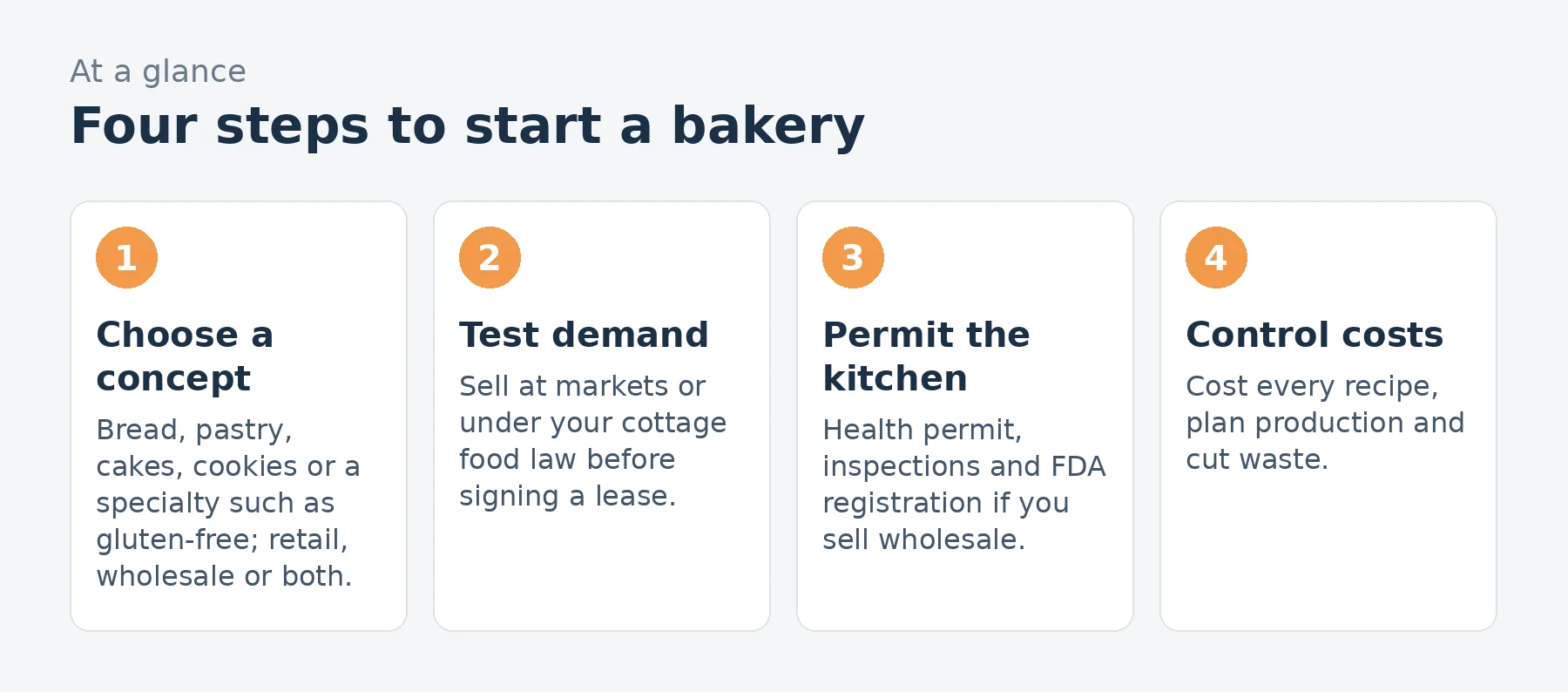
Cost every recipe: ingredients per batch divided by the number of items, plus packaging. Then add labor and overhead. Many bakeries aim for ingredient costs around a quarter to a third of retail prices. Wholesale prices are lower, so make sure wholesale orders still cover their share of labor and delivery. Use our pricing calculator to check each item.
A worked example: a small retail bakery
These are illustrative assumptions for a small retail bakery with a few wholesale accounts, not predictions.
| Assumption | Monthly | |
|---|---|---|
| Retail sales | 180 customers a day, 26 days, $11 average | $51,480 |
| Wholesale accounts | 6 cafés and grocers | $6,500 |
| Revenue | $57,980 | |
| Ingredients and packaging | About 30% of sales | $(17,400) |
| Labor | Bakers and counter staff with payroll costs | $(18,500) |
| Rent and common charges | $(5,200) | |
| Utilities | Ovens and refrigeration | $(1,800) |
| Card fees, software and marketing | $(1,600) | |
| Equipment loan and maintenance | $(1,300) | |
| Insurance, waste and supplies | Including unsold product | $(1,500) |
| Profit before owner pay and taxes | $10,680 |
That leaves about $10,680 a month before the owner’s pay and taxes, on about $57,980 of revenue. Waste is a hidden cost: planning production from sales history, and selling day-old items at a discount, protects margins.
Production planning and waste
Track what sells each day of the week and plan production from that history. Bake bread and pastries in waves to stay fresh through the day, take preorders for large items and holidays, and decide in advance what happens to leftovers: discounted day-old sales, donations or staff meals. Reducing waste by even a few percent of sales can make a meaningful difference to profit.
Building loyal customers
- Signature items people travel for.
- Consistent quality and friendly service.
- Preorders for holidays and celebrations.
- Loyalty rewards (try our free rewards program tool).
- Local partnerships with cafés, restaurants and events.
Staffing early mornings
Bakeries start before dawn. Build a schedule with a reliable opening baker, prep work done the afternoon before (doughs retarding overnight in the refrigerator) and counter staff arriving for the morning rush. Cross-train staff so absences do not stop production, and write recipes and procedures so quality does not depend on one person. Fair pay and predictable schedules help keep bakers who are hard to replace.
Winning wholesale accounts
Cafés, restaurants and grocers want consistency, reliable delivery times and items that fit their menus. Start with a small product list, offer samples, agree on standing orders with cut-off times for changes and set delivery days that fit your production. Make sure wholesale prices cover labor and delivery, and get payment terms in writing.
Seasonal and holiday sales
Holidays can be a bakery’s biggest weeks: Thanksgiving pies, holiday cookies, Easter breads and cultural celebrations. Open preorders early, set firm order deadlines and capacity limits, plan staffing and ingredients weeks ahead and use preorder pickups to keep lines short.
Bread or pastry first?
Your product mix shapes everything from equipment to staffing. Bread needs long fermentation, deck ovens and very early starts but sells daily to loyal customers and restaurants. Pastry needs laminating skill, a sheeter and careful temperature control but supports higher prices. Many bakeries start with a focused menu of a few breads and pastries they make exceptionally well, then expand once production is running smoothly.
Common mistakes to avoid
- Opening a storefront without testing demand.
- Underestimating labor and early-morning staffing.
- Not costing recipes accurately.
- Baking too much and wasting product.
- Weak allergen controls and labeling.
Your first 90 days
- Days 1-30: choose your concept, test products at markets or under cottage food rules and cost every recipe.
- Days 31-60: secure a licensed kitchen or storefront, order equipment and apply for permits.
- Days 61-90: pass inspections, soft-open, launch preorders and pitch three wholesale accounts.
Frequently asked questions
Do I need a commercial kitchen to start a bakery?
Not always at first. Cottage food laws in every state allow some home-based sales. A storefront or wholesale bakery needs a licensed kitchen.
Does a bakery need to register with the FDA?
Facilities making food for wholesale generally must register; retail establishments selling mainly to consumers are typically exempt.
How do I price bakery items?
Cost each recipe (ingredients and packaging), add labor and overhead, then compare with local prices.
How much do bakers earn?
The BLS reports a median pay of $37,160 for bakers. Owners earn the profit after all costs.
Should I sell wholesale?
Wholesale keeps ovens busy and adds volume, but prices are lower. Many bakeries combine retail and a few wholesale accounts.
How early do bakers start work?
Often in the very early morning, depending on what you bake. Overnight dough retarding and afternoon prep can shorten early shifts.
What sells best in a bakery?
It depends on your area, but signature breads, croissants and pastries, cookies and celebration cakes are common best sellers. Track sales daily and adjust.
Can I start a bakery in a shared commercial kitchen?
Yes. Many bakers rent time in licensed shared kitchens to sell wholesale or at markets before investing in a storefront.
How do bakeries reduce waste?
By planning production from daily sales history, taking preorders, baking in waves and selling day-old items at a discount or donating them.
Keep learning
- Bakery and specialty food industry data
- How to start a home bakery
- How to start a custom cake business
- Pricing calculator
Sources
- US Bureau of Labor Statistics, Bakers
- FDA, Food Code
- FDA, Registration of food facilities
- FDA, Food labeling guide
- FDA, Food allergies: what you need to know
- Institute for Justice, State reforms for cottage food and food freedom laws
Last reviewed November 2, 2026. Startup costs are estimates; check local prices, licensing and tax rules before you commit money.

