
A custom cake business designs and bakes cakes for birthdays, weddings, showers, graduations, corporate events and holidays. Customers pay for design, flavor and the stress-free experience of a beautiful cake delivered on time. It rewards both baking and artistic skills.
Wedding cakes are a meaningful market: The Knot’s 2025 Real Weddings Study found couples spent about $540 on their cake. Most custom cake makers also rely on steady celebration orders. Many start at home under cottage food laws, but cakes with cream cheese frosting, custard or fresh fruit fillings often require a licensed kitchen, so this guide covers rules, pricing per serving, orders, delivery, a worked example and growth.
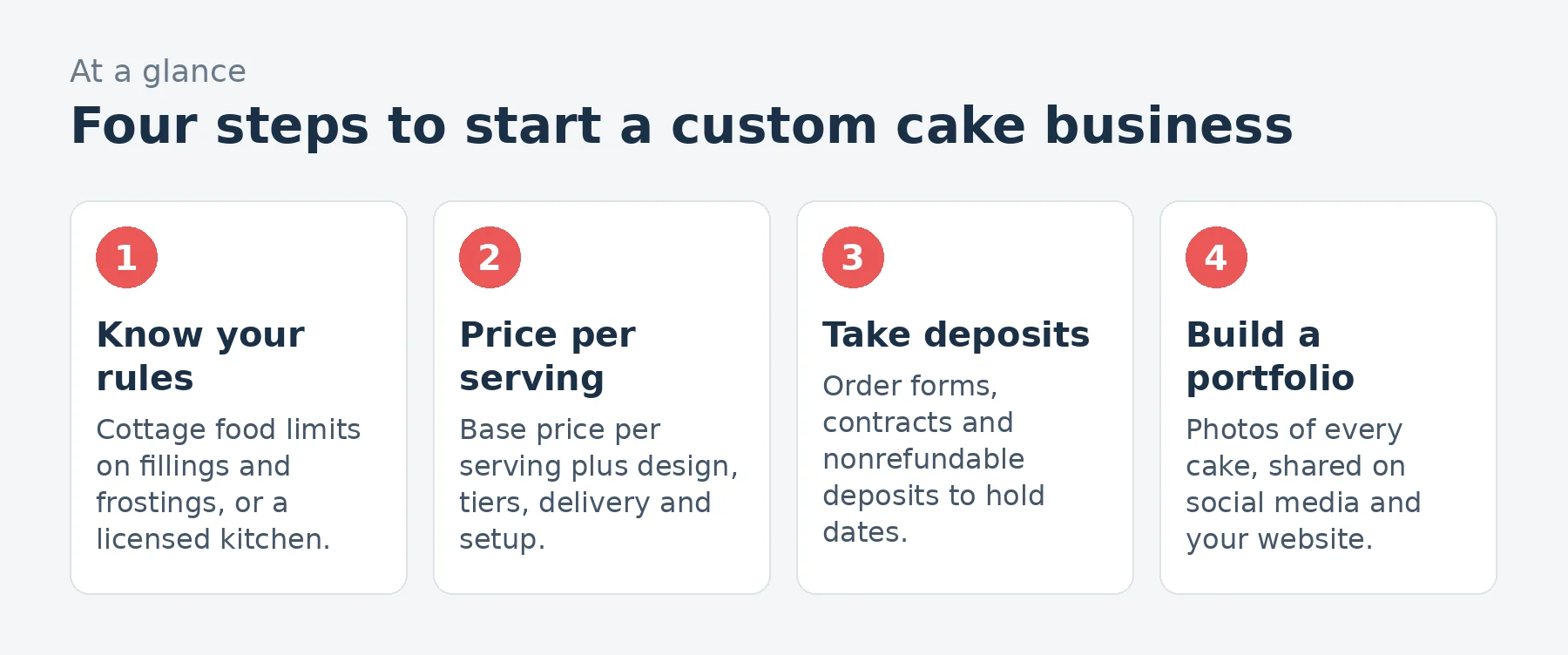
A custom cake business at a glance
Table of Contents
| Topic | What to expect |
|---|---|
| Startup cost | Low to moderate: decorating tools, pans, turntables, airbrush, boxes and boards; more for a licensed kitchen |
| Licenses | Cottage food rules for home bakers (often limiting perishable fillings) or a health permit for a licensed kitchen |
| How you charge | Per serving, with additions for complex designs, sugar flowers, tiers, delivery and setup |
| Wedding benchmark | Couples spent about $540 on a wedding cake on average (The Knot 2025 Real Weddings Study) |
| Best for | Bakers with artistic skill, patience and strong time management for weekend deadlines |
Who custom cakes suit
It suits bakers with an eye for design who enjoy working with clients and can manage weekend deadlines calmly. Every order is a promise for a specific date and time, so organization matters as much as artistry.
The Bureau of Labor Statistics reports a median pay of $37,160 for bakers, but skilled cake designers who run their own businesses can earn more through pricing for design work.
Home or licensed kitchen?
Every state has some cottage food program, but most limit home bakers to non-perishable foods. Many custom cakes use cream cheese frosting, whipped cream, custards or fresh fruit fillings, which typically need refrigeration and are often not allowed under cottage food laws, though some states with broader food freedom laws allow them. Check your state carefully. Many cake makers rent a shared commercial kitchen or commissary so they can offer any filling and sell to venues and planners.
Equipment and tools
- Quality pans in multiple sizes, a stand mixer and a large oven capacity.
- Turntable, offset spatulas, bench scrapers and piping tips.
- Cake boards, dowels or support systems for tiers.
- Fondant tools, airbrush and edible colors.
- Sturdy cake boxes and a level, cool vehicle space for delivery.
Startup costs to plan for
| Item | What to budget for |
|---|---|
| Baking and decorating tools | Pans, mixer, turntable, piping, airbrush |
| Packaging | Boxes, boards, supports |
| Kitchen | Home under cottage rules, or shared kitchen rental |
| Permits | Cottage registration or health permit |
| Portfolio and marketing | Photography, website, social media |
| Insurance | Liability, especially for events and venues |
Use our startup cost calculator for your total.
Pricing per serving
Most cake makers price per serving, with a base price that covers a simple design, then add charges for complex decorating, sugar flowers, figurines, premium flavors and fillings, tiers, delivery and setup. Calculate your base from ingredient and packaging costs plus your hourly rate for baking and decorating, then compare with local cake makers. The Knot’s 2025 study put the average wedding cake at about $540, but prices vary widely with guest count and design. Use our pricing calculator.
A worked example: one busy month
These are illustrative assumptions for a busy month from a licensed or shared kitchen, not predictions.
| Assumption | Monthly | |
|---|---|---|
| Celebration cakes | 30 cakes at $95 average | $2,850 |
| Wedding cakes | 4 weddings at $600 average | $2,400 |
| Cupcakes, dessert tables and tastings | $1,200 | |
| Revenue | $6,450 | |
| Ingredients and decorations | About 25% of sales | $(1,610) |
| Boxes, boards and supports | $(350) | |
| Shared kitchen rental | Hourly kitchen time | $(600) |
| Delivery and fuel | $(200) | |
| Marketing and payment fees | $(250) | |
| Profit before owner pay and taxes | $3,440 |
That leaves about $3,440 a month before taxes and the value of your time, on about $6,450 of revenue. Custom cakes take many hours; track design and decorating time on each order and price accordingly.
Orders, contracts and deposits
- Use an order form that captures date, time, servings, flavors, design, allergies and delivery details.
- Send a written quote and contract with your policies.
- Take a nonrefundable deposit to hold the date, with the balance due before the event.
- Set order deadlines and rush fees.
- Confirm details a week before and the day before delivery.
Wedding cakes
Wedding cakes involve tastings, design consultations, coordination with planners and venues and careful delivery and setup. Offer tasting boxes (often credited toward the order), build relationships with venues and planners and carry liability insurance, since many venues require certificates from vendors.
Delivery and setup
Delivery is where cakes are damaged. Chill cakes before transport, use sturdy boxes and non-slip mats, keep the vehicle cool and level, assemble tall tiers on site when needed and carry a repair kit. Get a signature or photo at delivery to confirm the cake arrived in perfect condition.
Building a flavor menu
Offer a focused list of cake flavors and fillings you make well, plus a few seasonal options. Each flavor should be tested for stability under decorations and during transport. Price premium flavors and fillings (such as fresh fruit or specialty creams) higher, and make sure every filling fits your kitchen’s legal status.
Tastings and consultations
For weddings and large events, tastings help couples choose and commit. Many cake makers sell tasting boxes with several flavors, credited toward the final order, and hold consultations to discuss design, servings, budget and delivery. Bring a portfolio and sketch the design so expectations are clear before the deposit.
Allergies and dietary requests
Ask about allergies on every order and document them. If your kitchen uses nuts, wheat or dairy, explain that you cannot guarantee allergen-free cakes, even when the recipe excludes them. Offer gluten-friendly or dairy-free options only if you can make them reliably and label them honestly.
Managing a weekend calendar
Most cakes are due on Saturdays. Set a weekly limit on orders based on your oven space and decorating time, stagger baking and decorating across the week, and block time for deliveries. Overbooking leads to rushed work, mistakes and burnout.
Photographing your work
Your portfolio wins orders. Photograph every cake in good natural light against a clean background, from the front and at an angle, plus close-ups of details. Ask clients to tag you on social media and share photos from events. Organize your portfolio by occasion (birthdays, weddings, baby showers) so customers can find designs like theirs quickly.
Growing beyond yourself
When demand outgrows your weekends, raise prices first, then consider hiring a baker so you can focus on decorating and client work, offering a smaller menu of standard designs that are faster to produce, or moving into a licensed shared kitchen or small studio with more oven space. Grow deliberately; quality and reliability are what keep referrals coming.
Common mistakes to avoid
- Selling perishable fillings your cottage law does not allow.
- Pricing by the cake instead of by servings and design.
- No deposits or contracts.
- Accepting more orders than you can finish on a weekend.
- Poor delivery planning.
Your first 90 days
- Days 1-30: check your state’s rules for fillings, choose home or shared kitchen and set your per-serving pricing.
- Days 31-60: create a portfolio of styled cakes, write contracts and launch an order form.
- Days 61-90: market to parents, event planners and venues, and offer tasting boxes.
Frequently asked questions
How much should I charge for a custom cake?
Most cake makers price per serving, plus design complexity, tiers, delivery and setup. Compare with local prices and track your hours.
How much do wedding cakes cost?
The Knot’s 2025 Real Weddings Study found couples spent about $540 on average, with wide variation.
Can I sell cakes with cream cheese frosting from home?
Often not under standard cottage food laws, because they need refrigeration. Some states with broader laws allow them; check your state.
Should I take deposits?
Yes. A nonrefundable deposit protects your calendar from last-minute cancellations.
How do I deliver tiered cakes safely?
Chill them, use strong supports and boxes, keep the vehicle cool and level and assemble on site when needed.
How far in advance should customers order?
Many cake makers require several weeks for custom cakes and months for wedding cakes, with rush fees for short-notice orders.
Do I need insurance for a cake business?
Liability insurance is wise for any food business, and many wedding venues require certificates of insurance from cake vendors.
Can I sell cupcakes and dessert tables too?
Yes. Cupcakes, cake pops and dessert tables complement cakes and suit events, within your kitchen’s legal limits on fillings and frostings.
Should I use fondant or buttercream?
Offer what you do best and what your customers want. Many clients prefer buttercream for taste, while fondant suits certain designs; price each for the time and skill it requires.
Keep learning
- Bakery and specialty food industry data
- How to start a home bakery
- How to start a wedding planning business
- Pricing calculator
Sources
- The Knot 2025 Real Weddings Study vendor costs (via Complete Weddings + Events)
- Institute for Justice, State reforms for cottage food and food freedom laws
- Forrager, 2026 cottage food bills by state
- US Bureau of Labor Statistics, Bakers
- FDA, Food allergies: what you need to know
Last reviewed November 2, 2026. Startup costs are estimates; check local prices, licensing and tax rules before you commit money.

