
Independent butcher shops offer what supermarket meat counters often can’t: custom cuts, local and specialty meats, expert advice and house-made sausages and charcuterie. Customers looking for quality, sourcing transparency and service keep good butchers busy. Butchers earned a median of $38,960 in May 2024, and the Bureau of Labor Statistics counted about 143,100 butchers and meat cutters, with 1% projected growth as more meat is sold pre-packaged.
Shops range from neighborhood butcher shops buying boxed meat to whole-animal butchers sourcing directly from local farms and shops adding delis and prepared foods. Food safety and inspection rules shape what each shop can make and sell.
The workforce
| Occupation | Jobs (2024) | Median pay (May 2024) | Projected growth, 2024 to 2034 |
|---|---|---|---|
| Butchers and meat cutters | 143,100 | $38,960 | +1% |
Source: U.S. Bureau of Labor Statistics, Occupational Outlook Handbook and Occupational Employment and Wage Statistics.
Market data
| Measure | Value |
|---|---|
| Projected job change, 2024 to 2034 | 1,400 |
Business models compared
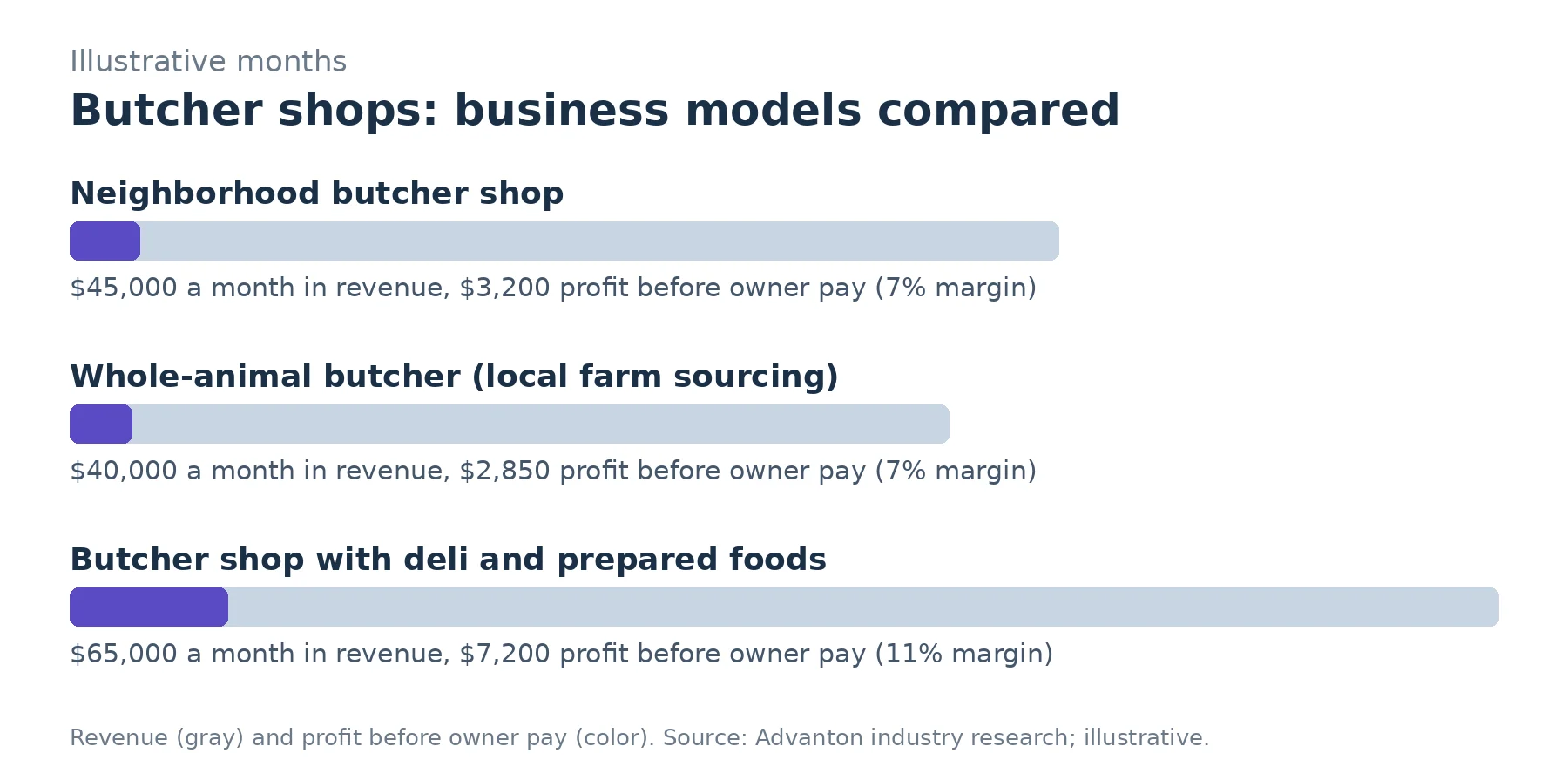
The figures below are illustrative months from our research, not industry averages. They show how revenue and costs typically fit together; your market, prices and costs will differ.
| Business model | Startup costs | Example monthly revenue | Costs | Profit before owner pay | Margin |
|---|---|---|---|---|---|
| Neighborhood butcher shop | High: coolers, saw, grinder, display cases, permits | $45,000 | $41,800 | $3,200 | 7% |
| Whole-animal butcher (local farm sourcing) | High: hanging cooler space, skilled butchers, farm relationships | $40,000 | $37,150 | $2,850 | 7% |
| Butcher shop with deli and prepared foods | Very high: butcher equipment plus kitchen, smoker, hood | $65,000 | $57,800 | $7,200 | 11% |
Fixed and variable costs
For projections, the most useful split is between variable costs, which rise and fall with sales (materials, supplies, hourly labor, fees), and fixed costs, which you pay every month regardless (rent, salaried staff, insurance, loan payments).
| Business model | Variable costs (% of revenue) | Fixed costs per month | What it means |
|---|---|---|---|
| Neighborhood butcher shop | 64.9% | $12,600 | Mostly variable: profitable early, but watch cash flow |
| Whole-animal butcher (local farm sourcing) | 59.8% | $13,250 | Mostly variable: profitable early, but watch cash flow |
| Butcher shop with deli and prepared foods | 57.1% | $20,700 | Mostly variable: profitable early, but watch cash flow |
What the numbers say
Meat cost is the largest expense, so cutting yield and pricing decide margins.
Whole-animal butchers must sell every cut, turning trim into sausages and ground meat.
Delis and prepared foods raise margins with more equipment, staff and permits.
The three models in brief
Neighborhood butcher shop. Boxed meats cut to order with service and specialty items. See bakery and specialty food data.
Whole-animal butcher. Buying whole carcasses from local farms and breaking them down. See ranching data.
Butcher shop with deli and prepared foods. Sandwiches, smoked meats and ready-to-heat meals. See restaurant data.
Cost structure: whole-animal butcher (local farm sourcing)
Each cost as a share of the example month’s revenue ($40,000):
| Cost | Monthly amount | Share of revenue | Type |
|---|---|---|---|
| Whole animals and processing | $22,000 | 55.0% | Variable |
| Butcher wages | $6,000 | 15.0% | Fixed |
| Rent | $3,500 | 8.8% | Fixed |
| Utilities | $1,200 | 3.0% | Fixed |
| Card fees | $1,100 | 2.8% | Variable |
| Packaging | $800 | 2.0% | Variable |
| Equipment payments | $800 | 2.0% | Fixed |
| Marketing | $700 | 1.8% | Fixed |
| Payroll taxes | $650 | 1.6% | Fixed |
| Insurance | $400 | 1.0% | Fixed |
| Profit before owner pay | $2,850 | 7% |
A first-year projection: whole-animal butcher (local farm sourcing)
New businesses rarely start at full speed. This projection assumes revenue ramps from 35% of the example month in month 1 to 100% by month 12, variable costs move with revenue, and fixed costs stay the same every month. It’s a planning illustration, not a forecast.
| Month | Revenue | Variable costs | Fixed costs | Profit | Cumulative |
|---|---|---|---|---|---|
| 1 | $14,000 | $8,372 | $13,250 | -$7,622 | -$7,622 |
| 2 | $18,000 | $10,764 | $13,250 | -$6,014 | -$13,636 |
| 3 | $22,000 | $13,156 | $13,250 | -$4,406 | -$18,042 |
| 4 | $24,800 | $14,830 | $13,250 | -$3,280 | -$21,322 |
| 5 | $28,000 | $16,744 | $13,250 | -$1,994 | -$23,316 |
| 6 | $30,400 | $18,179 | $13,250 | -$1,029 | -$24,345 |
| 7 | $32,800 | $19,614 | $13,250 | -$64 | -$24,409 |
| 8 | $34,800 | $20,810 | $13,250 | $740 | -$23,669 |
| 9 | $36,400 | $21,767 | $13,250 | $1,383 | -$22,286 |
| 10 | $38,000 | $22,724 | $13,250 | $2,026 | -$20,260 |
| 11 | $39,200 | $23,442 | $13,250 | $2,508 | -$17,752 |
| 12 | $40,000 | $23,920 | $13,250 | $2,830 | -$14,922 |
Year one: revenue $358,400, profit before owner pay -$14,922. The first profitable month is month 8. Cumulative results bottom out at -$24,409, which is the minimum cash cushion this plan would need, before any startup costs.
Butcher wages, rent and refrigeration start before regular customers build, so this neighborhood shop illustration turns profitable in month 8, with a cumulative low of about $24,400, before equipment and build-out.
How butcher shops earn
- Fresh cuts and custom orders.
- House-made sausages, burgers and marinated items.
- Charcuterie and smoked meats where permitted.
- Deli sandwiches and prepared foods.
- Wholesale to restaurants where inspection rules allow.
Yield and pricing
Every carcass or primal cut produces a mix of premium steaks, roasts, ground meat and trim. Track yield on every piece, price premium cuts to carry the whole animal and turn trim into sausages and ground blends so nothing is wasted.
Inspection and the retail exemption
Retail butchers cutting meat for consumers usually operate under the retail exemption, but wholesale sales and some processing require USDA or state inspection. Learn the limits before selling to restaurants or making shelf-stable products.
A startup checklist for butcher shops
- Secure health permits and confirm inspection requirements.
- Install walk-in coolers, saws and grinders.
- Line up suppliers from inspected facilities and local farms.
- Plan HACCP for curing or smoking.
- Certify scales and train staff on safety.
Food safety
Cold chain control, sanitation, separation of raw and ready-to-eat foods and safe grinding practices prevent illness. Temperature logs and cleaning schedules protect customers and inspections.
Where the opportunities are
- Local and grass-fed meats.
- Specialty sausages and charcuterie.
- Meal kits and marinated items.
- Restaurant supply with inspection.
- Butchery classes.
Key terms
| Term | Meaning |
|---|---|
| Retail exemption | USDA rule allowing retail stores to process meat for consumers without federal inspection, within limits |
| Primal | Large section of a carcass |
| Yield | Usable meat from a cut or carcass |
| HACCP | Hazard analysis plan for food safety |
Customer service
Customers value advice on cuts, cooking methods and portions. Butchers who teach and recommend build loyal regulars.
Key numbers to track
Track gross margin by category, yield per carcass, waste, average ticket and repeat customers.
Common mistakes
- Poor yield tracking.
- Selling wholesale without inspection.
- Curing without a HACCP plan.
- Too much fresh inventory.
- Weak cold chain control.
Marketing a butcher shop
Social media of cuts and specials, cooking classes, farm stories and holiday preorders bring customers. See ranching data.
Holiday preorders
Thanksgiving turkeys, holiday roasts and grilling season bring peaks; preorders with deposits help plan inventory and prevent sold-out disappointments.
Sausage and value-added products
House-made sausages, burgers and marinated items use trim, raise margins and give customers signature products they can’t find at supermarkets.
Equipment care
Band saws and grinders need daily cleaning, regular blade changes and thorough safety training for every employee who uses them.
Safety
Knife, saw and slip hazards require training, guards and protective gear.
Farm relationships
Working directly with farmers ensures consistent quality and a story customers love.
Staffing
Skilled butchers are scarce; apprenticeships and on-the-job training help develop talent, and fair pay keeps experienced cutters from leaving.
Delivery and online orders
Online ordering for pickup or local delivery extends reach, smooths busy weekends and helps customers order custom cuts ahead.
Test these numbers with your own plan
Open this industry in our free Business Idea Reality Check to start from any model above, change prices, costs, startup budget and your own pay, and see your break-even month, the cash you’d need, three scenarios and how new businesses in this sector survive in your state.
- Start with the closest model and its cost structure.
- Replace every price and cost with local quotes.
- Estimate your ramp: how fast customers will realistically come in year one.
- Map cash month by month with the free Cash & Payroll Planner.
- Build the full plan in the free Business Planner.
About this data
Workforce figures come from the U.S. Bureau of Labor Statistics (Occupational Outlook Handbook and Occupational Employment and Wage Statistics, May 2024 wages and the 2024 to 2034 projections, unless noted). Market figures cite their sources above. Business model figures are illustrative months built from typical prices and costs to show how revenue, fixed costs and variable costs fit together; they are not industry averages or guarantees. We review these profiles when new government data is released, at least once a year, and the same figures power the Business Idea Reality Check.
Licensing and rules
Retail butcher shops need local health permits and inspections, and they must buy meat from USDA- or state-inspected sources; cutting and selling meat directly to consumers generally falls under USDA’s retail exemption, but processing beyond its limits or selling wholesale to restaurants and stores in significant amounts can require federal or state inspection; custom-exempt processing serves animal owners only; curing, smoking and fermenting meats often require HACCP plans or variances under the FDA Food Code adopted by states; scales used for selling must be certified. Requirements change; confirm with your state and local agencies before you start.
Frequently asked questions about butcher shops
Do butcher shops need USDA inspection?
Retail shops selling to consumers usually operate under the retail exemption; wholesale or some processing may require inspection.
Can butcher shops make bacon and salami?
Often yes, with HACCP plans or variances for curing and fermenting.
What do butchers earn?
BLS reported a median of $38,960 in May 2024.
Is a butcher shop profitable?
It can be, with good yield, value-added products and loyal customers.
Where do butcher shops buy meat?
From USDA- or state-inspected suppliers, including local farms using inspected processors.
What is whole-animal butchery?
Buying whole carcasses and selling every part.
Can butcher shops sell to restaurants?
Small amounts may be allowed under the retail exemption; larger wholesale sales usually require inspection.
How can I test these numbers?
Open butcher shops in the Business Idea Reality Check and enter your own numbers.
Keep learning
Sources
Last reviewed November 2, 2026. Startup costs are estimates; check local prices, licensing and tax rules before you commit money.
In India
Small businesses like this in India
In MoSPI’s survey of unincorporated businesses (proprietorships, partnerships and similar firms), this falls under Retail trade. In 2023-24 India had 1.99 crore such establishments employing 3.31 crore workers, and 87.5% were run without hired workers. Across the wider trade group, the number of establishments grew 6.18% between 2023-24 and 2025.
| Urban | Rural | All India | |
|---|---|---|---|
| Value added per business a year | ₹3,13,011 | ₹1,61,621 | ₹2,34,248 |
| Value added per worker a year | ₹1,72,641 | ₹1,05,489 | ₹1,40,529 |
| Pay per hired worker a year | ₹1,34,040 | ₹1,14,058 | ₹1,30,041 |
Running it alone or with staff: businesses with no hired workers added about ₹1,60,797 a year on average, while those with hired workers added about ₹7,46,950 (all India).
Where these businesses are: the states with the most small trade businesses are Uttar Pradesh (15.2%), Maharashtra (9.8%), West Bengal (9.0%), Bihar (6.4%), Madhya Pradesh (6.3%) of the national total (2023-24).
Value added is what a business produces minus what it spends on materials and other inputs, before paying its workers and owner, so it’s a rough guide to the income a typical small business generates. These figures cover the whole activity, which can be broader than this one business type. Across all small businesses, average fixed assets such as equipment, furniture and vehicles were ₹3,42,242 per establishment in 2025.
Licences and registrations to expect
- FSSAI registration (turnover up to ₹12 lakh), a state FSSAI licence (up to ₹20 crore) or a central licence above that.
- A health or trade licence from your municipality, and a fire NOC for restaurants and commercial kitchens where local rules require one.
- An eating house licence from the police in some cities.
- Registration under your state’s Shops and Establishments Act if you have premises or employees.
- A trade licence from your municipal corporation or council for many shop and service businesses.
- GST registration once turnover crosses ₹40 lakh for goods or ₹20 lakh for services (lower in some special category states), or earlier if you sell goods to other states or through e-commerce marketplaces.
- Professional tax registration in states that levy it.
- Free Udyam (MSME) registration, which helps with loans, government schemes and delayed-payment protection.
Rules differ by state and city. Check with your municipal corporation, state departments and a chartered accountant before you start.
Run a business like this in India? List it free in the India Business Directory, with your hours, deals and GST registration.
Free tools for India: Make a GST invoice · Compare business credit cards
Build a market report for Butcher Shops in India Pick your state and see market size, earnings, competition and licences, from official data. Free, with a PDF download.
Sources: MoSPI, Annual Survey of Unincorporated Sector Enterprises (ASUSE) 2023-24, full report, Appendix A Tables 4, 29, 33, 35 and 37 (survey period October 2023 to September 2024); MoSPI, Annual Survey of Unincorporated Sector Enterprises (ASUSE) 2025, factsheet (survey period January to December 2025, released 24 March 2026). Licensing summary by Advanton, checked November 2026.