
Pet owners buy food and treats every few weeks, plus toys, beds, grooming supplies and health products, creating steady repeat business for neighborhood stores. Independent pet stores compete with big chains and online retailers through expert advice, premium products, delivery and services. Animal care and service workers earned a median of $33,860 in May 2024, according to the Bureau of Labor Statistics, and retail salespersons earned about $34,580, according to BLS figures as reported. Below is the key industry data on pet supply stores, with costs, business models and a first-year projection.
Businesses range from online pet supply shops to neighborhood stores and stores adding grooming, self-wash stations and training classes.
The workforce
| Occupation | Jobs (2024) | Median pay (May 2024) | Projected growth, 2024 to 2034 |
|---|---|---|---|
| Animal care and service workers | n/a | $33,860 | n/a |
| Retail salespersons (figures as reported) | n/a | $34,580 | n/a |
Source: U.S. Bureau of Labor Statistics, Occupational Outlook Handbook and Occupational Employment and Wage Statistics.
Business models compared
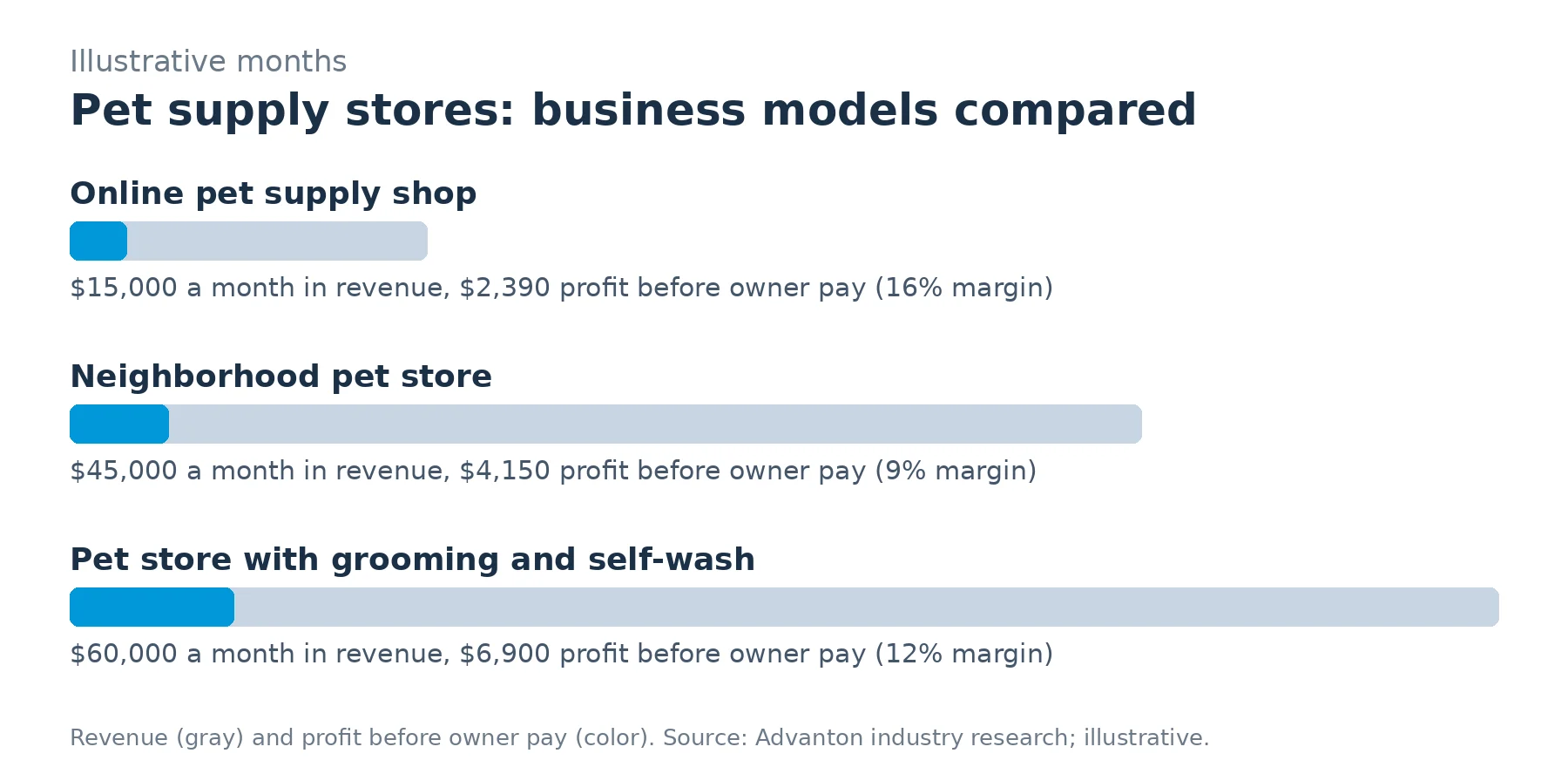
The figures below are illustrative months from our research, not industry averages. They show how revenue and costs typically fit together; your market, prices and costs will differ.
| Business model | Startup costs | Example monthly revenue | Costs | Profit before owner pay | Margin |
|---|---|---|---|---|---|
| Online pet supply shop | Low to moderate: inventory or dropship, store platform | $15,000 | $12,610 | $2,390 | 16% |
| Neighborhood pet store | Moderate: inventory, fixtures, point of sale, lease | $45,000 | $40,850 | $4,150 | 9% |
| Pet store with grooming and self-wash | Moderate to high: grooming room, tubs, dryers, plumbing | $60,000 | $53,100 | $6,900 | 12% |
Fixed and variable costs
For projections, the most useful split is between variable costs, which rise and fall with sales (materials, supplies, hourly labor, fees), and fixed costs, which you pay every month regardless (rent, salaried staff, insurance, loan payments).
| Business model | Variable costs (% of revenue) | Fixed costs per month | What it means |
|---|---|---|---|
| Online pet supply shop | 71.0% | $1,960 | Mostly variable: profitable early, but watch cash flow |
| Neighborhood pet store | 62.9% | $12,550 | Mostly variable: profitable early, but watch cash flow |
| Pet store with grooming and self-wash | 62.8% | $15,400 | Mostly variable: profitable early, but watch cash flow |
What the numbers say
Product cost takes most of each sale, so pricing, purchasing and inventory turns decide margins.
Services raise margins because grooming and self-wash carry less product cost.
Online shops avoid rent but compete heavily on price and shipping.
The three models in brief
Online pet supply shop. Specialty foods and supplies sold online. See e-commerce data.
Neighborhood pet store. Food, treats and supplies with expert advice. See independent retail data.
Pet store with grooming and self-wash. Retail plus services that bring customers back. See dog grooming data.
Cost structure: neighborhood pet store
Each cost as a share of the example month’s revenue ($45,000):
| Cost | Monthly amount | Share of revenue | Type |
|---|---|---|---|
| Product cost | $27,000 | 60.0% | Variable |
| Staff wages | $5,500 | 12.2% | Fixed |
| Rent | $4,500 | 10.0% | Fixed |
| Card fees | $1,300 | 2.9% | Variable |
| Marketing | $1,000 | 2.2% | Fixed |
| Payroll taxes | $550 | 1.2% | Fixed |
| Utilities | $500 | 1.1% | Fixed |
| Insurance | $300 | 0.7% | Fixed |
| Point of sale and software | $200 | 0.4% | Fixed |
| Profit before owner pay | $4,150 | 9% |
A first-year projection: neighborhood pet store
New businesses rarely start at full speed. This projection assumes revenue ramps from 35% of the example month in month 1 to 100% by month 12, variable costs move with revenue, and fixed costs stay the same every month. It’s a planning illustration, not a forecast.
| Month | Revenue | Variable costs | Fixed costs | Profit | Cumulative |
|---|---|---|---|---|---|
| 1 | $15,750 | $9,907 | $12,550 | -$6,707 | -$6,707 |
| 2 | $20,250 | $12,737 | $12,550 | -$5,037 | -$11,744 |
| 3 | $24,750 | $15,568 | $12,550 | -$3,368 | -$15,112 |
| 4 | $27,900 | $17,549 | $12,550 | -$2,199 | -$17,311 |
| 5 | $31,500 | $19,814 | $12,550 | -$864 | -$18,175 |
| 6 | $34,200 | $21,512 | $12,550 | $138 | -$18,037 |
| 7 | $36,900 | $23,210 | $12,550 | $1,140 | -$16,897 |
| 8 | $39,150 | $24,625 | $12,550 | $1,975 | -$14,922 |
| 9 | $40,950 | $25,758 | $12,550 | $2,642 | -$12,280 |
| 10 | $42,750 | $26,890 | $12,550 | $3,310 | -$8,970 |
| 11 | $44,100 | $27,739 | $12,550 | $3,811 | -$5,159 |
| 12 | $45,000 | $28,305 | $12,550 | $4,145 | -$1,014 |
Year one: revenue $403,200, profit before owner pay -$1,014. The first profitable month is month 6. Cumulative results bottom out at -$18,175, which is the minimum cash cushion this plan would need, before any startup costs.
Rent, staff and fixtures start before regular customers build, so this neighborhood store illustration turns profitable in month 6, with a cumulative low of about $18,200, before opening inventory.
How pet stores earn
- Pet food and treats.
- Supplies, toys and beds.
- Grooming and self-wash services.
- Delivery and autoship.
- Training classes and events.
Competing with chains and online
Independent stores win with knowledgeable staff, premium and specialty foods, local delivery, loyalty programs and community events. Price-match selectively on staples and earn margin on specialty items.
Pet food recalls
Monitor FDA recall notices, pull affected products quickly and contact customers who bought them. Fast action builds trust.
A startup checklist for pet supply stores
- Choose a location near pet owners and parking.
- Open distributor accounts.
- Check live animal sale rules if you plan to sell pets.
- Set up point of sale with loyalty and inventory tracking.
- Plan services such as self-wash or grooming.
Food is the anchor
Pet food brings customers back every few weeks. Carry quality brands, keep popular sizes in stock and offer frequent-buyer programs.
Where the opportunities are
- Premium and specialty diets.
- Self-wash stations.
- Local delivery and autoship.
- Training classes and puppy socials.
- Adoption events with shelters.
Key terms
| Term | Meaning |
|---|---|
| Autoship | Recurring automatic delivery of products |
| Inventory turns | How often stock sells and is replaced |
| Frequent-buyer program | Rewards for repeated purchases |
| Self-wash | Customer-operated pet washing stations |
Live animal sales
Many stores focus on supplies and partner with shelters for adoptions rather than selling dogs and cats. If you sell small animals, fish or reptiles, learn care standards and local rules.
Key numbers to track
Track sales per square foot, gross margin by category, inventory turns, loyalty members and service revenue.
Common mistakes
- Too much slow-moving inventory.
- Competing only on price.
- Ignoring recalls.
- No services or delivery.
- Weak staff training.
Marketing a pet store
Community events, adoption days, social media, loyalty programs and partnerships with vets, groomers and trainers bring customers. See pet care data.
Staff knowledge
Customers value advice about nutrition, allergies and behavior. Train staff on products and when to recommend a veterinarian.
Delivery
Local delivery of heavy food bags builds loyalty and competes with online sellers, especially for older customers and busy families.
Merchandising
Group products by pet type and need, highlight local and specialty items and keep aisles clean and easy to shop.
Supplier relationships
Distributors and brands offer promotions, education and new products.
Grooming add-on
Grooming brings customers every few weeks and raises store visits.
Community
Adoption events, pet birthday parties and training classes make stores community hubs.
Pricing
Price staples competitively and earn margin on specialty items and services.
Seasonality
Holidays, summer flea and tick season and new pet adoptions in spring bring peaks in sales.
Choosing what to carry
Start with foods and supplies your local customers ask for, then add specialty and premium lines. Track sales by brand and size, drop slow movers and keep best sellers always in stock, since running out of a customer’s food sends them elsewhere.
Raw and specialty diets
Freeze-dried, raw, limited-ingredient and veterinary-recommended diets attract dedicated customers. Frozen foods need freezer space and careful handling, and staff should know when to refer pets to veterinarians.
Shelters and rescues
Partnerships with rescues bring new pet owners who need supplies.
Test these numbers with your own plan
Open this industry in our free Business Idea Reality Check to start from any model above, change prices, costs, startup budget and your own pay, and see your break-even month, the cash you’d need, three scenarios and how new businesses in this sector survive in your state.
- Start with the closest model and its cost structure.
- Replace every price and cost with local quotes.
- Estimate your ramp: how fast customers will realistically come in year one.
- Map cash month by month with the free Cash & Payroll Planner.
- Build the full plan in the free Business Planner.
About this data
Workforce figures come from the U.S. Bureau of Labor Statistics (Occupational Outlook Handbook and Occupational Employment and Wage Statistics, May 2024 wages and the 2024 to 2034 projections, unless noted). Market figures cite their sources above. Business model figures are illustrative months built from typical prices and costs to show how revenue, fixed costs and variable costs fit together; they are not industry averages or guarantees. We review these profiles when new government data is released, at least once a year, and the same figures power the Business Idea Reality Check.
Licensing and rules
Register the business and collect sales tax; pet food is regulated by FDA and states, with labeling requirements, and stores should monitor and act on recalls; many states and cities license or restrict the sale of live animals, and some ban retail sales of dogs and cats from commercial breeders; grooming services need appropriate facilities and insurance for animals in your care; pesticides such as flea products may have state registration rules. Requirements change; confirm with your state and local agencies before you start.
Frequently asked questions about pet supply stores
Is a pet store profitable?
It can be, with strong food sales, services and loyal local customers.
Can pet stores sell dogs and cats?
Some places restrict or ban retail sales of dogs and cats; check state and local laws.
How do independent pet stores compete?
Expert advice, specialty products, delivery, services and community events.
Who regulates pet food?
FDA and state agencies regulate pet food labeling and safety.
Should a pet store offer grooming?
Grooming and self-wash bring regular visits and higher margins.
What do animal care workers earn?
BLS reported a median of $33,860 in May 2024.
How do pet stores handle recalls?
By monitoring notices, pulling products and contacting affected customers.
How can I test these numbers?
Open pet supply stores in the Business Idea Reality Check and enter your own numbers.
Keep learning
Sources
- U.S. Bureau of Labor Statistics, Animal care and service workers
- Retail salespersons median wage (BLS, as reported)
Last reviewed November 2, 2026. Startup costs are estimates; check local prices, licensing and tax rules before you commit money.
In India
Small businesses like this in India
In MoSPI’s survey of unincorporated businesses (proprietorships, partnerships and similar firms), this falls under Retail trade. In 2023-24 India had 1.99 crore such establishments employing 3.31 crore workers, and 87.5% were run without hired workers. Across the wider trade group, the number of establishments grew 6.18% between 2023-24 and 2025.
| Urban | Rural | All India | |
|---|---|---|---|
| Value added per business a year | ₹3,13,011 | ₹1,61,621 | ₹2,34,248 |
| Value added per worker a year | ₹1,72,641 | ₹1,05,489 | ₹1,40,529 |
| Pay per hired worker a year | ₹1,34,040 | ₹1,14,058 | ₹1,30,041 |
Running it alone or with staff: businesses with no hired workers added about ₹1,60,797 a year on average, while those with hired workers added about ₹7,46,950 (all India).
Where these businesses are: the states with the most small trade businesses are Uttar Pradesh (15.2%), Maharashtra (9.8%), West Bengal (9.0%), Bihar (6.4%), Madhya Pradesh (6.3%) of the national total (2023-24).
Value added is what a business produces minus what it spends on materials and other inputs, before paying its workers and owner, so it’s a rough guide to the income a typical small business generates. These figures cover the whole activity, which can be broader than this one business type. Across all small businesses, average fixed assets such as equipment, furniture and vehicles were ₹3,42,242 per establishment in 2025.
Licences and registrations to expect
- Registration of pet shops and dog breeding with your State Animal Welfare Board under the Prevention of Cruelty to Animals rules.
- Registration under your state’s Shops and Establishments Act if you have premises or employees.
- A trade licence from your municipal corporation or council for many shop and service businesses.
- GST registration once turnover crosses ₹40 lakh for goods or ₹20 lakh for services (lower in some special category states), or earlier if you sell goods to other states or through e-commerce marketplaces.
- Professional tax registration in states that levy it.
- Free Udyam (MSME) registration, which helps with loans, government schemes and delayed-payment protection.
Rules differ by state and city. Check with your municipal corporation, state departments and a chartered accountant before you start.
Run a business like this in India? List it free in the India Business Directory, with your hours, deals and GST registration.
Free tools for India: Make a GST invoice · Compare business credit cards
Build a market report for Pet Supply Stores in India Pick your state and see market size, earnings, competition and licences, from official data. Free, with a PDF download.
Sources: MoSPI, Annual Survey of Unincorporated Sector Enterprises (ASUSE) 2023-24, full report, Appendix A Tables 4, 29, 33, 35 and 37 (survey period October 2023 to September 2024); MoSPI, Annual Survey of Unincorporated Sector Enterprises (ASUSE) 2025, factsheet (survey period January to December 2025, released 24 March 2026). Licensing summary by Advanton, checked November 2026.