
As the population ages, more families look for safe, caring places where loved ones can get help with daily activities without the medical intensity of a nursing home. Assisted living and residential care homes fill that need. Medical and health services managers, who run care facilities, earned a median of $117,960 in May 2024, and the Bureau of Labor Statistics projects 23% growth from 2024 to 2034, among the fastest of any occupation. Below is the key industry data on assisted living and group homes, with costs, business models and a first-year projection.
Operators range from small residential care homes serving a handful of residents in a house to assisted living communities and specialized memory care homes. Assisted living is licensed by states, not the federal government, so rules vary widely.
The workforce
| Occupation | Jobs (2024) | Median pay (May 2024) | Projected growth, 2024 to 2034 |
|---|---|---|---|
| Medical and health services managers | n/a | $117,960 | +23% |
Source: U.S. Bureau of Labor Statistics, Occupational Outlook Handbook and Occupational Employment and Wage Statistics.
Business models compared
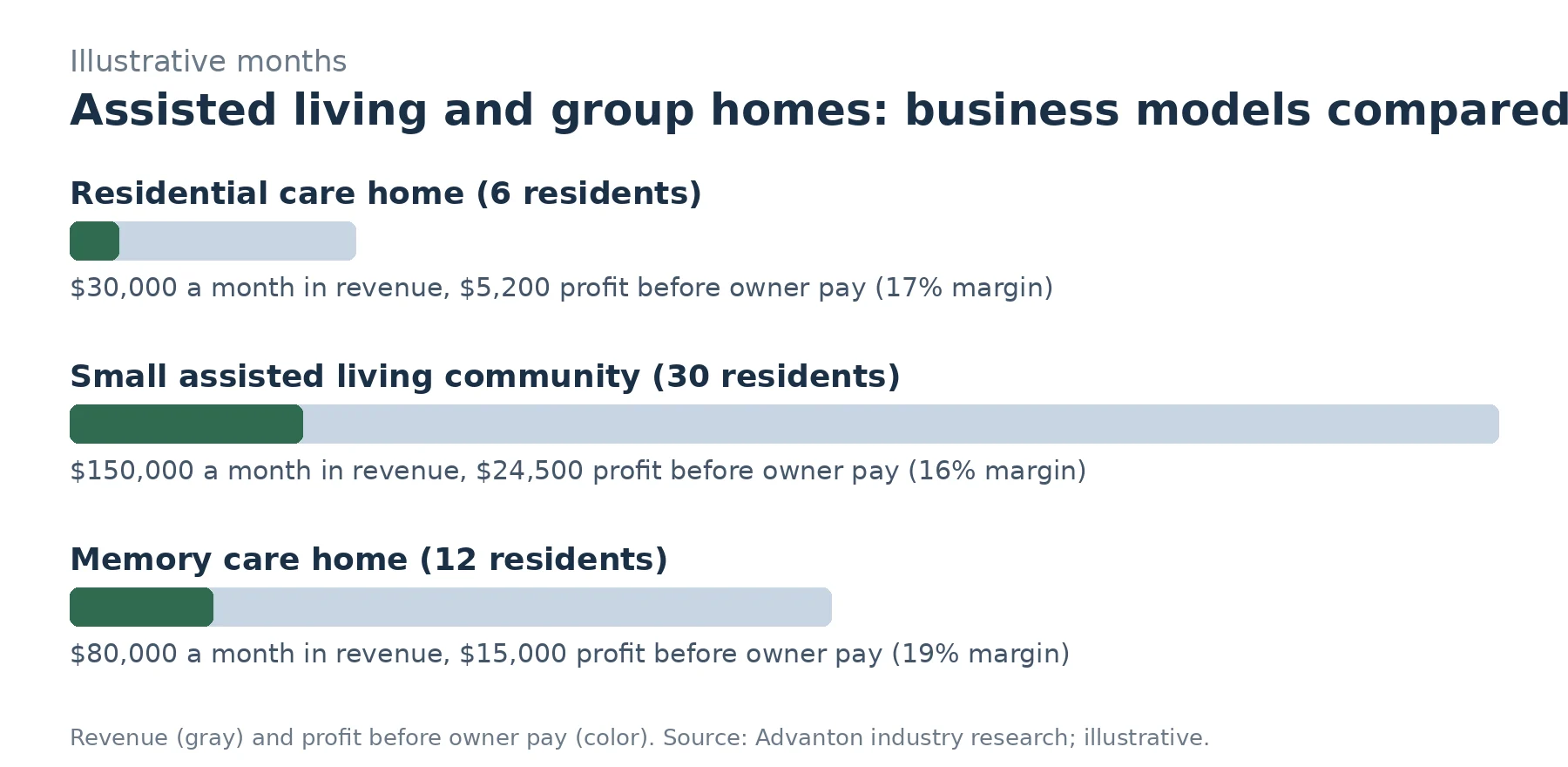
The figures below are illustrative months from our research, not industry averages. They show how revenue and costs typically fit together; your market, prices and costs will differ.
| Business model | Startup costs | Example monthly revenue | Costs | Profit before owner pay | Margin |
|---|---|---|---|---|---|
| Residential care home (6 residents) | High: home purchase or lease, accessibility upgrades, licensing | $30,000 | $24,800 | $5,200 | 17% |
| Small assisted living community (30 residents) | Very high: building, licensing, staff, furnishings | $150,000 | $125,500 | $24,500 | 16% |
| Memory care home (12 residents) | High: secured building, specialized training, staff | $80,000 | $65,000 | $15,000 | 19% |
Fixed and variable costs
For projections, the most useful split is between variable costs, which rise and fall with sales (materials, supplies, hourly labor, fees), and fixed costs, which you pay every month regardless (rent, salaried staff, insurance, loan payments).
| Business model | Variable costs (% of revenue) | Fixed costs per month | What it means |
|---|---|---|---|
| Residential care home (6 residents) | 56.0% | $8,000 | Mostly variable: profitable early, but watch cash flow |
| Small assisted living community (30 residents) | 51.0% | $49,000 | Mostly variable: profitable early, but watch cash flow |
| Memory care home (12 residents) | 54.4% | $21,500 | Mostly variable: profitable early, but watch cash flow |
What the numbers say
Care staff are the largest cost, because residents need help around the clock.
Occupancy decides profit: each empty bed loses revenue while staffing and building costs continue.
Memory care earns higher rates with more staff, training and secure facilities.
The three models in brief
Residential care home. A licensed home serving a small number of residents. See home health data.
Small assisted living community. Apartments or rooms with care, dining and activities.
Memory care home. Secured, specialized care for residents with dementia.
Cost structure: small assisted living community (30 residents)
Each cost as a share of the example month’s revenue ($150,000):
| Cost | Monthly amount | Share of revenue | Type |
|---|---|---|---|
| Care staff wages | $55,000 | 36.7% | Variable |
| Mortgage or lease | $22,000 | 14.7% | Fixed |
| Administrator and nurse | $14,000 | 9.3% | Fixed |
| Payroll taxes and benefits | $10,000 | 6.7% | Variable |
| Food and dining | $9,000 | 6.0% | Variable |
| Utilities | $4,000 | 2.7% | Fixed |
| Insurance | $3,000 | 2.0% | Fixed |
| Supplies | $2,500 | 1.7% | Variable |
| Maintenance | $2,500 | 1.7% | Fixed |
| Marketing | $2,000 | 1.3% | Fixed |
| Activities and transportation | $1,500 | 1.0% | Fixed |
| Profit before owner pay | $24,500 | 16% |
A first-year projection: small assisted living community (30 residents)
New businesses rarely start at full speed. This projection assumes revenue ramps from 35% of the example month in month 1 to 100% by month 12, variable costs move with revenue, and fixed costs stay the same every month. It’s a planning illustration, not a forecast.
| Month | Revenue | Variable costs | Fixed costs | Profit | Cumulative |
|---|---|---|---|---|---|
| 1 | $52,500 | $26,775 | $49,000 | -$23,275 | -$23,275 |
| 2 | $67,500 | $34,425 | $49,000 | -$15,925 | -$39,200 |
| 3 | $82,500 | $42,075 | $49,000 | -$8,575 | -$47,775 |
| 4 | $93,000 | $47,430 | $49,000 | -$3,430 | -$51,205 |
| 5 | $105,000 | $53,550 | $49,000 | $2,450 | -$48,755 |
| 6 | $114,000 | $58,140 | $49,000 | $6,860 | -$41,895 |
| 7 | $123,000 | $62,730 | $49,000 | $11,270 | -$30,625 |
| 8 | $130,500 | $66,555 | $49,000 | $14,945 | -$15,680 |
| 9 | $136,500 | $69,615 | $49,000 | $17,885 | $2,205 |
| 10 | $142,500 | $72,675 | $49,000 | $20,825 | $23,030 |
| 11 | $147,000 | $74,970 | $49,000 | $23,030 | $46,060 |
| 12 | $150,000 | $76,500 | $49,000 | $24,500 | $70,560 |
Year one: revenue $1,344,000, profit before owner pay $70,560. The first profitable month is month 5. Cumulative results bottom out at -$51,205, which is the minimum cash cushion this plan would need, before any startup costs.
Staff, the building and insurance must be in place before residents move in, so this community illustration turns profitable in month 5, with a cumulative low of about $51,200, before purchase and renovation. Real fill-up can take longer.
How assisted living earns
- Monthly private pay rates.
- Levels of care priced by need.
- Medicaid waiver payments where accepted.
- Memory care premiums.
- Respite stays for families needing short-term help.
Licensing comes first
Each state sets its own rules for assisted living and residential care: administrator training, staffing, caregiver hours, medication help, building requirements and inspections. Learn your state’s rules before buying or renovating a property, and talk with licensing staff early.
Staffing around the clock
Residents need care 24 hours a day. Plan staffing for every shift, including nights, weekends and holidays, and build a culture that keeps caregivers, since turnover affects both quality and cost.
A startup checklist for assisted living and group homes
- Learn state licensing requirements and timelines.
- Choose a property that meets building, fire and accessibility codes.
- Recruit and train staff with background checks.
- Write policies for care, medication help and emergencies.
- Decide on private pay and Medicaid participation.
Levels of care
Pricing by level of care matches rates to the help each resident needs, such as bathing, dressing, mobility and medication reminders. Regular assessments keep rates fair and care appropriate.
Where the opportunities are
- Small residential homes in neighborhoods.
- Memory care for growing dementia needs.
- Respite care for family caregivers.
- Rural communities with few options.
- Partnerships with home health and hospice.
Key terms
| Term | Meaning |
|---|---|
| Residential care home | A licensed home providing care to a small number of residents |
| Level of care | Pricing tier based on assistance needed |
| Medicaid waiver | State program paying for certain long-term care services |
| Respite care | Short-term stays giving family caregivers a break |
Families and communication
Families want to know their loved ones are safe and happy. Regular updates, care conferences and quick responses build trust and referrals.
Key numbers to track
Track occupancy, average monthly rate, staffing hours per resident, turnover, incidents and inspection results.
Common mistakes
- Buying property before confirming licensing requirements.
- Understaffing nights and weekends.
- Weak medication procedures.
- Underpricing care levels.
- Slow fill-up without marketing.
Marketing an assisted living home
Hospital discharge planners, physicians, senior placement advisors, faith communities and tours bring residents. See home health data.
Safety and emergencies
Fall prevention, emergency plans, fire drills and staff training protect residents and meet licensing requirements.
Food and activities
Good meals and meaningful activities shape quality of life and family satisfaction more than any other daily experience.
Medicaid participation
Medicaid waivers expand access but often pay less than private rates and add paperwork.
Working with health providers
Coordinate with physicians, home health agencies, therapists and hospice to support residents.
Insurance
General and professional liability, property and workers’ compensation coverage protect the business.
Choosing a location
Look for neighborhoods near hospitals, families and services, with zoning that allows residential care. Single-story homes with wide hallways, accessible bathrooms and room for required safety features reduce renovation costs.
Buying an existing home
Existing licensed homes bring residents and staff, but review inspection history and finances closely.
Test these numbers with your own plan
Open this industry in our free Business Idea Reality Check to start from any model above, change prices, costs, startup budget and your own pay, and see your break-even month, the cash you’d need, three scenarios and how new businesses in this sector survive in your state.
- Start with the closest model and its cost structure.
- Replace every price and cost with local quotes.
- Estimate your ramp: how fast customers will realistically come in year one.
- Map cash month by month with the free Cash & Payroll Planner.
- Build the full plan in the free Business Planner.
About this data
Workforce figures come from the U.S. Bureau of Labor Statistics (Occupational Outlook Handbook and Occupational Employment and Wage Statistics, May 2024 wages and the 2024 to 2034 projections, unless noted). Market figures cite their sources above. Business model figures are illustrative months built from typical prices and costs to show how revenue, fixed costs and variable costs fit together; they are not industry averages or guarantees. We review these profiles when new government data is released, at least once a year, and the same figures power the Business Idea Reality Check.
Licensing and rules
States license assisted living and residential care, with rules on administrator qualifications, staffing, caregiver training, background checks, medication assistance, resident rights, food safety and inspections; building and fire codes for residential care can require sprinklers and accessibility features; memory care often has additional requirements for secured units and dementia training; accepting Medicaid requires participating in state waiver programs with their own rules; labor laws apply to around-the-clock staffing. Requirements change; confirm with your state and local agencies before you start.
Frequently asked questions about assisted living and group homes
Who licenses assisted living?
States license assisted living and residential care; rules vary widely.
What do health services managers earn?
BLS reported a median of $117,960 in May 2024.
Is assisted living growing?
Yes; demand rises with the aging population, and manager jobs are projected to grow 23%.
Can I open a care home in a house?
Many states license small residential care homes; zoning and building codes apply.
Does Medicaid pay for assisted living?
Some states pay for services through Medicaid waivers; room and board are often separate.
What is memory care?
Specialized, secured care for residents with dementia.
How long does it take to fill a new care home?
It varies; marketing to discharge planners and placement advisors speeds fill-up.
How can I test these numbers?
Open assisted living and group homes in the Business Idea Reality Check and enter your own rates and costs.
Keep learning
Sources
Last reviewed November 1, 2026. Startup costs are estimates; check local prices, licensing and tax rules before you commit money.
In India
In India: Senior living communities and retirement homes.
Small businesses like this in India
In MoSPI’s survey of unincorporated businesses (proprietorships, partnerships and similar firms), this falls under Health and social work. In 2023-24 India had 12.8 lakh such establishments employing 30.5 lakh workers, and 66.9% were run without hired workers. Across the wider other services group, the number of establishments grew 10.29% between 2023-24 and 2025.
| Urban | Rural | All India | |
|---|---|---|---|
| Value added per business a year | ₹8,87,384 | ₹2,35,935 | ₹5,86,558 |
| Value added per worker a year | ₹2,79,630 | ₹1,65,488 | ₹2,47,874 |
| Pay per hired worker a year | ₹1,72,418 | ₹1,30,226 | ₹1,66,828 |
Running it alone or with staff: businesses with no hired workers added about ₹1,94,768 a year on average, while those with hired workers added about ₹13,87,950 (all India).
Where these businesses are: the states with the most small other services businesses are West Bengal (13.1%), Uttar Pradesh (11.6%), Maharashtra (8.8%), Tamil Nadu (6.2%), Gujarat (6.0%) of the national total (2023-24).
Value added is what a business produces minus what it spends on materials and other inputs, before paying its workers and owner, so it’s a rough guide to the income a typical small business generates. These figures cover the whole activity, which can be broader than this one business type. Across all small businesses, average fixed assets such as equipment, furniture and vehicles were ₹3,42,242 per establishment in 2025.
Licences and registrations to expect
- Registration under your state’s Shops and Establishments Act if you have premises or employees.
- A trade licence from your municipal corporation or council for many shop and service businesses.
- GST registration once turnover crosses ₹40 lakh for goods or ₹20 lakh for services (lower in some special category states), or earlier if you sell goods to other states or through e-commerce marketplaces.
- Professional tax registration in states that levy it.
- Free Udyam (MSME) registration, which helps with loans, government schemes and delayed-payment protection.
Rules differ by state and city. Check with your municipal corporation, state departments and a chartered accountant before you start.
Run a business like this in India? List it free in the India Business Directory, with your hours, deals and GST registration.
Free tools for India: Make a GST invoice · Compare business credit cards
Build a market report for Assisted Living and Group Homes in India Pick your state and see market size, earnings, competition and licences, from official data. Free, with a PDF download.
Sources: MoSPI, Annual Survey of Unincorporated Sector Enterprises (ASUSE) 2023-24, full report, Appendix A Tables 4, 29, 33, 35 and 37 (survey period October 2023 to September 2024); MoSPI, Annual Survey of Unincorporated Sector Enterprises (ASUSE) 2025, factsheet (survey period January to December 2025, released 24 March 2026). Licensing summary by Advanton, checked November 2026.