
Handmade candles and soaps are popular gifts and everyday luxuries, and they can be started at a kitchen table with modest supplies. They are also regulated products: what you claim about a soap determines which agency oversees it, and candles carry fire risks that call for clear labeling. Makers are part of the broader craft workforce; the Bureau of Labor Statistics counted about 52,000 craft and fine artists in 2024, with a median wage of $56,260 in May 2024. Below is the key industry data on candle and soap making businesses, with costs, business models and a first-year projection.
Businesses range from makers selling at markets and online to wholesale brands supplying boutiques and studios teaching candle-pouring and soap-making workshops.
The workforce
| Occupation | Jobs (2024) | Median pay (May 2024) | Projected growth, 2024 to 2034 |
|---|---|---|---|
| Craft and fine artists | 52,000 | $56,260 | 0% |
Source: U.S. Bureau of Labor Statistics, Occupational Outlook Handbook and Occupational Employment and Wage Statistics.
Business models compared
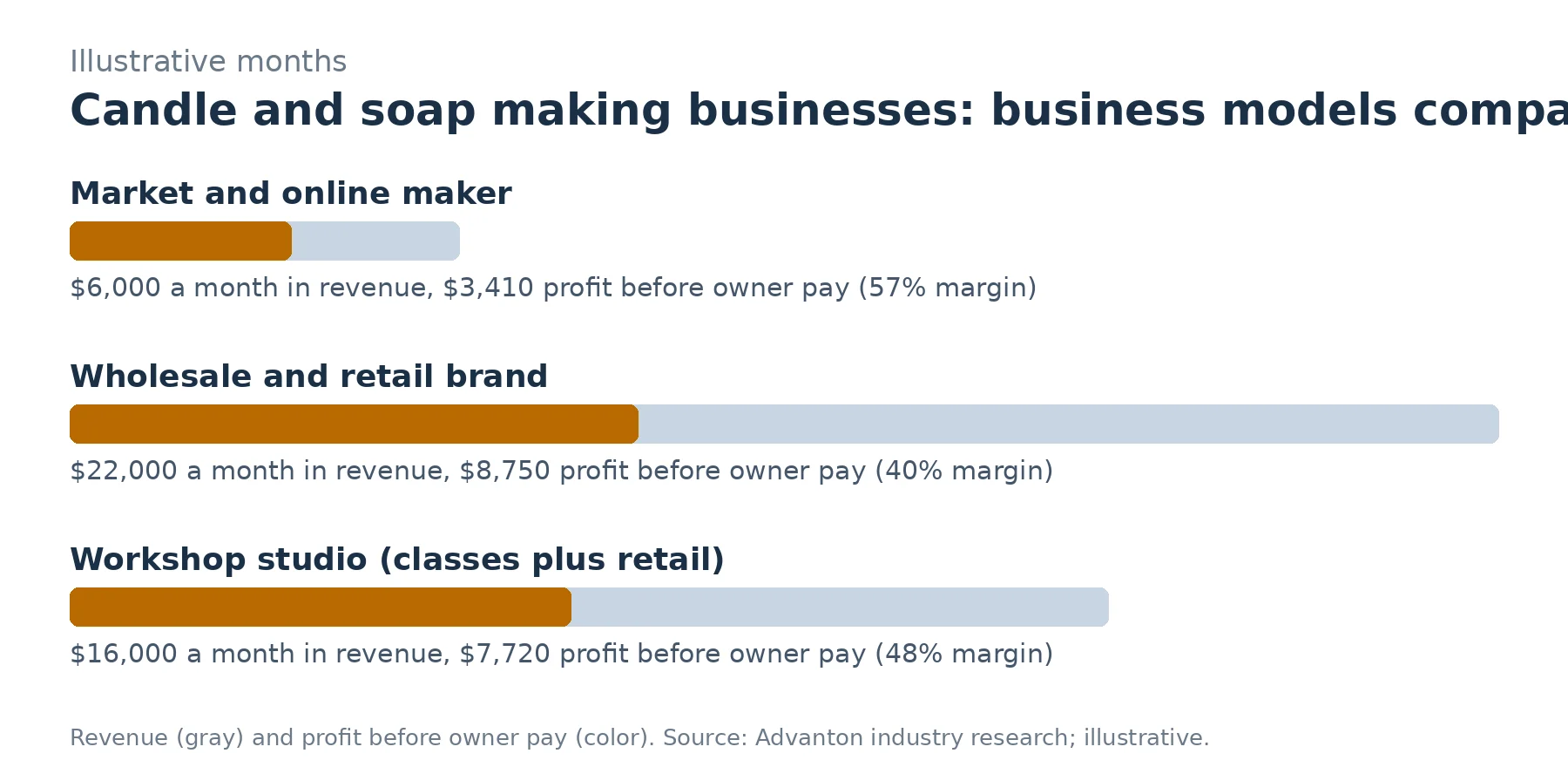
The figures below are illustrative months from our research, not industry averages. They show how revenue and costs typically fit together; your market, prices and costs will differ.
| Business model | Startup costs | Example monthly revenue | Costs | Profit before owner pay | Margin |
|---|---|---|---|---|---|
| Market and online maker | Low: wax, oils, fragrance, molds, packaging, labels | $6,000 | $2,590 | $3,410 | 57% |
| Wholesale and retail brand | Moderate: production space, inventory, branding, wholesale samples | $22,000 | $13,250 | $8,750 | 40% |
| Workshop studio (classes plus retail) | Moderate: studio lease, pouring stations, ventilation, supplies | $16,000 | $8,280 | $7,720 | 48% |
Fixed and variable costs
For projections, the most useful split is between variable costs, which rise and fall with sales (materials, supplies, hourly labor, fees), and fixed costs, which you pay every month regardless (rent, salaried staff, insurance, loan payments).
| Business model | Variable costs (% of revenue) | Fixed costs per month | What it means |
|---|---|---|---|
| Market and online maker | 36.7% | $390 | Balanced: margins improve as volume grows |
| Wholesale and retail brand | 48.2% | $2,650 | Balanced: margins improve as volume grows |
| Workshop studio (classes plus retail) | 27.2% | $3,930 | Mostly fixed: needs steady volume to cover overhead |
What the numbers say
Materials are a modest share of price, so time, packaging and selling fees decide real margins.
Wholesale lowers margins per item but raises volume and reach.
Workshops turn skills into experiences with strong margins and repeat customers.
The three models in brief
Market and online maker. Markets, craft fairs, Etsy and your own website. See handmade and crafts data.
Wholesale and retail brand. Products sold to boutiques and gift shops plus direct to customers. See independent retail data.
Workshop studio. Candle-pouring and soap-making classes, parties and retail.
Cost structure: wholesale and retail brand
Each cost as a share of the example month’s revenue ($22,000):
| Cost | Monthly amount | Share of revenue | Type |
|---|---|---|---|
| Materials | $4,400 | 20.0% | Variable |
| Production help | $3,000 | 13.6% | Variable |
| Packaging and labels | $1,500 | 6.8% | Variable |
| Studio rent | $1,200 | 5.5% | Fixed |
| Trade shows and marketing | $1,200 | 5.5% | Fixed |
| Shipping | $1,000 | 4.5% | Variable |
| Payment and platform fees | $700 | 3.2% | Variable |
| Insurance | $150 | 0.7% | Fixed |
| Software | $100 | 0.5% | Fixed |
| Profit before owner pay | $8,750 | 40% |
A first-year projection: wholesale and retail brand
New businesses rarely start at full speed. This projection assumes revenue ramps from 35% of the example month in month 1 to 100% by month 12, variable costs move with revenue, and fixed costs stay the same every month. It’s a planning illustration, not a forecast.
| Month | Revenue | Variable costs | Fixed costs | Profit | Cumulative |
|---|---|---|---|---|---|
| 1 | $7,700 | $3,711 | $2,650 | $1,339 | $1,339 |
| 2 | $9,900 | $4,772 | $2,650 | $2,478 | $3,817 |
| 3 | $12,100 | $5,832 | $2,650 | $3,618 | $7,435 |
| 4 | $13,640 | $6,574 | $2,650 | $4,416 | $11,851 |
| 5 | $15,400 | $7,423 | $2,650 | $5,327 | $17,178 |
| 6 | $16,720 | $8,059 | $2,650 | $6,011 | $23,189 |
| 7 | $18,040 | $8,695 | $2,650 | $6,695 | $29,884 |
| 8 | $19,140 | $9,225 | $2,650 | $7,265 | $37,149 |
| 9 | $20,020 | $9,650 | $2,650 | $7,720 | $44,869 |
| 10 | $20,900 | $10,074 | $2,650 | $8,176 | $53,045 |
| 11 | $21,560 | $10,392 | $2,650 | $8,518 | $61,563 |
| 12 | $22,000 | $10,604 | $2,650 | $8,746 | $70,309 |
Year one: revenue $197,120, profit before owner pay $70,309. The first profitable month is month 1. Cumulative results stay positive from the start, before any startup costs.
Materials, packaging and production help move with sales and fixed costs are modest, so this brand illustration is profitable from month 1. The real early investments are inventory for wholesale orders, packaging design and trade show booths, which come before the first large orders.
How makers earn
- Retail sales at markets, online and in shops.
- Wholesale to boutiques and gift stores.
- Custom and wedding favors.
- Workshops and private parties.
- Subscription boxes and seasonal collections.
Soap or cosmetic?
What you say matters. Soap marketed only for cleaning is generally a consumer product, but claims such as "moisturizing" or "anti-aging" make it a cosmetic under FDA rules, with labeling requirements. Claims to treat skin conditions make a product a drug. Choose your marketing words carefully.
Candle safety
Test wicks and burn times, use appropriate fragrance loads and label candles with fire safety warnings, such as never leaving a burning candle unattended. Consistent testing prevents tunneling, sooting and dangerous flare-ups.
A startup checklist for candle and soap making businesses
- Develop and test consistent recipes.
- Learn soap and cosmetic labeling rules.
- Add candle warning labels.
- Get product liability insurance.
- Price for profit including time and fees.
Pricing for profit
Include materials, packaging, labor, overhead and selling fees, then check market prices. Wholesale pricing is typically about half of retail, so your retail price must support it.
Where the opportunities are
- Local and seasonal scents.
- Corporate gifts and wedding favors.
- Refill and sustainable packaging.
- Workshops and team-building events.
- Subscription boxes.
Key terms
| Term | Meaning |
|---|---|
| Cold process | Traditional soap-making method using lye and oils |
| Fragrance load | Share of fragrance in wax |
| MoCRA | Federal cosmetics law modernizing FDA oversight |
| Wholesale price | Price to retailers, often about half of retail |
Lye safety
Cold-process soap uses sodium hydroxide, which causes burns. Use gloves, eye protection and ventilation, and keep lye away from children and food areas.
Key numbers to track
Track cost per unit, retail and wholesale margins, sell-through, wholesale accounts and workshop attendance.
Common mistakes
- Making cosmetic or drug claims without following the rules.
- Underpricing time.
- Skipping burn tests.
- No liability insurance.
- Inconsistent batches.
Marketing handmade products
Instagram and TikTok videos, markets, boutiques, Etsy, email lists and gift guides bring buyers. See handmade and crafts data.
Wholesale relationships
Boutiques want reliable restocks, attractive displays and fair terms. Line sheets and samples help win accounts, and checking in before each season keeps your products on their shelves.
Packaging and branding
Beautiful, consistent packaging sells handmade products and justifies higher prices.
Scaling production
Batch production schedules, standardized recipes and helper training keep quality consistent as you grow.
Ingredient sourcing
Consistent suppliers for wax, oils, lye, fragrances and colorants keep batches predictable. Buy from suppliers who provide safety data sheets and fragrance usage guidance, and keep batch records so you can trace any problem back to its ingredients.
Testing and documentation
Burn-test every candle design, cure soap fully before selling and keep notes on recipes, batches and test results. Documentation supports consistency, helps answer customer questions and is part of good practice under cosmetic safety rules.
Seasonality
Holidays drive most candle and gift sales; plan inventory months ahead.
Test these numbers with your own plan
Open this industry in our free Business Idea Reality Check to start from any model above, change prices, costs, startup budget and your own pay, and see your break-even month, the cash you’d need, three scenarios and how new businesses in this sector survive in your state.
- Start with the closest model and its cost structure.
- Replace every price and cost with local quotes.
- Estimate your ramp: how fast customers will realistically come in year one.
- Map cash month by month with the free Cash & Payroll Planner.
- Build the full plan in the free Business Planner.
About this data
Workforce figures come from the U.S. Bureau of Labor Statistics (Occupational Outlook Handbook and Occupational Employment and Wage Statistics, May 2024 wages and the 2024 to 2034 projections, unless noted). Market figures cite their sources above. Business model figures are illustrative months built from typical prices and costs to show how revenue, fixed costs and variable costs fit together; they are not industry averages or guarantees. We review these profiles when new government data is released, at least once a year, and the same figures power the Business Idea Reality Check.
Licensing and rules
Business and sales tax registration; under FDA rules, true soap made of fats and alkali and marketed only for cleansing is regulated by the Consumer Product Safety Commission, but soap marketed with cosmetic claims (such as moisturizing) or made with synthetic detergents is a cosmetic regulated by FDA, and products with drug claims are drugs; the Modernization of Cosmetics Regulation Act requires cosmetic safety substantiation and adverse event reporting, while exempting many small businesses from facility registration and product listing; candles should carry fire safety warnings, and many makers follow voluntary industry labeling standards; product liability insurance is recommended. Requirements change; confirm with your state and local agencies before you start.
Frequently asked questions about candle and soap making businesses
Is soap a cosmetic?
It depends on ingredients and claims; true soap marketed only for cleansing is regulated by CPSC, while cosmetic claims bring FDA rules.
Do candles need warning labels?
Fire safety warnings are strongly recommended and widely expected.
What is MoCRA?
A 2022 federal law that updated FDA oversight of cosmetics, with some small business exemptions.
How should I price handmade candles?
Cover materials, labor, packaging, overhead and fees, and leave room for wholesale.
Do I need insurance?
Product liability insurance is strongly recommended.
What do craft artists earn?
BLS reported a median of $56,260 in May 2024.
Can I make soap at home to sell?
Many makers do, following labeling rules and safe practices; check local business and zoning rules.
How can I test these numbers?
Open candle and soap making in the Business Idea Reality Check and enter your own prices and costs.
Keep learning
- Handmade and crafts data
- Independent retail data
- Boutiques industry data
- Business Idea Reality Check
Sources
Last reviewed November 1, 2026. Startup costs are estimates; check local prices, licensing and tax rules before you commit money.
In India
Small businesses like this in India
In MoSPI’s survey of unincorporated businesses (proprietorships, partnerships and similar firms), this falls under Chemicals and chemical products (including soaps and cosmetics). In 2023-24 India had 41,176 such establishments employing 1.5 lakh workers, and 60.5% were run without hired workers. Across the wider manufacturing group, the number of establishments grew 6.48% between 2023-24 and 2025.
| Urban | Rural | All India | |
|---|---|---|---|
| Value added per business a year | ₹6,48,800 | ₹6,40,647 | ₹6,45,479 |
| Value added per worker a year | ₹1,75,623 | ₹1,67,483 | ₹1,72,239 |
| Pay per hired worker a year | ₹1,15,836 | ₹1,27,516 | ₹1,20,069 |
Running it alone or with staff: businesses with no hired workers added about ₹1,42,674 a year on average, while those with hired workers added about ₹14,15,884 (all India).
Where these businesses are: the states with the most small manufacturing businesses are West Bengal (16.0%), Uttar Pradesh (11.8%), Maharashtra (7.7%), Gujarat (7.2%), Tamil Nadu (6.9%) of the national total (2023-24).
Value added is what a business produces minus what it spends on materials and other inputs, before paying its workers and owner, so it’s a rough guide to the income a typical small business generates. These figures cover the whole activity, which can be broader than this one business type. Across all small businesses, average fixed assets such as equipment, furniture and vehicles were ₹3,42,242 per establishment in 2025.
Licences and registrations to expect
- Consent to Establish and Consent to Operate from your State Pollution Control Board, unless your activity is in the exempt white category.
- Factory registration under the OSH Code once you have 20 or more workers with power (40 without).
- BIS certification for products covered by mandatory quality control orders, and Legal Metrology registration for packaged goods.
- Registration under your state’s Shops and Establishments Act if you have premises or employees.
- A trade licence from your municipal corporation or council for many shop and service businesses.
- GST registration once turnover crosses ₹40 lakh for goods or ₹20 lakh for services (lower in some special category states), or earlier if you sell goods to other states or through e-commerce marketplaces.
- Professional tax registration in states that levy it.
- Free Udyam (MSME) registration, which helps with loans, government schemes and delayed-payment protection.
Rules differ by state and city. Check with your municipal corporation, state departments and a chartered accountant before you start.
Run a business like this in India? List it free in the India Business Directory, with your hours, deals and GST registration.
Free tools for India: Make a GST invoice · Compare business credit cards
Build a market report for Candle and Soap Making Businesses in India Pick your state and see market size, earnings, competition and licences, from official data. Free, with a PDF download.
Sources: MoSPI, Annual Survey of Unincorporated Sector Enterprises (ASUSE) 2023-24, full report, Appendix A Tables 4, 29, 33, 35 and 37 (survey period October 2023 to September 2024); MoSPI, Annual Survey of Unincorporated Sector Enterprises (ASUSE) 2025, factsheet (survey period January to December 2025, released 24 March 2026). Licensing summary by Advanton, checked November 2026.