
Demand for mental health care has grown sharply, and more people are seeking therapy in person and online. The Bureau of Labor Statistics projects employment of substance abuse, behavioral disorder and mental health counselors to grow 17% from 2024 to 2034, among the fastest of any occupation, with a median wage of $59,190 in May 2024. Many counselors earn more in private practice than in employed roles, though income depends on caseload, fees and payer mix. Below is the key industry data on mental health counseling practices, with costs, business models and a first-year projection.
Private practices range from a solo clinician seeing clients in a small office or online to group practices that employ or contract several therapists. Licensing, privacy and billing rules shape every model.
The workforce
| Occupation | Jobs (2024) | Median pay (May 2024) | Projected growth, 2024 to 2034 |
|---|---|---|---|
| Substance abuse, behavioral disorder and mental health counselors | n/a | $59,190 | +17% |
Source: U.S. Bureau of Labor Statistics, Occupational Outlook Handbook and Occupational Employment and Wage Statistics.
Business models compared
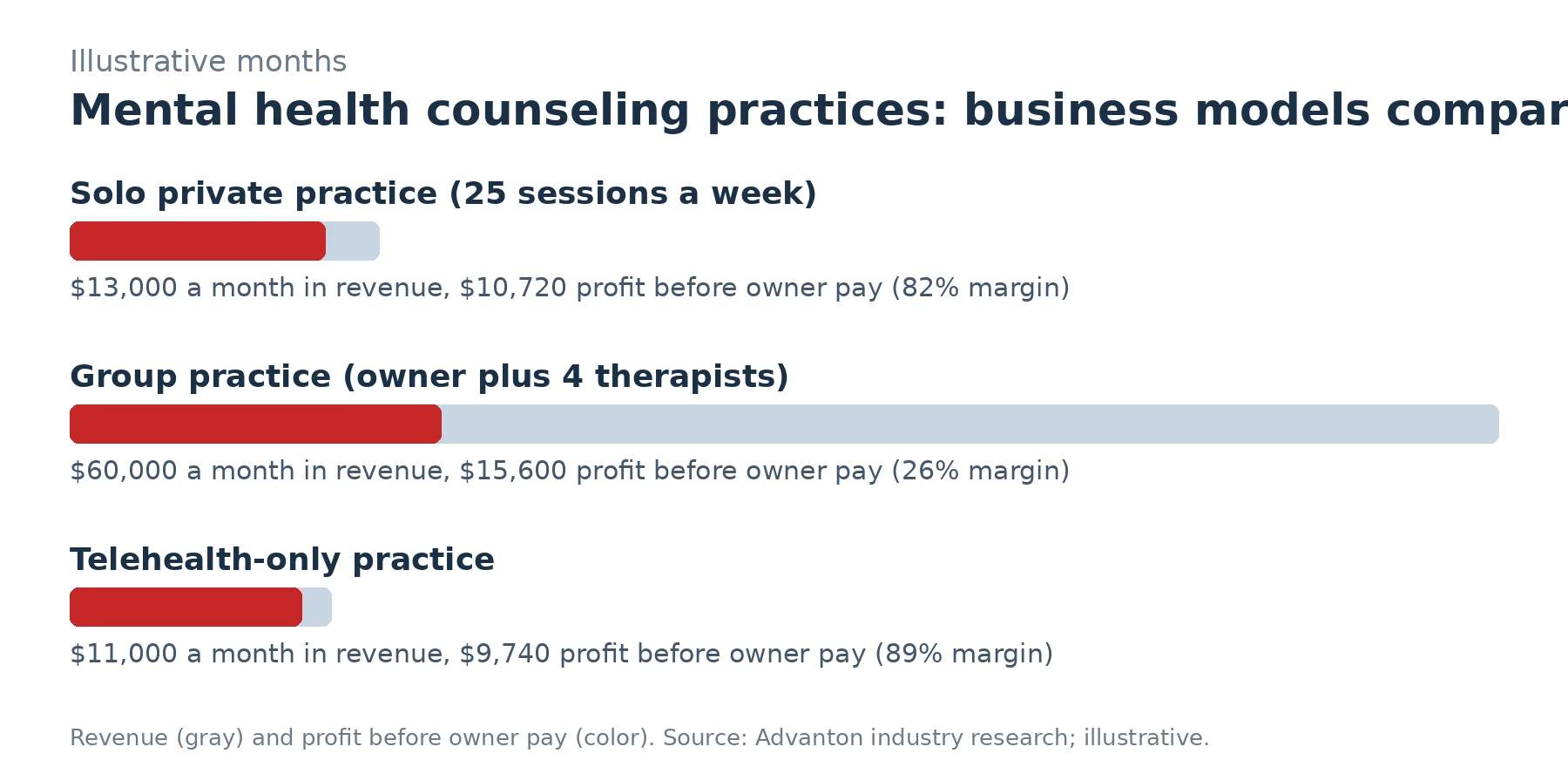
The figures below are illustrative months from our research, not industry averages. They show how revenue and costs typically fit together; your market, prices and costs will differ.
| Business model | Startup costs | Example monthly revenue | Costs | Profit before owner pay | Margin |
|---|---|---|---|---|---|
| Solo private practice (25 sessions a week) | Low: office share or telehealth, EHR, liability insurance | $13,000 | $2,280 | $10,720 | 82% |
| Group practice (owner plus 4 therapists) | Moderate: suite, credentialing, admin staff, marketing | $60,000 | $44,400 | $15,600 | 26% |
| Telehealth-only practice | Low: secure telehealth platform, licensing in client states | $11,000 | $1,260 | $9,740 | 89% |
Fixed and variable costs
For projections, the most useful split is between variable costs, which rise and fall with sales (materials, supplies, hourly labor, fees), and fixed costs, which you pay every month regardless (rent, salaried staff, insurance, loan payments).
| Business model | Variable costs (% of revenue) | Fixed costs per month | What it means |
|---|---|---|---|
| Solo private practice (25 sessions a week) | 5.0% | $1,630 | Mostly fixed: needs steady volume to cover overhead |
| Group practice (owner plus 4 therapists) | 56.0% | $10,800 | Mostly variable: profitable early, but watch cash flow |
| Telehealth-only practice | 4.1% | $810 | Mostly fixed: needs steady volume to cover overhead |
What the numbers say
Solo practices keep most of what they bill, with low overhead, but income is capped by sessions a clinician can sustainably see each week.
Group practices add revenue through other clinicians at the cost of admin staff, rent and the risk of turnover.
Telehealth lowers overhead further, though licensing limits where clients can be seen.
The three models in brief
Solo private practice. One licensed clinician, private pay, insurance or both. See healthcare practices data.
Group practice. An owner clinician plus employed or contracted therapists, an intake coordinator and shared marketing.
Telehealth-only practice. Sessions delivered online to clients in states where the clinician is licensed.
Cost structure: group practice (owner plus 4 therapists)
Each cost as a share of the example month’s revenue ($60,000):
| Cost | Monthly amount | Share of revenue | Type |
|---|---|---|---|
| Therapist pay (split of collections) | $30,000 | 50.0% | Variable |
| Office suite rent | $4,000 | 6.7% | Fixed |
| Billing service | $3,600 | 6.0% | Variable |
| Intake coordinator | $3,500 | 5.8% | Fixed |
| Marketing | $1,500 | 2.5% | Fixed |
| Payroll taxes for staff | $800 | 1.3% | Fixed |
| EHR and telehealth software | $500 | 0.8% | Fixed |
| Insurance and compliance | $500 | 0.8% | Fixed |
| Profit before owner pay | $15,600 | 26% |
A first-year projection: group practice (owner plus 4 therapists)
New businesses rarely start at full speed. This projection assumes revenue ramps from 35% of the example month in month 1 to 100% by month 12, variable costs move with revenue, and fixed costs stay the same every month. It’s a planning illustration, not a forecast.
| Month | Revenue | Variable costs | Fixed costs | Profit | Cumulative |
|---|---|---|---|---|---|
| 1 | $21,000 | $11,760 | $10,800 | -$1,560 | -$1,560 |
| 2 | $27,000 | $15,120 | $10,800 | $1,080 | -$480 |
| 3 | $33,000 | $18,480 | $10,800 | $3,720 | $3,240 |
| 4 | $37,200 | $20,832 | $10,800 | $5,568 | $8,808 |
| 5 | $42,000 | $23,520 | $10,800 | $7,680 | $16,488 |
| 6 | $45,600 | $25,536 | $10,800 | $9,264 | $25,752 |
| 7 | $49,200 | $27,552 | $10,800 | $10,848 | $36,600 |
| 8 | $52,200 | $29,232 | $10,800 | $12,168 | $48,768 |
| 9 | $54,600 | $30,576 | $10,800 | $13,224 | $61,992 |
| 10 | $57,000 | $31,920 | $10,800 | $14,280 | $76,272 |
| 11 | $58,800 | $32,928 | $10,800 | $15,072 | $91,344 |
| 12 | $60,000 | $33,600 | $10,800 | $15,600 | $106,944 |
Year one: revenue $537,600, profit before owner pay $106,944. The first profitable month is month 2. Cumulative results bottom out at -$1,560, which is the minimum cash cushion this plan would need, before any startup costs.
Rent, an intake coordinator and marketing start before clinicians’ caseloads fill, so this group practice illustration turns profitable in month 2, with a cumulative low of about $1,600.
How counseling practices earn
- Private-pay sessions at set fees, sometimes with sliding scales.
- Insurance reimbursement after credentialing with each payer.
- Employee assistance programs (EAPs).
- Groups and workshops.
- Clinical supervision for pre-licensed counselors.
Private pay or insurance?
Private pay offers higher fees, less paperwork and more control, but fewer people can afford it. Insurance brings more clients at lower contracted rates, with credentialing, billing and documentation requirements. Many practices start in-network with a few plans and add private-pay options over time.
A startup checklist for mental health counseling practices
- Confirm licensure in every state where clients are located.
- Set up HIPAA-compliant systems: EHR, telehealth, email and record storage.
- Prepare Good Faith Estimates for self-pay clients.
- Carry professional liability insurance.
- Write policies for fees, cancellations, emergencies and confidentiality.
Telehealth rules
Telehealth expands access, but clinicians generally need a license in the client’s state at the time of the session. Interstate compacts are making multi-state practice easier for some professions as they take effect. Verify client location at each session, keep emergency resources for each client’s area, and confirm that each insurer covers telehealth sessions before billing them.
Where the opportunities are
- Specialties: trauma, couples, adolescents, perinatal and anxiety.
- Underserved rural areas through telehealth.
- Employer and EAP contracts.
- Group therapy and workshops.
- Bilingual services.
Avoiding burnout
Counseling is emotionally demanding. Sustainable caseloads, supervision or consultation groups, time off and boundaries protect clinicians and quality of care. Group practice owners should plan caseloads that keep therapists healthy and engaged.
Key terms
| Term | Meaning |
|---|---|
| Credentialing | Enrolling with insurers to bill them |
| Good Faith Estimate | Required cost estimate for uninsured and self-pay clients |
| 42 CFR Part 2 | Federal confidentiality rules for many substance use disorder programs |
| EAP | Employer-sponsored employee assistance program |
Documentation and treatment planning
Clear intake assessments, treatment plans and progress notes support good care, continuity if a client changes clinicians, and insurance reimbursement. Use templates in your records system, write notes promptly, and review documentation standards for each payer you bill.
Key numbers to track
Track sessions per week per clinician, no-show and late-cancellation rates, average collection per session, days to payment, client retention and referral sources.
Common mistakes
- Overloading caseloads and burning out.
- Seeing clients in states where you aren’t licensed.
- Weak cancellation policies.
- Insecure communication tools.
- Skipping Good Faith Estimates for self-pay clients.
Marketing a counseling practice
Therapist directories, Google Business Profile, a clear website describing specialties and fees, and relationships with physicians, schools and other clinicians bring clients. Follow professional ethics on testimonials and advertising. See directory listings for professional services.
Building a group practice
Owners grow by hiring or contracting clinicians, sharing marketing and intake, and splitting collections. Clear agreements, fair pay, consistent intake and good culture keep clinicians, and clients, with the practice. Check employment and contractor classification rules with an advisor.
Test these numbers with your own plan
Open this industry in our free Business Idea Reality Check to start from any model above, change prices, costs, startup budget and your own pay, and see your break-even month, the cash you’d need, three scenarios and how new businesses in this sector survive in your state.
- Start with the closest model and its cost structure.
- Replace every price and cost with local quotes.
- Estimate your ramp: how fast customers will realistically come in year one.
- Map cash month by month with the free Cash & Payroll Planner.
- Build the full plan in the free Business Planner.
About this data
Workforce figures come from the U.S. Bureau of Labor Statistics (Occupational Outlook Handbook and Occupational Employment and Wage Statistics, May 2024 wages and the 2024 to 2034 projections, unless noted). Market figures cite their sources above. Business model figures are illustrative months built from typical prices and costs to show how revenue, fixed costs and variable costs fit together; they are not industry averages or guarantees. We review these profiles when new government data is released, at least once a year, and the same figures power the Business Idea Reality Check.
Licensing and rules
Counselors must hold a state license (such as LPC, LMHC or LCPC), and practicing via telehealth generally requires licensure in the state where the client is located, although interstate compacts are expanding; HIPAA privacy and security rules apply to covered practices; federally assisted substance use disorder programs must follow 42 CFR Part 2 confidentiality rules; under the No Surprises Act, providers must give uninsured and self-pay clients a Good Faith Estimate of expected charges; liability insurance is standard. Requirements change; confirm with your state and local agencies before you start.
Frequently asked questions about mental health counseling practices
What do mental health counselors earn?
BLS reported a median of $59,190 in May 2024; private practice income varies widely with caseload and fees.
Can I see clients in other states via telehealth?
Generally only if you are licensed where the client is located, unless an interstate compact allows it.
Do I have to accept insurance?
No; many practices are private pay, while others are in-network with selected plans and offer superbills for out-of-network reimbursement.
What is a Good Faith Estimate?
A written cost estimate that providers must give uninsured and self-pay clients under the No Surprises Act, before services begin.
How many clients does a full-time therapist see?
Many see roughly 20 to 30 sessions a week; sustainable caseloads vary by clinician.
How can I test these numbers?
Open mental health counseling in the Business Idea Reality Check and enter your own fees and caseload.
Keep learning
- Healthcare practices industry data
- Directory listings for professional services
- Wellness industry data
- Business Idea Reality Check
Sources
Last reviewed November 1, 2026. Startup costs are estimates; check local prices, licensing and tax rules before you commit money.
In India
Small businesses like this in India
In MoSPI’s survey of unincorporated businesses (proprietorships, partnerships and similar firms), this falls under Health and social work. In 2023-24 India had 12.8 lakh such establishments employing 30.5 lakh workers, and 66.9% were run without hired workers. Across the wider other services group, the number of establishments grew 10.29% between 2023-24 and 2025.
| Urban | Rural | All India | |
|---|---|---|---|
| Value added per business a year | ₹8,87,384 | ₹2,35,935 | ₹5,86,558 |
| Value added per worker a year | ₹2,79,630 | ₹1,65,488 | ₹2,47,874 |
| Pay per hired worker a year | ₹1,72,418 | ₹1,30,226 | ₹1,66,828 |
Running it alone or with staff: businesses with no hired workers added about ₹1,94,768 a year on average, while those with hired workers added about ₹13,87,950 (all India).
Where these businesses are: the states with the most small other services businesses are West Bengal (13.1%), Uttar Pradesh (11.6%), Maharashtra (8.8%), Tamil Nadu (6.2%), Gujarat (6.0%) of the national total (2023-24).
Value added is what a business produces minus what it spends on materials and other inputs, before paying its workers and owner, so it’s a rough guide to the income a typical small business generates. These figures cover the whole activity, which can be broader than this one business type. Across all small businesses, average fixed assets such as equipment, furniture and vehicles were ₹3,42,242 per establishment in 2025.
Licences and registrations to expect
- Registration of each practitioner with the relevant council, such as the state medical, dental or veterinary council.
- Registration as a clinical establishment where your state requires it.
- Biomedical waste authorisation from your State Pollution Control Board.
- Registration under your state’s Shops and Establishments Act if you have premises or employees.
- A trade licence from your municipal corporation or council for many shop and service businesses.
- GST registration once turnover crosses ₹40 lakh for goods or ₹20 lakh for services (lower in some special category states), or earlier if you sell goods to other states or through e-commerce marketplaces.
- Professional tax registration in states that levy it.
- Free Udyam (MSME) registration, which helps with loans, government schemes and delayed-payment protection.
Rules differ by state and city. Check with your municipal corporation, state departments and a chartered accountant before you start.
Run a business like this in India? List it free in the India Business Directory, with your hours, deals and GST registration.
Free tools for India: Make a GST invoice · Compare business credit cards
Build a market report for Mental Health Counseling Practices in India Pick your state and see market size, earnings, competition and licences, from official data. Free, with a PDF download.
Sources: MoSPI, Annual Survey of Unincorporated Sector Enterprises (ASUSE) 2023-24, full report, Appendix A Tables 4, 29, 33, 35 and 37 (survey period October 2023 to September 2024); MoSPI, Annual Survey of Unincorporated Sector Enterprises (ASUSE) 2025, factsheet (survey period January to December 2025, released 24 March 2026). Licensing summary by Advanton, checked November 2026.