
Nearly everyone needs dental care, and many patients stay with the same practice for years. Dental practices are among the most stable small healthcare businesses, but they require large upfront investment and a team of licensed professionals. The Bureau of Labor Statistics reported a median wage of $94,260 for dental hygienists and $47,300 for dental assistants in May 2024, with about 381,900 dental assistant jobs and 6% projected growth; dentists earned a median of about $179,210 in 2024, as cited from BLS by the University of Louisville School of Dentistry.
New dentists usually choose between starting a practice from scratch, joining or buying an established practice, or working as an associate first. Each path trades risk, cost and speed differently.
The workforce
| Occupation | Jobs (2024) | Median pay (May 2024) | Projected growth, 2024 to 2034 |
|---|---|---|---|
| Dentists (median as cited by the University of Louisville from BLS) | n/a | $179,210 | n/a |
| Dental hygienists | n/a | $94,260 | n/a |
| Dental assistants | 381,900 | $47,300 | +6% |
Source: U.S. Bureau of Labor Statistics, Occupational Outlook Handbook and Occupational Employment and Wage Statistics.
Market data
| Measure | Value |
|---|---|
| Projected dental assistant job change, 2024 to 2034 | 24,400 |
Business models compared
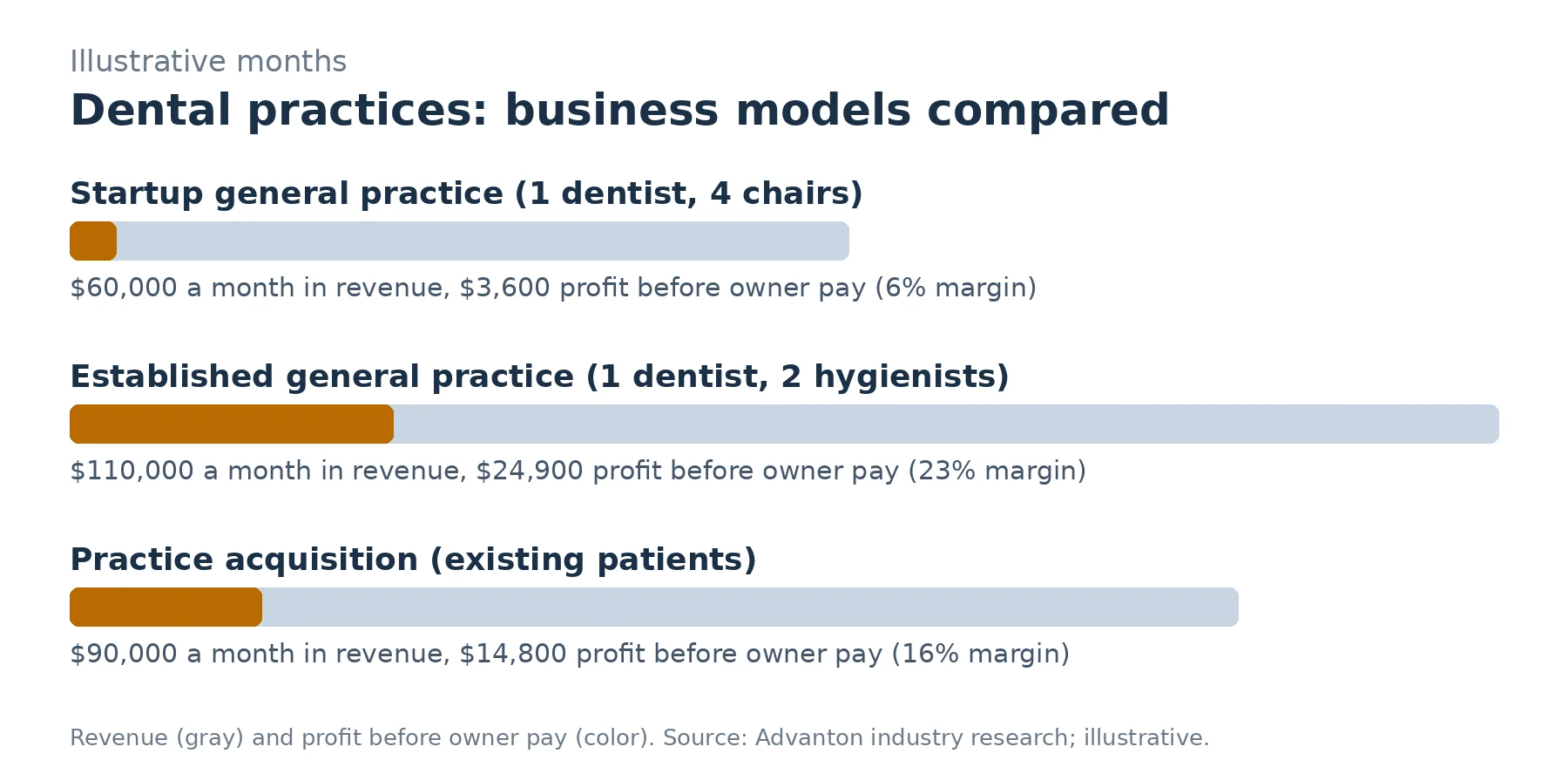
The figures below are illustrative months from our research, not industry averages. They show how revenue and costs typically fit together; your market, prices and costs will differ.
| Business model | Startup costs | Example monthly revenue | Costs | Profit before owner pay | Margin |
|---|---|---|---|---|---|
| Startup general practice (1 dentist, 4 chairs) | High: lease build-out, chairs, imaging, sterilization, software | $60,000 | $56,400 | $3,600 | 6% |
| Established general practice (1 dentist, 2 hygienists) | High: purchase price or build-out plus working capital | $110,000 | $85,100 | $24,900 | 23% |
| Practice acquisition (existing patients) | High: purchase loan, transition costs | $90,000 | $75,200 | $14,800 | 16% |
Fixed and variable costs
For projections, the most useful split is between variable costs, which rise and fall with sales (materials, supplies, hourly labor, fees), and fixed costs, which you pay every month regardless (rent, salaried staff, insurance, loan payments).
| Business model | Variable costs (% of revenue) | Fixed costs per month | What it means |
|---|---|---|---|
| Startup general practice (1 dentist, 4 chairs) | 16.0% | $46,800 | Mostly fixed: needs steady volume to cover overhead |
| Established general practice (1 dentist, 2 hygienists) | 16.0% | $67,500 | Mostly fixed: needs steady volume to cover overhead |
| Practice acquisition (existing patients) | 16.0% | $60,800 | Mostly fixed: needs steady volume to cover overhead |
What the numbers say
Staff and debt dominate costs. Payroll and equipment or practice loans make dentistry a high-fixed-cost business, so patient volume and scheduling efficiency decide profit.
Hygiene is the backbone. Recall visits keep the schedule full and lead to restorative treatment.
Acquisitions trade a higher loan for immediate patients, while startups trade lower purchase costs for a slower ramp.
The three models in brief
Startup practice. Built from scratch with new equipment and marketing to attract patients. See healthcare practices data.
Established general practice. A full patient base with hygienists keeping recall visits steady.
Practice acquisition. Buying an existing practice and its patients, financed with a practice loan.
Cost structure: established general practice (1 dentist, 2 hygienists)
Each cost as a share of the example month’s revenue ($110,000):
| Cost | Monthly amount | Share of revenue | Type |
|---|---|---|---|
| Hygienist and assistant wages | $26,000 | 23.6% | Fixed |
| Practice loan payment | $12,000 | 10.9% | Fixed |
| Front office and billing | $9,000 | 8.2% | Fixed |
| Dental lab fees | $8,800 | 8.0% | Variable |
| Rent | $8,000 | 7.3% | Fixed |
| Clinical supplies | $6,600 | 6.0% | Variable |
| Payroll taxes and benefits | $6,000 | 5.5% | Fixed |
| Marketing | $3,000 | 2.7% | Fixed |
| Card and financing fees | $2,200 | 2.0% | Variable |
| Software, imaging and IT | $2,000 | 1.8% | Fixed |
| Insurance | $1,500 | 1.4% | Fixed |
| Profit before owner pay | $24,900 | 23% |
A first-year projection: established general practice (1 dentist, 2 hygienists)
New businesses rarely start at full speed. This projection assumes revenue ramps from 35% of the example month in month 1 to 100% by month 12, variable costs move with revenue, and fixed costs stay the same every month. It’s a planning illustration, not a forecast.
| Month | Revenue | Variable costs | Fixed costs | Profit | Cumulative |
|---|---|---|---|---|---|
| 1 | $38,500 | $6,160 | $67,500 | -$35,160 | -$35,160 |
| 2 | $49,500 | $7,920 | $67,500 | -$25,920 | -$61,080 |
| 3 | $60,500 | $9,680 | $67,500 | -$16,680 | -$77,760 |
| 4 | $68,200 | $10,912 | $67,500 | -$10,212 | -$87,972 |
| 5 | $77,000 | $12,320 | $67,500 | -$2,820 | -$90,792 |
| 6 | $83,600 | $13,376 | $67,500 | $2,724 | -$88,068 |
| 7 | $90,200 | $14,432 | $67,500 | $8,268 | -$79,800 |
| 8 | $95,700 | $15,312 | $67,500 | $12,888 | -$66,912 |
| 9 | $100,100 | $16,016 | $67,500 | $16,584 | -$50,328 |
| 10 | $104,500 | $16,720 | $67,500 | $20,280 | -$30,048 |
| 11 | $107,800 | $17,248 | $67,500 | $23,052 | -$6,996 |
| 12 | $110,000 | $17,600 | $67,500 | $24,900 | $17,904 |
Year one: revenue $985,600, profit before owner pay $17,904. The first profitable month is month 6. Cumulative results bottom out at -$90,792, which is the minimum cash cushion this plan would need, before any startup costs.
Staff, rent and equipment loans start before patients fill the schedule, so this practice illustration turns profitable in month 6, with a cumulative low of about $90,800, before the build-out and equipment investment itself.
How dental practices earn
- Preventive care: exams, cleanings and X-rays, often covered by dental insurance.
- Restorative treatment: fillings, crowns and root canals.
- Cosmetic services: whitening, veneers and clear aligners.
- Membership plans for uninsured patients.
- Specialty referrals or in-house specialists.
Insurance and fee schedules
Most practices accept some dental insurance plans, which set allowed fees. Being in-network can bring patients but limits prices; fee-for-service practices rely on reputation and service. Many practices offer in-house membership plans as an alternative for uninsured patients.
A startup checklist for dental practices
- Confirm state licensing for every clinical role.
- Plan the location: demographics, competition, parking and visibility.
- Secure practice financing for build-out and equipment.
- Set up compliance: OSHA, HIPAA and X-ray registration.
- Choose practice management software with scheduling, charting and billing.
Hygiene and recall
Recall systems (reminders for six-month cleanings and follow-up treatment) keep hygiene chairs full and patients healthy. Track hygiene reappointment rates and unscheduled treatment, and follow up consistently.
Where the opportunities are
- Growing suburbs with few practices per resident.
- Membership plans for uninsured patients.
- Sedation and anxiety-friendly care.
- Pediatric and family dentistry.
- Clear aligners and cosmetic dentistry.
Technology and equipment
Digital X-rays, intraoral scanners, practice management software and patient communication tools improve care and efficiency, but each adds cost. Many startup practices finance core equipment, lease or delay advanced technology such as 3D imaging or in-office milling, and add it once patient volume supports the payments. Plan for maintenance contracts and IT security from day one.
Team and culture
Patients return to friendly, well-run practices. Hiring, training and keeping hygienists and assistants is often harder than finding patients; competitive pay, predictable schedules and a respectful culture reduce turnover.
Key terms
| Term | Meaning |
|---|---|
| Recall | Scheduled return visits for preventive care |
| In-network | Accepting an insurer’s contracted fees |
| Production | Value of dental work performed |
| Collections | Payments actually received |
Patient experience
Online booking, clear cost estimates before treatment, short waits and gentle communication turn first visits into long-term relationships. Ask satisfied patients for reviews, answer questions about costs plainly, and follow up after major procedures.
Key numbers to track
Watch production and collections per provider, new patients per month, hygiene reappointment rate, case acceptance, accounts receivable and overhead as a share of collections.
Common mistakes
- Overbuilding before patient demand is proven.
- Too many insurance contracts with low fees.
- Weak recall systems.
- High staff turnover.
- Ignoring online reviews and patient experience.
Marketing a dental practice
Google Business Profile, reviews, a clear website with services and insurance information, and community involvement bring new patients. Follow state rules on advertising claims and patient testimonials. See directory listings for professional services.
Test these numbers with your own plan
Open this industry in our free Business Idea Reality Check to start from any model above, change prices, costs, startup budget and your own pay, and see your break-even month, the cash you’d need, three scenarios and how new businesses in this sector survive in your state.
- Start with the closest model and its cost structure.
- Replace every price and cost with local quotes.
- Estimate your ramp: how fast customers will realistically come in year one.
- Map cash month by month with the free Cash & Payroll Planner.
- Build the full plan in the free Business Planner.
About this data
Workforce figures come from the U.S. Bureau of Labor Statistics (Occupational Outlook Handbook and Occupational Employment and Wage Statistics, May 2024 wages and the 2024 to 2034 projections, unless noted). Market figures cite their sources above. Business model figures are illustrative months built from typical prices and costs to show how revenue, fixed costs and variable costs fit together; they are not industry averages or guarantees. We review these profiles when new government data is released, at least once a year, and the same figures power the Business Idea Reality Check.
Licensing and rules
Dentists, hygienists and in many states assistants are licensed by state dental boards; practices must follow OSHA bloodborne pathogens and infection-control rules, HIPAA privacy and security rules, and state rules for X-ray equipment registration and inspection; controlled-substance prescribing requires DEA registration; malpractice insurance is standard. Requirements change; confirm with your state and local agencies before you start.
Frequently asked questions about dental practices
What do dental hygienists earn?
BLS reported a median of $94,260 in May 2024.
Is it better to start or buy a dental practice?
Buying brings patients immediately with a larger loan; starting costs less upfront but takes longer to fill.
How long does a new dental practice take to become profitable?
It varies with location and marketing; this illustration turns profitable within the first year, before repaying build-out costs.
How much does it cost to equip a dental operatory?
It varies widely by equipment choices; many practices finance chairs, imaging and sterilization equipment over several years.
Do dental practices need to accept insurance?
No, but many do; in-network status can bring patients while limiting fees.
What regulations apply to dental offices?
State dental board licensing, OSHA infection control, HIPAA and X-ray equipment rules, among others.
How can I test these numbers?
Open dental practices in the Business Idea Reality Check and enter your own fees, staff and costs.
Keep learning
- Healthcare practices industry data
- Directory listings for professional services
- SBA loans
- Business Idea Reality Check
Sources
- University of Louisville School of Dentistry, citing the BLS Occupational Outlook Handbook (dentists median pay, 2024)
- U.S. Bureau of Labor Statistics, Dental hygienists
- U.S. Bureau of Labor Statistics, Dental assistants
Last reviewed November 1, 2026. Startup costs are estimates; check local prices, licensing and tax rules before you commit money.
In India
Small businesses like this in India
In MoSPI’s survey of unincorporated businesses (proprietorships, partnerships and similar firms), this falls under Health and social work. In 2023-24 India had 12.8 lakh such establishments employing 30.5 lakh workers, and 66.9% were run without hired workers. Across the wider other services group, the number of establishments grew 10.29% between 2023-24 and 2025.
| Urban | Rural | All India | |
|---|---|---|---|
| Value added per business a year | ₹8,87,384 | ₹2,35,935 | ₹5,86,558 |
| Value added per worker a year | ₹2,79,630 | ₹1,65,488 | ₹2,47,874 |
| Pay per hired worker a year | ₹1,72,418 | ₹1,30,226 | ₹1,66,828 |
Running it alone or with staff: businesses with no hired workers added about ₹1,94,768 a year on average, while those with hired workers added about ₹13,87,950 (all India).
Where these businesses are: the states with the most small other services businesses are West Bengal (13.1%), Uttar Pradesh (11.6%), Maharashtra (8.8%), Tamil Nadu (6.2%), Gujarat (6.0%) of the national total (2023-24).
Value added is what a business produces minus what it spends on materials and other inputs, before paying its workers and owner, so it’s a rough guide to the income a typical small business generates. These figures cover the whole activity, which can be broader than this one business type. Across all small businesses, average fixed assets such as equipment, furniture and vehicles were ₹3,42,242 per establishment in 2025.
Licences and registrations to expect
- Registration of each practitioner with the relevant council, such as the state medical, dental or veterinary council.
- Registration as a clinical establishment where your state requires it.
- Biomedical waste authorisation from your State Pollution Control Board.
- Registration under your state’s Shops and Establishments Act if you have premises or employees.
- A trade licence from your municipal corporation or council for many shop and service businesses.
- GST registration once turnover crosses ₹40 lakh for goods or ₹20 lakh for services (lower in some special category states), or earlier if you sell goods to other states or through e-commerce marketplaces.
- Professional tax registration in states that levy it.
- Free Udyam (MSME) registration, which helps with loans, government schemes and delayed-payment protection.
Rules differ by state and city. Check with your municipal corporation, state departments and a chartered accountant before you start.
Run a business like this in India? List it free in the India Business Directory, with your hours, deals and GST registration.
Free tools for India: Make a GST invoice · Compare business credit cards
Build a market report for Dental Practices in India Pick your state and see market size, earnings, competition and licences, from official data. Free, with a PDF download.
Sources: MoSPI, Annual Survey of Unincorporated Sector Enterprises (ASUSE) 2023-24, full report, Appendix A Tables 4, 29, 33, 35 and 37 (survey period October 2023 to September 2024); MoSPI, Annual Survey of Unincorporated Sector Enterprises (ASUSE) 2025, factsheet (survey period January to December 2025, released 24 March 2026). Licensing summary by Advanton, checked November 2026.