
Homes, contractors and businesses constantly generate waste, from renovation debris to cleanouts and recycling. The Bureau of Labor Statistics counted about 147,900 refuse and recyclable material collectors in 2024; BLS wage data show a median of about $49,690 (May 2025, via a wage site summarizing BLS data), and about 16,900 openings are projected each year.
Small waste businesses usually focus on niches large haulers serve less well: junk removal, dumpster rentals for contractors and homeowners, and specialized recycling routes. Disposal fees, fuel and truck payments decide margins.
The workforce
| Occupation | Jobs (2024) | Median pay (May 2024) | Projected growth, 2024 to 2034 |
|---|---|---|---|
| Refuse and recyclable material collectors | about 147,900 | $49,690 | +0.9% |
Source: U.S. Bureau of Labor Statistics, Occupational Outlook Handbook.
Market data
| Measure | Value |
|---|---|
| Collector openings per year, 2024-2034 | about 16,900 |
Business models compared
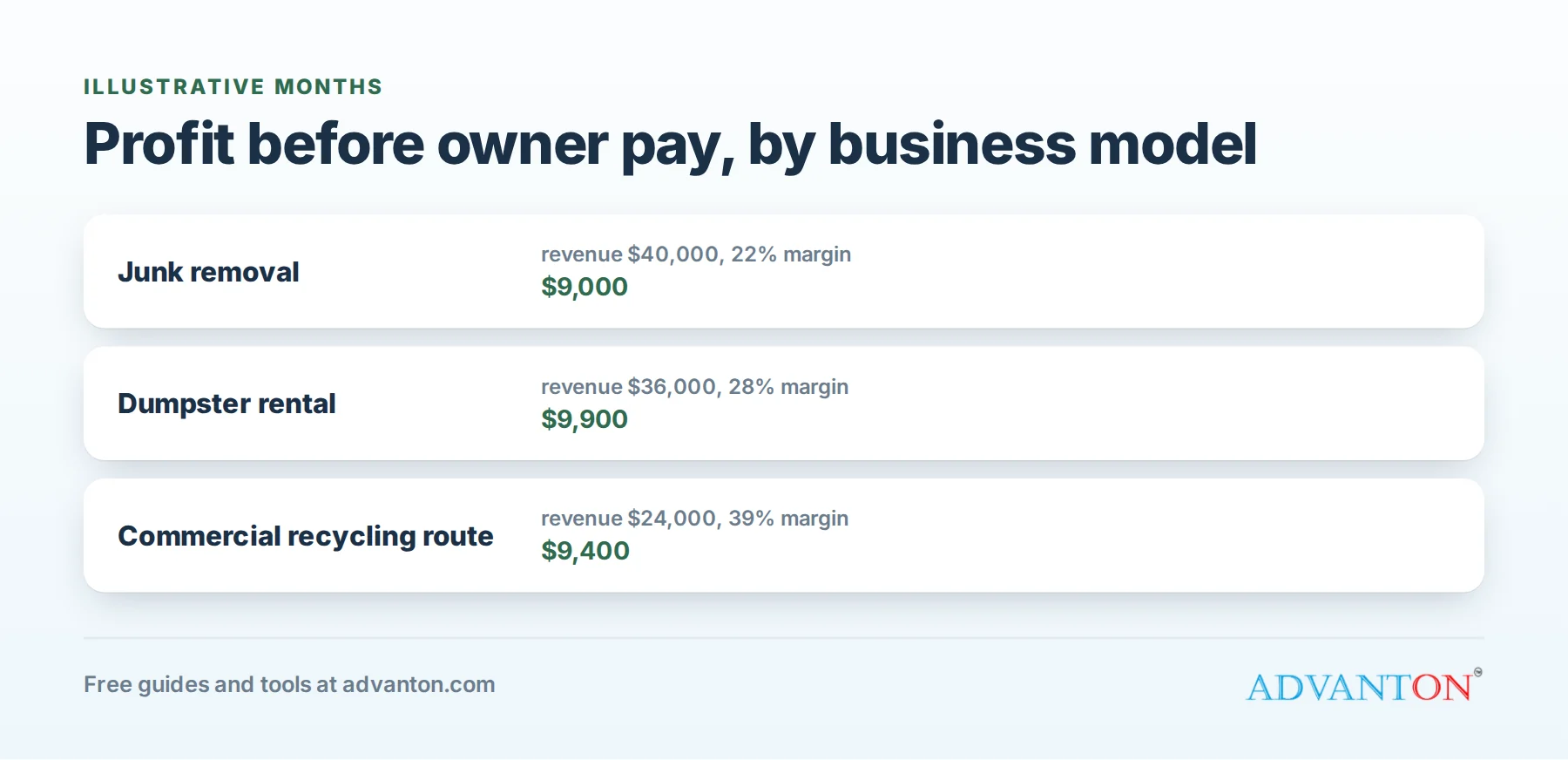
The figures below are illustrative months from our step-by-step guides, not industry averages. They show how revenue and costs typically fit together; your market, prices and costs will differ.
| Business model | Startup costs | Example monthly revenue | Costs | Profit before owner pay | Margin |
|---|---|---|---|---|---|
| Junk removal (2 trucks) | Moderate: trucks, disposal accounts, insurance | $40,000 | $31,000 | $9,000 | 22% |
| Dumpster rental (40 containers) | High: roll-off truck, containers, yard space | $36,000 | $26,100 | $9,900 | 28% |
| Commercial recycling route | Moderate to high: truck, bins, processor relationships | $24,000 | $14,600 | $9,400 | 39% |
Fixed and variable costs
For projections, the most useful split is between variable costs, which rise and fall with sales (materials, parts, hourly labor), and fixed costs, which you pay every month regardless (rent, salaried staff, insurance, loan payments).
| Business model | Variable costs (% of revenue) | Fixed costs per month | What it means |
|---|---|---|---|
| Junk removal (2 trucks) | 57.5% | $8,000 | Mostly variable: profitable early, but watch cash flow |
| Dumpster rental (40 containers) | 31.9% | $14,600 | Mostly fixed: slow start-up months are expensive |
| Commercial recycling route | 20.8% | $9,600 | Mostly fixed: slow start-up months are expensive |
What the numbers say
Disposal fees are a major variable cost. Sorting, recycling and donating items reduce them.
Trucks and containers are fixed costs. Keeping them busy is the key to profit.
Contractors are steady customers. Renovation debris brings repeat dumpster rentals.
The three models in brief
Junk removal. Cleanouts, furniture and appliance removal for homes and businesses.
Dumpster rental. Roll-off containers for contractors, renovations and cleanouts.
Commercial recycling routes. Scheduled pickups of cardboard and recyclables for businesses.
Cost structure: junk removal (2 trucks)
Each cost as a share of the example month’s revenue ($40,000):
| Cost | Monthly amount | Share of revenue | Type |
|---|---|---|---|
| Crew | $12,000 | 30.0% | Variable |
| Dump and recycling fees | $6,000 | 15.0% | Variable |
| Truck payments | $3,000 | 7.5% | Fixed |
| Marketing | $3,000 | 7.5% | Fixed |
| Payroll taxes and workers’ comp | $2,600 | 6.5% | Variable |
| Fuel | $2,400 | 6.0% | Variable |
| Insurance | $1,500 | 3.8% | Fixed |
| Booking and software | $500 | 1.2% | Fixed |
| Profit before owner pay | $9,000 | 22% |
A first-year projection: junk removal (2 trucks)
New businesses rarely start at full speed. This projection assumes revenue ramps from 35% of the example month in month 1 to 100% by month 12, variable costs move with revenue, and fixed costs stay the same every month. It’s a planning illustration, not a forecast.
| Month | Revenue | Variable costs | Fixed costs | Profit | Cumulative |
|---|---|---|---|---|---|
| 1 | $14,000 | $8,050 | $8,000 | -$2,050 | -$2,050 |
| 2 | $18,000 | $10,350 | $8,000 | -$350 | -$2,400 |
| 3 | $22,000 | $12,650 | $8,000 | $1,350 | -$1,050 |
| 4 | $24,800 | $14,260 | $8,000 | $2,540 | $1,490 |
| 5 | $28,000 | $16,100 | $8,000 | $3,900 | $5,390 |
| 6 | $30,400 | $17,480 | $8,000 | $4,920 | $10,310 |
| 7 | $32,800 | $18,860 | $8,000 | $5,940 | $16,250 |
| 8 | $34,800 | $20,010 | $8,000 | $6,790 | $23,040 |
| 9 | $36,400 | $20,930 | $8,000 | $7,470 | $30,510 |
| 10 | $38,000 | $21,850 | $8,000 | $8,150 | $38,660 |
| 11 | $39,200 | $22,540 | $8,000 | $8,660 | $47,320 |
| 12 | $40,000 | $23,000 | $8,000 | $9,000 | $56,320 |
Year one: revenue $358,400, profit before owner pay $56,320. The first profitable month is month 3. Cumulative results bottom out at -$2,400, which is the minimum cash cushion this plan would need, before any startup costs.
Truck payments, insurance and marketing start immediately, so this junk removal illustration turns profitable in month 3, with a cumulative low of about $2,400.
How waste businesses price
- Junk removal by truck volume, with minimums and surcharges for heavy items.
- Dumpster rental by size and rental period, with weight limits.
- Recycling routes by pickup frequency and volume.
A startup checklist for waste and recycling businesses
- Check hauler permits with your city and county.
- Open disposal and recycling accounts.
- Learn restricted items rules for hazardous and electronic waste.
- Arrange insurance and safety training for heavy lifting.
- Get CDLs where truck weights require them.
Where the opportunities are
- Contractor dumpster rentals.
- Estate and moving cleanouts.
- Donation and recycling partnerships that reduce disposal fees.
- Commercial cardboard recycling.
Key terms
| Term | Meaning |
|---|---|
| Roll-off | A large open-top container delivered by truck |
| Tipping fee | The charge for dumping at a landfill or transfer station |
| Diversion | Keeping materials out of landfills through recycling or donation |
| Weight limit | The maximum load included in a dumpster rental price |
Safety first
Lifting, sharp debris and heavy trucks make waste work hazardous. Train crews, provide protective gear and plan routes to avoid fatigue.
Marketing a waste business
Contractors, property managers, realtors and moving companies bring repeat business. Local search, reviews and clear pricing help homeowners book.
Control disposal costs
Sort loads, recycle metals and donate usable items. Every ton diverted lowers fees and helps the community.
How to use these numbers for your own plan
- Start with the closest model above and its cost structure.
- Replace every price and cost with local quotes: insurance, wages, vehicles, materials and your expected prices.
- Estimate your ramp: how many jobs you can realistically win each month in year one.
- Separate fixed and variable costs, then calculate your break-even point with our free break-even calculator.
- Map cash month by month with our cash flow forecast, including equipment and loan payments.
- Build the plan in our free Business Planner.
These figures will also feed a planned Advanton projection tool, so you’ll be able to start from an industry template and adjust it to your situation.
About this data
Workforce figures come from the U.S. Bureau of Labor Statistics (Occupational Outlook Handbook and Occupational Employment and Wage Statistics, May 2024 and the 2024 to 2034 projections). Market figures cite their sources in the list above. Business model figures are illustrative months built from typical prices and costs to show how revenue, fixed costs and variable costs fit together; they are not industry averages or guarantees. We review these profiles when new government data is released, at least once a year. The same figures are available in a structured format for Advanton’s upcoming business projection tool.
Licensing and rules
Waste hauler permits or registrations in many cities and counties; disposal and recycling facility rules; hazardous and electronic waste restrictions; commercial driver’s licenses for larger trucks; insurance and safety programs for heavy lifting. Requirements change; confirm with your state and local agencies before you start.
Frequently asked questions about waste and recycling businesses
What do waste collectors earn?
BLS wage data show a median of about $49,690 (May 2025).
Do junk removal businesses need permits?
Many cities and counties require hauler permits or registrations.
What’s the cheapest waste business to start?
Junk removal with one truck is often the most accessible.
How can I use these numbers?
Start with the closest waste and recycling model, then replace every figure with your local prices, wages and expected volume.
Keep learning
- Junk removal
- Local SEO for contractors
- How to get more contractor leads
- Specialty trades industry data
Sources
- BLS Occupational Outlook Handbook (employment 2024) and OEWS May 2025 wages via Wagedex
- BLS Employment Projections via WorkXYZ, refuse and recyclable material collectors
Last reviewed October 30, 2026. Startup costs are estimates; check local prices, licensing and tax rules before you commit money.
In India
Small businesses like this in India
In MoSPI’s survey of unincorporated businesses (proprietorships, partnerships and similar firms), this falls under Personal and community services (salons, repair, laundry, recreation). In 2023-24 India had 80 lakh such establishments employing 1.08 crore workers, and 87.8% were run without hired workers. Across the wider other services group, the number of establishments grew 10.29% between 2023-24 and 2025.
| Urban | Rural | All India | |
|---|---|---|---|
| Value added per business a year | ₹1,90,118 | ₹1,18,169 | ₹1,57,707 |
| Value added per worker a year | ₹1,33,879 | ₹95,399 | ₹1,17,836 |
| Pay per hired worker a year | ₹1,23,337 | ₹76,541 | ₹1,10,529 |
Running it alone or with staff: businesses with no hired workers added about ₹1,16,951 a year on average, while those with hired workers added about ₹5,02,402 (all India).
Where these businesses are: the states with the most small other services businesses are West Bengal (13.1%), Uttar Pradesh (11.6%), Maharashtra (8.8%), Tamil Nadu (6.2%), Gujarat (6.0%) of the national total (2023-24).
Value added is what a business produces minus what it spends on materials and other inputs, before paying its workers and owner, so it’s a rough guide to the income a typical small business generates. These figures cover the whole activity, which can be broader than this one business type. Across all small businesses, average fixed assets such as equipment, furniture and vehicles were ₹3,42,242 per establishment in 2025.
Licences and registrations to expect
- Registration under your state’s Shops and Establishments Act if you have premises or employees.
- A trade licence from your municipal corporation or council for many shop and service businesses.
- GST registration once turnover crosses ₹40 lakh for goods or ₹20 lakh for services (lower in some special category states), or earlier if you sell goods to other states or through e-commerce marketplaces.
- Professional tax registration in states that levy it.
- Free Udyam (MSME) registration, which helps with loans, government schemes and delayed-payment protection.
Rules differ by state and city. Check with your municipal corporation, state departments and a chartered accountant before you start.
Run a business like this in India? List it free in the India Business Directory, with your hours, deals and GST registration.
Free tools for India: Make a GST invoice · Compare business credit cards
Build a market report for Waste and Recycling Businesses in India Pick your state and see market size, earnings, competition and licences, from official data. Free, with a PDF download.
Sources: MoSPI, Annual Survey of Unincorporated Sector Enterprises (ASUSE) 2023-24, full report, Appendix A Tables 4, 29, 33, 35 and 37 (survey period October 2023 to September 2024); MoSPI, Annual Survey of Unincorporated Sector Enterprises (ASUSE) 2025, factsheet (survey period January to December 2025, released 24 March 2026). Licensing summary by Advanton, checked November 2026.