
HVAC is a seasonal, high-stakes business. On the first heat wave or cold snap, phones ring nonstop; a few weeks later, they can go quiet. The HVAC companies that grow steadily aren’t the ones chasing every emergency at peak season; they’re the ones that fill the calendar before the peaks with tune-ups and maintenance agreements, win replacement jobs with clear options, and stay visible all year.
The market supports it. The Bureau of Labor Statistics counted about 425,200 HVAC technicians in 2024, with a median wage of $59,810, and projects employment to grow 8% from 2024 to 2034, much faster than average, with about 40,100 openings a year. Demand for repairs, replacements and newer technologies like heat pumps keeps growing. This playbook shows how to capture it.
HVAC leads at a glance
Table of Contents
| Channel | Best season | Cost | Best for |
|---|---|---|---|
| Google Business Profile and reviews | All year | Free | Every HVAC company |
| Local Services Ads | Peak seasons | Pay per lead | Repair and no-heat or no-cool calls |
| Pre-season tune-up campaigns | Spring and fall | Low | Filling the calendar before peaks |
| Maintenance agreements | All year | Low | Recurring revenue and replacements |
| Replacement and heat pump pages | All year | Low | High-value installations |
| Builders and property managers | All year | Low | Steady volume |
1. Own the "no heat" and "no AC" searches
Searches like "AC repair near me" and "furnace not working" bring urgent, high-value calls during peak seasons. Choose "HVAC contractor" as your primary category, add services such as air conditioning repair, furnace repair and heat pump installation, show accurate hours, and make your phone number prominent. Answer live during heat waves and cold snaps, when customers call several companies at once. See Google Business Profile for contractors.
2. Use Local Services Ads during peaks
HVAC is a core Local Services Ads category. You pay per lead, and verification can include licensing where your state requires it and EPA Section 608 certification for refrigerant work, plus insurance and background checks. Because responsiveness affects ranking, raise budgets only when you have technicians available. See our Local Services Ads guide.
3. Fill shoulder seasons with tune-up campaigns
The best time to market tune-ups is before customers need repairs:
- Spring: AC tune-ups before the first heat wave.
- Fall: furnace and heat pump tune-ups before cold weather.
Email and text past customers, mail postcards to neighborhoods with older homes, and post offers on your profile. Tune-ups fill slow weeks, uncover repairs, and identify aging systems that will need replacement. Our free EDDM postcard maker helps with neighborhood mailings.
4. Build a maintenance agreement program
Maintenance agreements are the backbone of steady HVAC businesses: customers pay monthly or yearly for seasonal tune-ups, priority service and repair discounts. They:
- Fill shoulder seasons with scheduled visits.
- Create recurring revenue that smooths cash flow.
- Build loyalty, so members call you first.
- Lead to replacements when systems age.
Offer agreements after every service call and tune-up, explain the benefits clearly, and make renewal automatic. See our HVAC, plumbing and electrical industry data for an illustrative program’s economics.
5. Win more replacements
System replacements are the largest HVAC tickets. Win more of them by:
- Inspecting thoroughly and showing customers photos and readings.
- Offering good-better-best options with different efficiency levels, comfort features and warranties.
- Explaining long-term costs, not just installation price.
- Mentioning financing for customers who prefer monthly payments.
- Following up within two days on every proposal.
6. Promote heat pumps and indoor air quality
Heat pumps, ductless mini-splits, air purification, humidity control and ventilation are growing categories. Create service pages for each, explain the benefits plainly, and stay informed about utility rebates and incentives in your area, which can help customers say yes. Check the current status of any incentive before promoting it, since programs change.
7. Build service and area pages
Create pages for AC repair, AC installation, furnace repair, furnace replacement, heat pumps, ductless systems, maintenance plans and indoor air quality, then town pages for your best areas. Include price ranges where possible, photos, reviews and FAQs. Our free HVAC website builder includes service and area pages.
8. Win builder, property manager and commercial accounts
New construction builders, property managers and small commercial buildings (restaurants, offices, retail) need dependable HVAC service and preventive maintenance contracts. These accounts fill weekday schedules and smooth seasonal swings.
9. Answer every call during peaks
During heat waves and cold snaps, the company that answers wins. Add temporary phone staff or an answering service, use missed-call text-back, and give realistic arrival windows. A script:
"Thanks for calling [Business]. I’m sorry your system is down. Is anyone in the home at risk from the heat or cold? We can be there [window]. Our diagnostic visit is [$X], credited toward any repair. Can I get your address?"
Prioritizing vulnerable households, such as older adults and young children, is the right thing to do and builds lasting loyalty.
11. What a maintenance agreement can include
| Benefit | Why customers value it |
|---|---|
| Two seasonal tune-ups a year | Fewer breakdowns and better efficiency |
| Priority scheduling | Faster help during peak seasons |
| Repair discounts | Lower costs when something breaks |
| Waived or reduced diagnostic fees | Easy decision to call you first |
| Reminders and records | Peace of mind and warranty documentation |
Price agreements simply, monthly or yearly, and make renewal automatic with a reminder before each charge, so members never feel surprised.
12. Market around the weather
Weather drives HVAC demand. Watch forecasts and raise ad budgets, staffing and phone coverage a few days before heat waves and cold snaps, then lower them when demand falls. In mild weeks, shift effort to tune-ups, maintenance agreements and replacement proposals.
13. Offer financing for replacements
Many homeowners can’t pay for a new system at once, especially when it fails unexpectedly. Offering financing through a lender partner, with clear terms, helps customers choose the system they actually want rather than the cheapest repair. Explain options plainly and follow lending and disclosure rules.
14. Promote ductless and mini-split systems
Ductless systems solve problems traditional systems can’t: additions, garages, sunrooms, older homes without ducts and rooms that are always too hot or cold. A dedicated page with photos, typical uses and price ranges attracts high-value installation leads.
15. Put a yard sign on every installation
With the homeowner’s permission, a yard sign during and after a system replacement tells neighbors with similar homes, and similarly aged systems, who to call. Pair it with door hangers offering tune-ups nearby. Our free yard sign maker designs them.
16. Hire before the season, not during it
Leads are only valuable if you can answer them. Recruit and train technicians and support staff before peak seasons, and plan overtime and on-call schedules in advance. Check the full cost of each hire with our hiring cost calculator.
17. Content that builds trust
Short videos and articles answering common questions work well for HVAC: how often to change filters, what to check before calling for service, signs a system needs replacing, and how heat pumps work in cold weather. Post them on your profile, website and social media.
10. Track cost per booked job
An illustrative peak month:
| Channel | Spend | Leads | Booked jobs | Cost per booked job |
|---|---|---|---|---|
| Local Services Ads | $2,000 | 40 | 18 | $111 |
| Search ads | $1,500 | 25 | 9 | $167 |
| Tune-up postcards | $800 | 30 | 22 | $36 |
| Member and referral calls | $0 | 15 | 14 | $0 |
Tune-up campaigns and members often book at much lower cost and create replacement opportunities. Track your own results in our free lead source tracker.
Commercial preventive maintenance
Small commercial buildings, such as restaurants, medical offices, retail stores and churches, depend on reliable heating and cooling and often prefer a single contractor under a preventive maintenance contract with scheduled visits, filter changes and priority response. Contracts like these bring predictable weekday work and repair calls between visits. Start with nearby businesses, document every visit with a short report, and ask satisfied managers for introductions to other properties.
Home warranty dispatch work
Home warranty companies send HVAC contractors many repair calls, especially in summer. The work can fill schedules, but rates are often lower and paperwork heavier. Treat it as a filler, track its real profitability, and give those homeowners excellent service; many will call you directly for future work and replacements outside their warranty.
Make installation day memorable
Replacement customers remember how the installation went: on-time arrival, protected floors, clean work, a clear walkthrough of the new thermostat and system, registration of manufacturer warranties, and a follow-up call a week later. That experience produces reviews, referrals and maintenance agreement sign-ups.
Be the recommended company in local groups
When neighbors post "Our AC just died, who do you recommend?" in Nextdoor or local Facebook groups, recommendations from real customers carry enormous weight. Claim your business pages, encourage happy customers to recommend you, and share helpful seasonal tips rather than ads.
The numbers to watch
| Measure | Why it matters |
|---|---|
| Calls answered at peak | Missed calls at peak are the most expensive |
| Booking rate | Calls that become appointments |
| Replacement close rate | Share of proposals that become installs |
| Maintenance agreement members and renewals | The foundation of steady revenue |
| Cost per booked job by channel | Where marketing money works best |
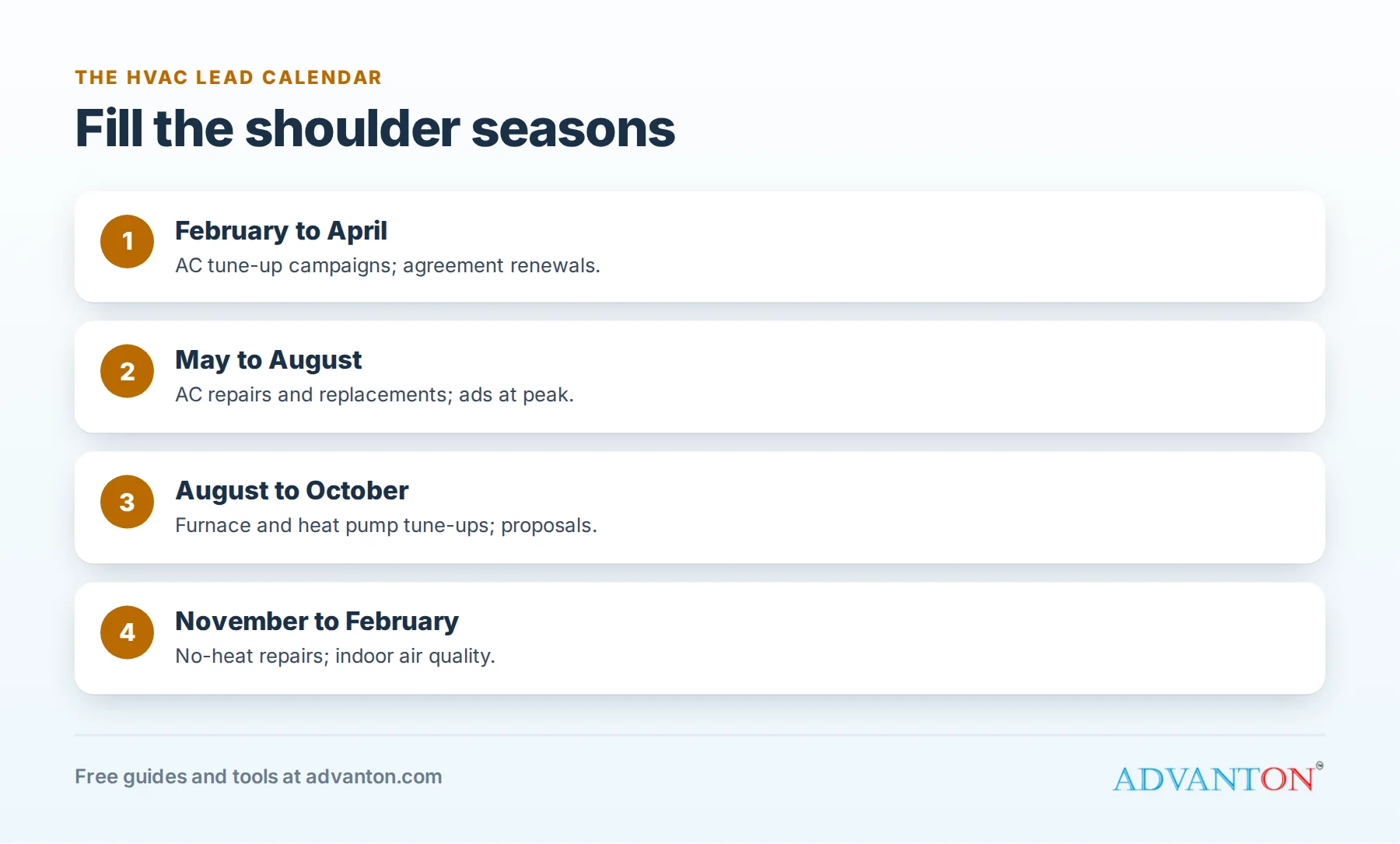
An HVAC marketing calendar
| Months | Focus |
|---|---|
| February to April | AC tune-up campaigns; maintenance agreement renewals |
| May to August | AC repair and replacement; Local Services Ads at peak |
| August to October | Furnace and heat pump tune-ups; replacement proposals before winter |
| November to February | No-heat repairs; indoor air quality and humidity |
Partner with builders, remodelers and energy auditors
New homes, additions and remodels all need heating and cooling, so builders and remodelers can send steady installation work. Energy auditors and weatherization contractors often find homes that need system upgrades, and electricians installing panel upgrades may meet homeowners planning heat pumps. Build relationships with these partners, respond quickly to their requests, and keep them updated on jobs they send you. A few reliable partners can supply a meaningful share of installations each year, especially in shoulder seasons when residential repair calls slow down.
Common mistakes to avoid
- Marketing only during peaks, when you can’t take more work.
- No maintenance agreement program.
- Single-option replacement quotes.
- Missed calls during heat waves and cold snaps.
- Promoting rebates that have changed without checking current terms.
Your 30-day plan
| Week | Actions |
|---|---|
| 1 | Update your Business Profile services and hours; request reviews from recent customers |
| 2 | Launch or refresh your maintenance agreement offer |
| 3 | Run a pre-season tune-up campaign to past customers and nearby neighborhoods |
| 4 | Build or improve replacement and heat pump pages; contact property managers |
Frequently asked questions
What’s the best source of HVAC leads?
Google local search, reviews and maintenance agreement members provide the most valuable long-term leads; Local Services Ads add volume during peaks.
How do HVAC companies stay busy in slow seasons?
Tune-up campaigns, maintenance agreements, indoor air quality services and commercial accounts fill shoulder seasons.
How do I sell more system replacements?
Thorough inspections, good-better-best options, clear long-term costs, financing options and prompt follow-up.
Do HVAC technicians need EPA certification?
Technicians who handle refrigerants need EPA Section 608 certification, and many states and cities also license HVAC contractors.
When should I raise my Local Services Ads budget?
Just before and during peak heat and cold, when you have technicians available to respond quickly.
Are maintenance agreements worth the effort?
Yes, for most HVAC companies. They fill slow seasons, build loyalty and lead to replacement work.
Should HVAC companies list prices?
Showing starting prices for tune-ups and diagnostic visits, and typical ranges for replacements, builds trust; final prices depend on the inspection.
How can a new HVAC company compete with established brands?
Respond faster, communicate better and specialize. New companies often win by answering every call, offering clear upfront pricing, building reviews quickly, and focusing on growing services such as heat pumps and ductless systems, where many established companies are less specialized and customers actively search for experts.
Keep learning
Sources
- U.S. Bureau of Labor Statistics, Heating, air conditioning and refrigeration mechanics and installers
- TradeColleges.org summary of BLS Employment Projections 2024-2034
Last reviewed October 29, 2026. Startup costs are estimates; check local prices, licensing and tax rules before you commit money.
This article is general information, not financial, legal or tax advice. Check the rules that apply to you or talk to a qualified professional before making decisions. See our disclaimer.
Leave a Reply