
Every roof eventually needs repair or replacement, and storms can create sudden waves of demand. That makes roofing one of the highest-ticket trades in home services, with single jobs often worth tens of thousands of dollars. It’s also demanding: dangerous work at height, weather-dependent schedules, tight margins on replacements and intense competition for leads. Below is the key industry data on roofing contractors, with costs, business models and a first-year projection.
The BLS Occupational Employment and Wage Statistics survey counted about 136,740 roofers employed in May 2024, with a median wage of $50,970; roofers’ helpers earned a median of $40,590. Roofing business owners earn their profit through sales, project management and running crews efficiently, not just installation.
The workforce
| Occupation | Jobs (2024) | Median pay (May 2024) | Projected growth, 2024 to 2034 |
|---|---|---|---|
| Roofers | n/a | $50,970 | n/a |
| Helpers, roofers | n/a | $40,590 | n/a |
Source: U.S. Bureau of Labor Statistics, Occupational Outlook Handbook.
Market data
| Measure | Value |
|---|---|
| Roofers employed (BLS OEWS, May 2024) | 136,740 |
Business models compared
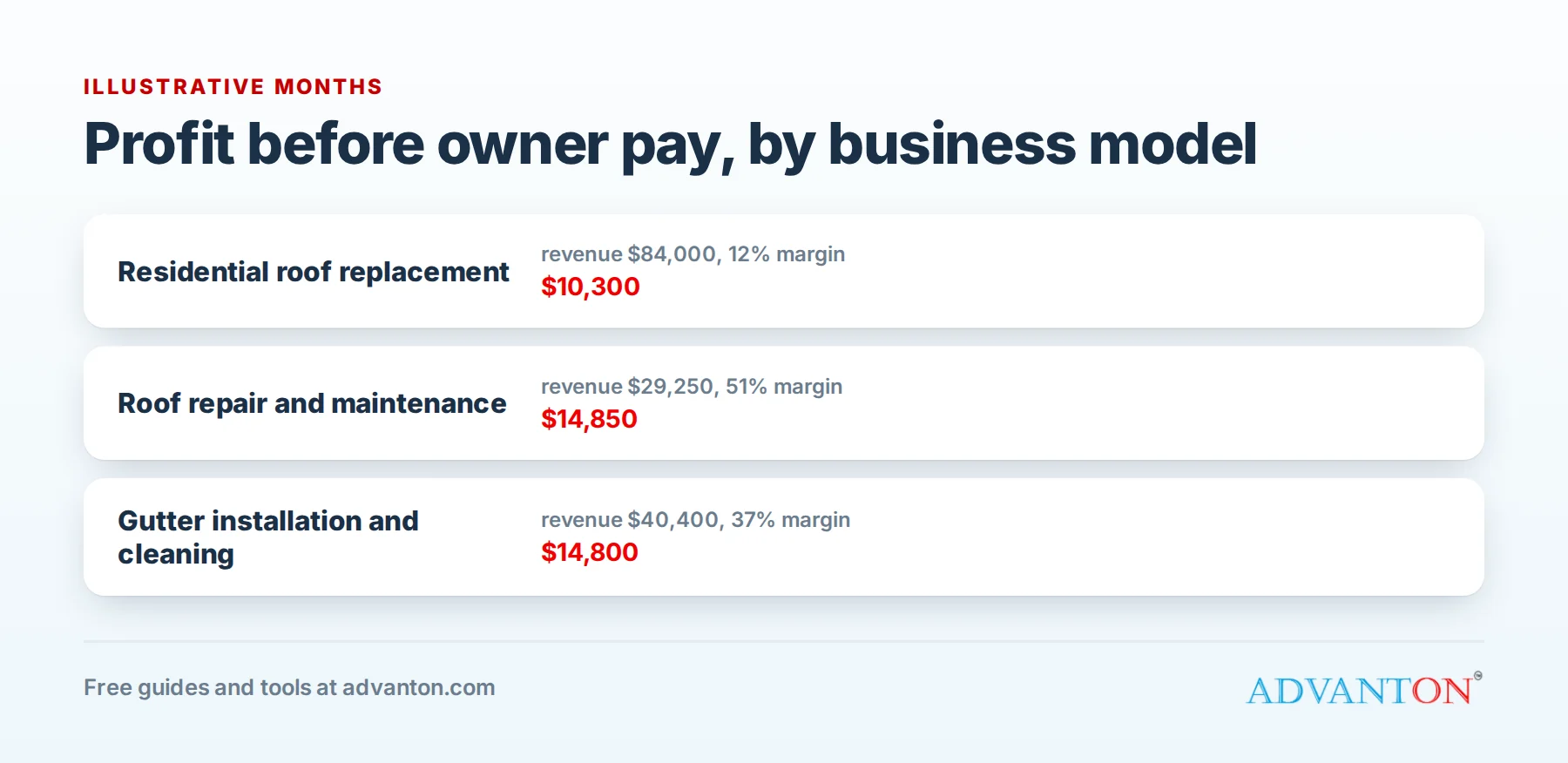
The figures below are illustrative months from our step-by-step guides, not industry averages. They show how revenue and costs typically fit together; your market, prices and costs will differ.
| Business model | Startup costs | Example monthly revenue | Costs | Profit before owner pay | Margin |
|---|---|---|---|---|---|
| Residential roof replacement | Moderate to high: trucks, insurance, sales, working capital for materials | $84,000 | $73,700 | $10,300 | 12% |
| Roof repair and maintenance | Low to moderate: truck, ladders, safety gear, insurance | $29,250 | $14,400 | $14,850 | 51% |
| Gutter installation and cleaning | Moderate: seamless gutter machine, truck, ladders | $40,400 | $25,600 | $14,800 | 37% |
Fixed and variable costs
For projections, the most useful split is between variable costs, which rise and fall with sales (materials, parts, hourly labor), and fixed costs, which you pay every month regardless (rent, salaried staff, insurance, loan payments).
| Business model | Variable costs (% of revenue) | Fixed costs per month | What it means |
|---|---|---|---|
| Residential roof replacement | 68.9% | $15,800 | Mostly variable: profitable early, but watch cash flow |
| Roof repair and maintenance | 15.0% | $10,000 | Low costs overall: time is the main constraint |
| Gutter installation and cleaning | 48.5% | $6,000 | Mostly variable: profitable early, but watch cash flow |
What the numbers say
Replacements are big but thin. In the example, materials and crews take almost 70% of revenue, leaving a margin around 12% before the owner’s pay. Accurate measurement, tight material orders and efficient crews decide whether a job makes money.
Repairs and gutters carry higher margins. Smaller jobs need less material and lead to replacement work later, which is why many roofers combine them.
Marketing is a major cost. Roofing leads are expensive, so referral systems, reviews, yard signs and strong local search visibility make a large difference to profit.
The three models in brief
Roof replacement. High revenue per job, heavy material and crew costs, and a long sales process. See how to get more roofing leads.
Roof repair and maintenance. Lower tickets but higher margins and faster sales; builds trust that leads to replacements.
Gutters. Seamless gutter installation and cleaning pair naturally with roofing, with recurring cleaning work each year.
Cost structure: residential roof replacement
Each cost as a share of the example month’s revenue ($84,000):
| Cost | Monthly amount | Share of revenue | Type |
|---|---|---|---|
| Materials | $33,600 | 40.0% | Variable |
| Installation crew (subcontracted) | $21,000 | 25.0% | Variable |
| Marketing | $6,000 | 7.1% | Fixed |
| Sales and office staff | $4,500 | 5.4% | Fixed |
| Insurance | $3,500 | 4.2% | Fixed |
| Dumpsters and disposal | $2,400 | 2.9% | Variable |
| Truck and fuel | $1,500 | 1.8% | Fixed |
| Permits | $900 | 1.1% | Variable |
| Software | $300 | 0.4% | Fixed |
| Profit before owner pay | $10,300 | 12% |
A first-year projection: residential roof replacement
New businesses rarely start at full speed. This projection assumes revenue ramps from 35% of the example month in month 1 to 100% by month 12, variable costs move with revenue, and fixed costs stay the same every month. It’s a planning illustration, not a forecast.
| Month | Revenue | Variable costs | Fixed costs | Profit | Cumulative |
|---|---|---|---|---|---|
| 1 | $29,400 | $20,265 | $15,800 | -$6,665 | -$6,665 |
| 2 | $37,800 | $26,055 | $15,800 | -$4,055 | -$10,720 |
| 3 | $46,200 | $31,845 | $15,800 | -$1,445 | -$12,165 |
| 4 | $52,080 | $35,898 | $15,800 | $382 | -$11,783 |
| 5 | $58,800 | $40,530 | $15,800 | $2,470 | -$9,313 |
| 6 | $63,840 | $44,004 | $15,800 | $4,036 | -$5,277 |
| 7 | $68,880 | $47,478 | $15,800 | $5,602 | $325 |
| 8 | $73,080 | $50,373 | $15,800 | $6,907 | $7,232 |
| 9 | $76,440 | $52,689 | $15,800 | $7,951 | $15,183 |
| 10 | $79,800 | $55,005 | $15,800 | $8,995 | $24,178 |
| 11 | $82,320 | $56,742 | $15,800 | $9,778 | $33,956 |
| 12 | $84,000 | $57,900 | $15,800 | $10,300 | $44,256 |
Year one: revenue $752,640, profit before owner pay $44,256. The first profitable month is month 4. Cumulative results bottom out at -$12,165, which is the minimum cash cushion this plan would need, before any startup costs.
A replacement company carries sales staff, insurance and marketing costs every month, and its thin margin means slow early months lose money: in this illustration, the first profitable month is month 4 and the cumulative low is about $12,200. Materials are often paid before final payment, so deposits and supplier credit are essential.
How roofers price
- Replacements are usually priced per square (100 square feet of roof), adjusted for pitch, layers to remove, materials and complexity.
- Repairs often use minimum charges plus time and materials, or flat prices for common fixes.
- Gutters are priced per linear foot, plus downspouts and guards.
- Insurance work follows the claim’s approved scope; contractors must be careful to follow state rules and never promise to cover deductibles where prohibited.
Seasonality and demand patterns
Roofing is busiest from spring through fall in most climates, with winter slowdowns in cold regions. Severe weather (hail, wind and hurricanes) creates sudden spikes in demand and attracts out-of-area "storm chasers." Many states regulate post-storm contracting; local roofers who follow the rules and build long-term reputations win over time.
A startup checklist for roofing contractors
- Check licensing for roofing in your state and cities.
- Get insurance: general liability and workers’ comp (roofing rates are high), commercial auto.
- Plan safety: fall protection, ladder safety and training under OSHA rules.
- Choose measurement tools and estimating software.
- Line up suppliers and installation crews.
- Set deposit and payment terms.
- Build your local presence and review system; see local SEO for contractors.
Questions to answer before starting in roofing contractors
- Will you install with your own crews or subcontract?
- How will you generate leads without depending only on storms?
- What’s your real cost per square, including tear-off and disposal?
- How will you handle insurance claims ethically and legally?
- How much working capital do you need for materials and payroll?
Selling roof replacements
A roof is one of the largest purchases homeowners make, and they usually compare several quotes. Roofers who win more jobs inspect thoroughly and show customers photos of what they found, explain options clearly (often good-better-best shingle and warranty choices), put everything in a written proposal, and follow up promptly. Financing options help homeowners who can’t pay all at once. Speed matters too: the first roofer to deliver a clear, professional quote often wins.
Insurance claims, done right
Storm damage claims are a large part of roofing, and they’re closely regulated. Inspect honestly, document damage with photos, explain the claims process to homeowners, and let the homeowner and insurer agree on the scope. Never offer to waive or cover a deductible where your state prohibits it, and be cautious about acting as a public adjuster, which requires a separate license in many states. Ethical claims work protects your license and reputation, and builds the referrals that keep a roofing company busy after the storm season ends.
Where the opportunities are
- Repair and maintenance plans for homeowners and property managers.
- Commercial roofing for small buildings, with higher requirements and larger contracts.
- Gutters, skylights and attic ventilation as add-on services.
- Solar-ready roofing coordinated with solar installers.
- Local reputation: homeowners increasingly check reviews before trusting a roofer.
Key terms
| Term | Meaning |
|---|---|
| Square | 100 square feet of roof area; the standard pricing unit |
| Tear-off | Removing old roofing layers before installation |
| Pitch | Roof steepness, which affects labor and safety requirements |
| Supplement | An additional request to an insurer for items missing from the original claim scope |
| Storm chasing | Out-of-area contractors arriving after storms; often regulated by states |
Safety comes first
Falls are a leading cause of serious construction injuries. OSHA’s construction rules require fall protection at heights, and roofing companies need written safety plans, training, harnesses and anchors, guardrails or safety monitoring as required, and ladder safety. Good safety practices protect your crews and reduce workers’ compensation costs, which are among roofing’s largest expenses. Check the full cost of each crew member with our hiring cost calculator.
Marketing a roofing company
Roofing leads are expensive, so the best companies build their own: a strong Google Business Profile with photos and reviews, service area pages for each town, yard signs on every job (with permission), door hangers in the neighborhood around each project, and follow-up with past customers for referrals and maintenance. Paid leads and ads can add volume, but track the cost per signed job, not just per lead. See local SEO for contractors and our free yard sign maker.
Warranties
Homeowners compare warranties when choosing a roofer. Manufacturers warrant materials, often with longer coverage when installed by certified contractors, while you warrant your workmanship. Put your workmanship warranty in writing, explain what’s covered and for how long, and register manufacturer warranties for customers. Clear warranties build trust and reduce disputes.
Materials and climate
Asphalt shingles dominate residential roofing in much of the country, while metal, tile, slate and flat-roof systems serve specific climates, styles and budgets. Learn the materials common in your area, the building code requirements for wind and fire where you work, and the manufacturer installation rules that protect warranties. Specializing in a premium material, such as metal or tile, can set you apart and raise average job values, but requires training and specialized tools. Ask your suppliers which manufacturer certification programs are available locally; certification often unlocks longer warranties that help you win jobs against uncertified competitors, and some manufacturers also share leads with their certified installers.
How to use these numbers for your own plan
- Start with the closest model above and its cost structure.
- Replace every price and cost with local quotes: insurance, wages, vehicles, materials and your expected prices.
- Estimate your ramp: how many jobs you can realistically win each month in year one.
- Separate fixed and variable costs, then calculate your break-even point with our free break-even calculator.
- Map cash month by month with our cash flow forecast, including equipment and loan payments.
- Build the plan in our free Business Planner.
These figures will also feed a planned Advanton projection tool, so you’ll be able to start from an industry template and adjust it to your situation.
Licensing and rules
Roofing licensing varies widely by state and city: some states license roofing contractors specifically, others under general contractor licenses; permits for most replacements; OSHA fall protection rules on construction sites; some states regulate post-storm contracting and insurance-claim practices. Requirements change; confirm with your state and local agencies before you start.
Frequently asked questions about roofing contractors
What do roofers earn?
The BLS reported a median wage of $50,970 for roofers in May 2024; roofers’ helpers earned a median of $40,590.
Why are roof replacement margins so thin?
Materials and installation labor take most of each dollar, so accurate measurement and efficient crews decide profitability.
Do I need a license to start a roofing company?
It depends on your state and city; some license roofing specifically, others under general contractor licenses. Permits are usually required for replacements.
How do roofers get steady work beyond storms?
Repairs, maintenance plans, gutters, referrals and strong local search visibility keep work flowing between storm seasons.
How can I use these numbers?
Start with the closest model, then replace every figure with your local material prices, crew costs and expected volume.
Should I subcontract installation crews?
Many replacement companies do, paying crews per square. It keeps fixed costs lower but makes quality control and scheduling more important.
How long does it take to build a profitable roofing company?
It varies by market and season. Many owners start with repairs and smaller jobs to build cash, reviews and referrals before scaling up replacement crews and sales staff.
Keep learning
Sources
Last reviewed October 29, 2026. Startup costs are estimates; check local prices, licensing and tax rules before you commit money.
In India
In India: Roof and terrace waterproofing; sloped shingle roofs are rare.
MoSPI’s survey of unincorporated businesses doesn’t cover construction, so there are no comparable small-business figures for this trade. Demand follows housing, commercial building and infrastructure activity in your area.
Licences and registrations to expect
- Contractor registration with the PWD, municipality or other departments if you bid for government work.
- Registration and cess under the building and other construction workers rules for larger projects.
- A contractor licence if you engage contract workers above the threshold set by labour rules.
- Registration under your state’s Shops and Establishments Act if you have premises or employees.
- A trade licence from your municipal corporation or council for many shop and service businesses.
- GST registration once turnover crosses ₹40 lakh for goods or ₹20 lakh for services (lower in some special category states), or earlier if you sell goods to other states or through e-commerce marketplaces.
- Professional tax registration in states that levy it.
- Free Udyam (MSME) registration, which helps with loans, government schemes and delayed-payment protection.
Rules differ by state and city. Check with your municipal corporation, state departments and a chartered accountant before you start.
Run a business like this in India? List it free in the India Business Directory, with your hours, deals and GST registration.
Free tools for India: Make a GST invoice · Compare business credit cards
Build a market report for Roofing Contractors in India Pick your state and see market size, earnings, competition and licences, from official data. Free, with a PDF download.
Sources: MoSPI, Annual Survey of Unincorporated Sector Enterprises (ASUSE) 2025, factsheet (survey period January to December 2025, released 24 March 2026). Licensing summary by Advanton, checked November 2026.