
Heating, cooling, plumbing and electrical systems are the essential services of every home and business. When an air conditioner fails in July or a pipe bursts in January, customers need help now, and they’ll pay for skilled, reliable service. That urgency, plus a steady stream of replacements and upgrades, makes these some of the most durable trade businesses to own. Below is the key industry data on HVAC, plumbing and electrical contractors, with costs, business models and a first-year projection.
The workforce numbers show the opportunity. The Bureau of Labor Statistics counted about 425,200 HVAC technicians in 2024, with a median wage of $59,810 and employment projected to grow 8% from 2024 to 2034. Plumbers earned a median of $62,970 and electricians $62,350 in May 2024, with electrician employment projected to grow 9%. Thousands of openings each year come from retirements and growth, which means skilled people are in demand, and contractors who can hire and keep them can grow.
The workforce
| Occupation | Jobs (2024) | Median pay (May 2024) | Projected growth, 2024 to 2034 |
|---|---|---|---|
| Heating, air conditioning and refrigeration mechanics | about 425,200 | $59,810 | +8% |
| Plumbers, pipefitters and steamfitters | about 504,500 | $62,970 | +4% |
| Electricians | n/a | $62,350 | +9% |
Source: U.S. Bureau of Labor Statistics, Occupational Outlook Handbook.
Market data
| Measure | Value |
|---|---|
| HVAC technician openings per year, 2024-2034 | about 40,100 |
| Plumber openings per year, 2024-2034 | about 44,000 |
| HVAC jobs added, 2024-2034 | 34,500 |
Business models compared
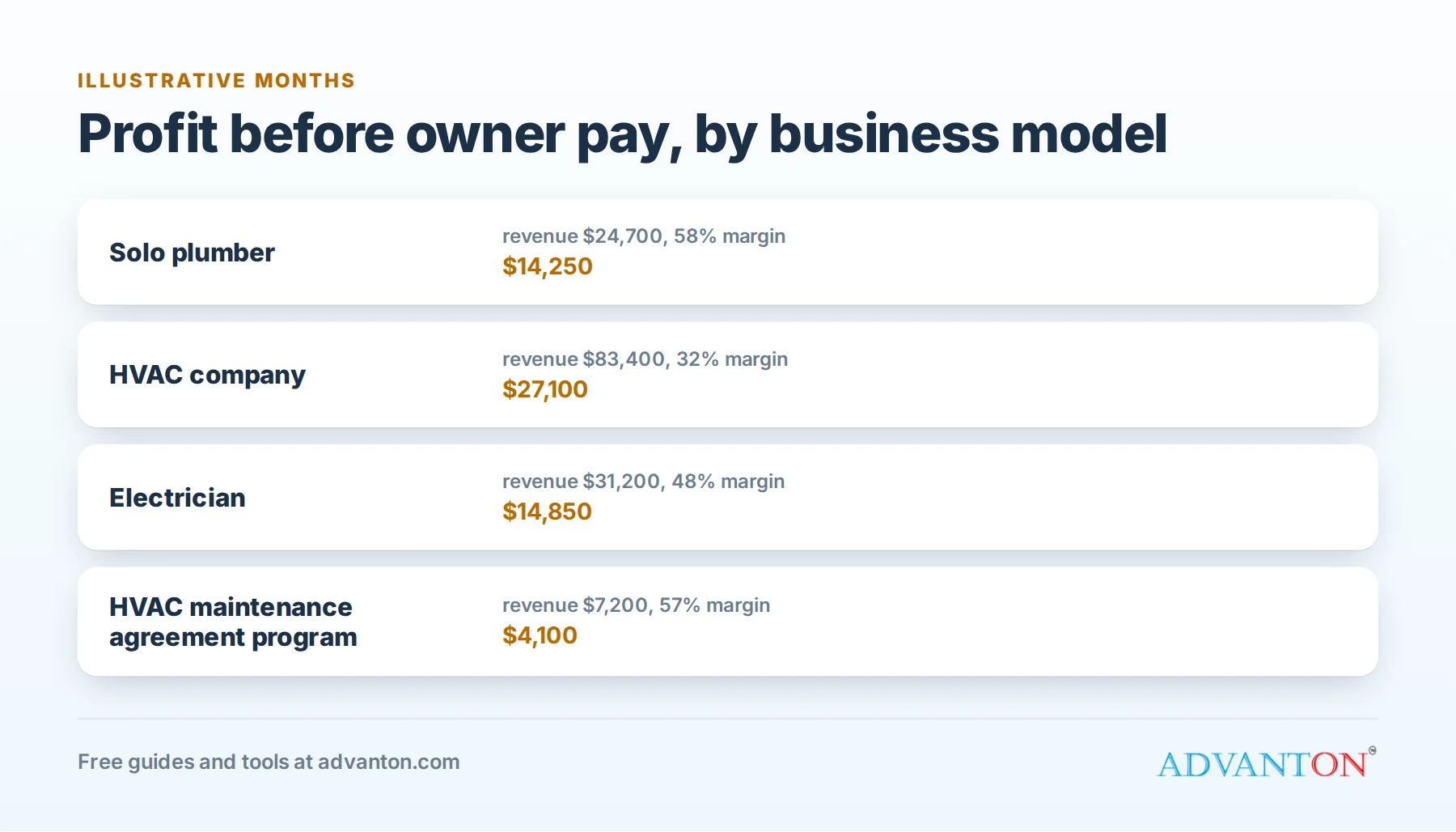
The figures below are illustrative months from our step-by-step guides, not industry averages. They show how revenue and costs typically fit together; your market, prices and costs will differ.
| Business model | Startup costs | Example monthly revenue | Costs | Profit before owner pay | Margin |
|---|---|---|---|---|---|
| Solo plumber (service and repair) | Moderate: van, tools, license, insurance | $24,700 | $10,450 | $14,250 | 58% |
| HVAC company (owner plus 2 technicians) | Moderate to high: vans, equipment, licenses, working capital | $83,400 | $56,300 | $27,100 | 32% |
| Electrician (owner plus apprentice) | Moderate: van, tools, license, insurance | $31,200 | $16,350 | $14,850 | 48% |
| HVAC maintenance agreement program (400 members) | Low once the business exists: software and scheduling | $7,200 | $3,100 | $4,100 | 57% |
Fixed and variable costs
For projections, the most useful split is between variable costs, which rise and fall with sales (materials, parts, hourly labor), and fixed costs, which you pay every month regardless (rent, salaried staff, insurance, loan payments).
| Business model | Variable costs (% of revenue) | Fixed costs per month | What it means |
|---|---|---|---|
| Solo plumber (service and repair) | 21.7% | $5,100 | Low costs overall: time is the main constraint |
| HVAC company (owner plus 2 technicians) | 32.4% | $29,300 | Mostly fixed: slow start-up months are expensive |
| Electrician (owner plus apprentice) | 23.2% | $9,100 | Low costs overall: time is the main constraint |
| HVAC maintenance agreement program (400 members) | 41.7% | $100 | Mostly variable: profitable early, but watch cash flow |
What the numbers say
Demand is steady, and often urgent. Breakdowns don’t wait, so emergency service commands premium prices. Replacement and upgrade work, from new HVAC systems to panel upgrades and repiping, adds larger tickets.
Labor is the constraint. With many openings each year and licensing requirements that take years to meet, finding and keeping licensed technicians is the main brake on growth. Owners who train apprentices build a lasting advantage.
Recurring revenue changes the business. Maintenance agreements smooth seasonal swings, keep customers loyal and create a pipeline of repair and replacement work. The example program above is small but almost entirely profit after labor.
The four models in brief
Solo plumber. Low overhead and strong margins; revenue is limited by the owner’s hours and emergency calls can make long days. See how to get more plumbing leads.
HVAC company. Service calls fill the schedule, and system replacements provide large tickets. Fixed costs for technicians, vans and office staff mean early months need cash. See how to get more HVAC leads.
Electrician. Service work, panel upgrades, lighting, EV chargers and remodel wiring; permits and inspections are part of most jobs. See how to get more electrical leads.
Maintenance agreements. Customers pay monthly or yearly for tune-ups and priority service. It’s an add-on to an existing business rather than a business on its own. See how to get more contractor leads for ways to sell them.
Cost structure: hvac company (owner plus 2 technicians)
Each cost as a share of the example month’s revenue ($83,400):
| Cost | Monthly amount | Share of revenue | Type |
|---|---|---|---|
| Equipment and parts | $27,000 | 32.4% | Variable |
| Technicians | $13,000 | 15.6% | Fixed |
| Marketing | $5,000 | 6.0% | Fixed |
| Dispatcher and office | $3,800 | 4.6% | Fixed |
| Vans and fuel | $3,000 | 3.6% | Fixed |
| Payroll taxes and benefits | $2,600 | 3.1% | Fixed |
| Insurance | $1,500 | 1.8% | Fixed |
| Software | $400 | 0.5% | Fixed |
| Profit before owner pay | $27,100 | 32% |
A first-year projection: hvac company (owner plus 2 technicians)
New businesses rarely start at full speed. This projection assumes revenue ramps from 35% of the example month in month 1 to 100% by month 12, variable costs move with revenue, and fixed costs stay the same every month. It’s a planning illustration, not a forecast.
| Month | Revenue | Variable costs | Fixed costs | Profit | Cumulative |
|---|---|---|---|---|---|
| 1 | $29,190 | $9,450 | $29,300 | -$9,560 | -$9,560 |
| 2 | $37,530 | $12,150 | $29,300 | -$3,920 | -$13,480 |
| 3 | $45,870 | $14,850 | $29,300 | $1,720 | -$11,760 |
| 4 | $51,708 | $16,740 | $29,300 | $5,668 | -$6,092 |
| 5 | $58,380 | $18,900 | $29,300 | $10,180 | $4,088 |
| 6 | $63,384 | $20,520 | $29,300 | $13,564 | $17,652 |
| 7 | $68,388 | $22,140 | $29,300 | $16,948 | $34,600 |
| 8 | $72,558 | $23,490 | $29,300 | $19,768 | $54,368 |
| 9 | $75,894 | $24,570 | $29,300 | $22,024 | $76,392 |
| 10 | $79,230 | $25,650 | $29,300 | $24,280 | $100,672 |
| 11 | $81,732 | $26,460 | $29,300 | $25,972 | $126,644 |
| 12 | $83,400 | $27,000 | $29,300 | $27,100 | $153,744 |
Year one: revenue $747,264, profit before owner pay $153,744. The first profitable month is month 3. Cumulative results bottom out at -$13,480, which is the minimum cash cushion this plan would need, before any startup costs.
An HVAC company pays technicians, vans and office staff from the first day, which is why this projection shows two months of losses before month 3 turns profitable, with a cumulative low of about $13,500. Strong marketing before opening, and a few commercial maintenance contracts, shorten that gap. Equipment purchases for replacements also require cash before customers pay, so many owners arrange supplier credit.
How these trades price
- Service calls: a trip or diagnostic fee, then flat-rate pricing from a price book for common repairs. Flat rates are easier for customers to approve than hourly estimates.
- Replacements and installations: good-better-best options, such as three system choices with different efficiency and warranty levels.
- Emergency and after-hours work: premium rates, clearly stated before work begins.
- Maintenance agreements: a monthly or yearly fee including tune-ups, priority scheduling and repair discounts.
Seasonality and demand patterns
HVAC demand peaks in the hottest and coldest months, with shoulder seasons ideal for maintenance and replacements. Plumbing emergencies spike with freezing weather and holidays, when heavy use strains drains. Electrical work follows remodeling and new construction, with growing demand for EV chargers, generators and panel upgrades. Maintenance agreements and commercial contracts smooth these cycles.
A startup checklist for HVAC, plumbing and electrical contractors
- Confirm licensing for your trade and every city you’ll serve; get EPA Section 608 certification for refrigerant work.
- Register your business and get insurance: general liability, commercial auto, tools and workers’ comp once you hire.
- Set up a price book for common jobs and good-better-best options for replacements.
- Choose field service software for scheduling, dispatch, invoicing and maintenance agreements.
- Build your local presence: Google Business Profile, website and reviews. See local SEO for contractors.
- Open supplier accounts for parts and equipment.
- Model cash flow, including payroll before customers pay.
Questions to answer before starting in HVAC, plumbing and electrical contractors
- Can you meet licensing requirements in every area you plan to serve?
- How will customers find you when they have an emergency?
- What will your average ticket be for service and for replacements?
- Who will answer the phone when you’re on a job?
- When will you hire your first technician, and can your prices support it?
An example price book
| Job | Example flat price |
|---|---|
| Diagnostic service call | $129 |
| Replace capacitor (HVAC) | $285 |
| Clear main drain line | $325 |
| Replace water heater (40-gallon, standard) | $1,950 |
| Install a standard outlet or switch | $175 |
| Panel upgrade to 200 amps | From $2,800 |
These prices are illustrative; they vary widely by region, materials and code requirements. A written price book makes quotes consistent across technicians and easier for customers to approve.
Where the opportunities are
- Electrification: heat pumps, EV chargers and panel upgrades.
- Indoor air quality: filtration, humidity control and ventilation.
- Water heaters and repiping in aging homes.
- Commercial service contracts with restaurants, offices and property managers.
- Maintenance agreement programs that build steady, loyal customer bases.
Key terms
| Term | Meaning |
|---|---|
| Flat-rate pricing | A set price per task from a price book, rather than time and materials |
| Average ticket | Average revenue per job or service call |
| Maintenance agreement | A paid plan for regular tune-ups and priority service |
| EPA Section 608 | Federal certification required to handle refrigerants in stationary systems |
| Journeyman and master | Common license levels for plumbers and electricians |
Hiring and keeping technicians
Technicians are the business. Many owners grow by hiring apprentices and helpers and training them toward licenses, which builds loyalty and capacity at the same time. Competitive pay, a clear path to higher licenses, good trucks and tools, and predictable on-call schedules keep good people. Include payroll taxes, benefits and vehicle costs when you calculate the true cost of each hire with our hiring cost calculator, and make sure your price book supports it.
Commercial service work
Restaurants, offices, retail stores, schools and apartment buildings all need HVAC, plumbing and electrical service, often under recurring contracts. Commercial work brings larger, steadier accounts and fills weekday schedules, but it usually requires higher insurance limits, safety documentation, invoicing on terms and sometimes after-hours response. Start with a few local businesses you already serve, offer preventive maintenance with priority response, and build relationships with property managers who oversee several buildings. A handful of commercial accounts can steady a residential business through slow seasons, and they often lead to referrals from managers who oversee other properties.
How to use these numbers for your own plan
- Start with the closest model above and its cost structure.
- Replace every price and cost with local quotes: insurance, wages, vehicles, materials and your expected prices.
- Estimate your ramp: how many jobs you can realistically win each month in year one.
- Separate fixed and variable costs, then calculate your break-even point with our free break-even calculator.
- Map cash month by month with our cash flow forecast, including equipment and loan payments.
- Build the plan in our free Business Planner.
These figures will also feed a planned Advanton projection tool, so you’ll be able to start from an industry template and adjust it to your situation.
Licensing and rules
Plumbers and electricians are licensed in most states (journeyman and master levels); HVAC technicians who handle refrigerants need EPA Section 608 certification, and many states and cities license HVAC contractors; permits and inspections for most installations. Requirements change; confirm with your state and local agencies before you start.
Frequently asked questions about HVAC, plumbing and electrical contractors
What do HVAC technicians, plumbers and electricians earn?
In May 2024, the median wage was $59,810 for HVAC technicians, $62,970 for plumbers and $62,350 for electricians, according to the BLS.
Which of these trades is growing fastest?
Electricians (projected +9% from 2024 to 2034) and HVAC technicians (+8%) are growing faster than average; plumbers are projected to grow 4%.
Do I need a license to start?
Usually yes for plumbing and electrical work, and refrigerant handling requires EPA Section 608 certification. Check your state and city rules.
What’s the best way to get steady revenue?
Maintenance agreements and commercial service contracts smooth seasonal swings and build a loyal customer base.
How can I use these numbers?
Start with the closest model, then replace every figure with your own local prices, wages and expected job volume.
Should I start solo or with a team?
Many contractors start solo or with one helper to keep fixed costs low, then hire technicians once demand regularly exceeds their own hours.
Where do most new customers come from?
For most service contractors, local search, reviews and referrals bring the most valuable calls. See our guide to local SEO for contractors.
Keep learning
- Solo plumber
- HVAC company
- Electrician
- HVAC maintenance agreement program
- Local SEO for contractors
- How to get more contractor leads
Sources
- U.S. Bureau of Labor Statistics, Heating, air conditioning and refrigeration mechanics and installers
- BLS Occupational Employment and Wage Statistics, May 2024 (construction and extraction occupations)
- TradeColleges.org summary of BLS Employment Projections 2024-2034
Last reviewed October 29, 2026. Startup costs are estimates; check local prices, licensing and tax rules before you commit money.
In India
MoSPI’s survey of unincorporated businesses doesn’t cover construction, so there are no comparable small-business figures for this trade. Demand follows housing, commercial building and infrastructure activity in your area.
Licences and registrations to expect
- An electrical contractor licence from your state’s electrical inspectorate, with licensed supervisors and wiremen.
- For rooftop solar under PM Surya Ghar, registration as a vendor with the DISCOM or on the national portal.
- Registration under your state’s Shops and Establishments Act if you have premises or employees.
- A trade licence from your municipal corporation or council for many shop and service businesses.
- GST registration once turnover crosses ₹40 lakh for goods or ₹20 lakh for services (lower in some special category states), or earlier if you sell goods to other states or through e-commerce marketplaces.
- Professional tax registration in states that levy it.
- Free Udyam (MSME) registration, which helps with loans, government schemes and delayed-payment protection.
Rules differ by state and city. Check with your municipal corporation, state departments and a chartered accountant before you start.
Run a business like this in India? List it free in the India Business Directory, with your hours, deals and GST registration.
Free tools for India: Make a GST invoice · Compare business credit cards
Build a market report for HVAC, Plumbing and Electrical Contractors in India Pick your state and see market size, earnings, competition and licences, from official data. Free, with a PDF download.
Sources: MoSPI, Annual Survey of Unincorporated Sector Enterprises (ASUSE) 2025, factsheet (survey period January to December 2025, released 24 March 2026). Licensing summary by Advanton, checked November 2026.