
Homes and businesses constantly need new floors, walls, tile and landscapes, and skilled tradespeople who run their own businesses can earn well above typical wages. The Bureau of Labor Statistics counted about 103,100 drywall and ceiling tile installers (median pay $58,140 in May 2024) and 112,300 flooring installers and tile and stone setters (median $52,000) in 2024. Below is the key industry data on specialty trades industry, with costs, business models and a first-year projection.
Trade businesses are relatively inexpensive to start compared with storefronts or clinics, and most of their costs rise and fall with the work. The challenges are accurate estimating, steady work through slow seasons, licensing and safety rules, and growing beyond the owner’s own hands. This page gathers the key numbers, compares four trade businesses and shows how a first year might look.
The workforce
| Occupation | Jobs (2024) | Median pay (May 2024) | Projected growth, 2024 to 2034 |
|---|---|---|---|
| Drywall and ceiling tile installers | about 103,100 | $58,140 | +4% |
| Flooring installers and tile and stone setters | about 112,300 | $52,000 | n/a |
| Woodworkers (incl. 86,000 cabinetmakers) | about 214,600 | $43,720 | -2% |
Source: U.S. Bureau of Labor Statistics, Occupational Outlook Handbook.
Business models compared
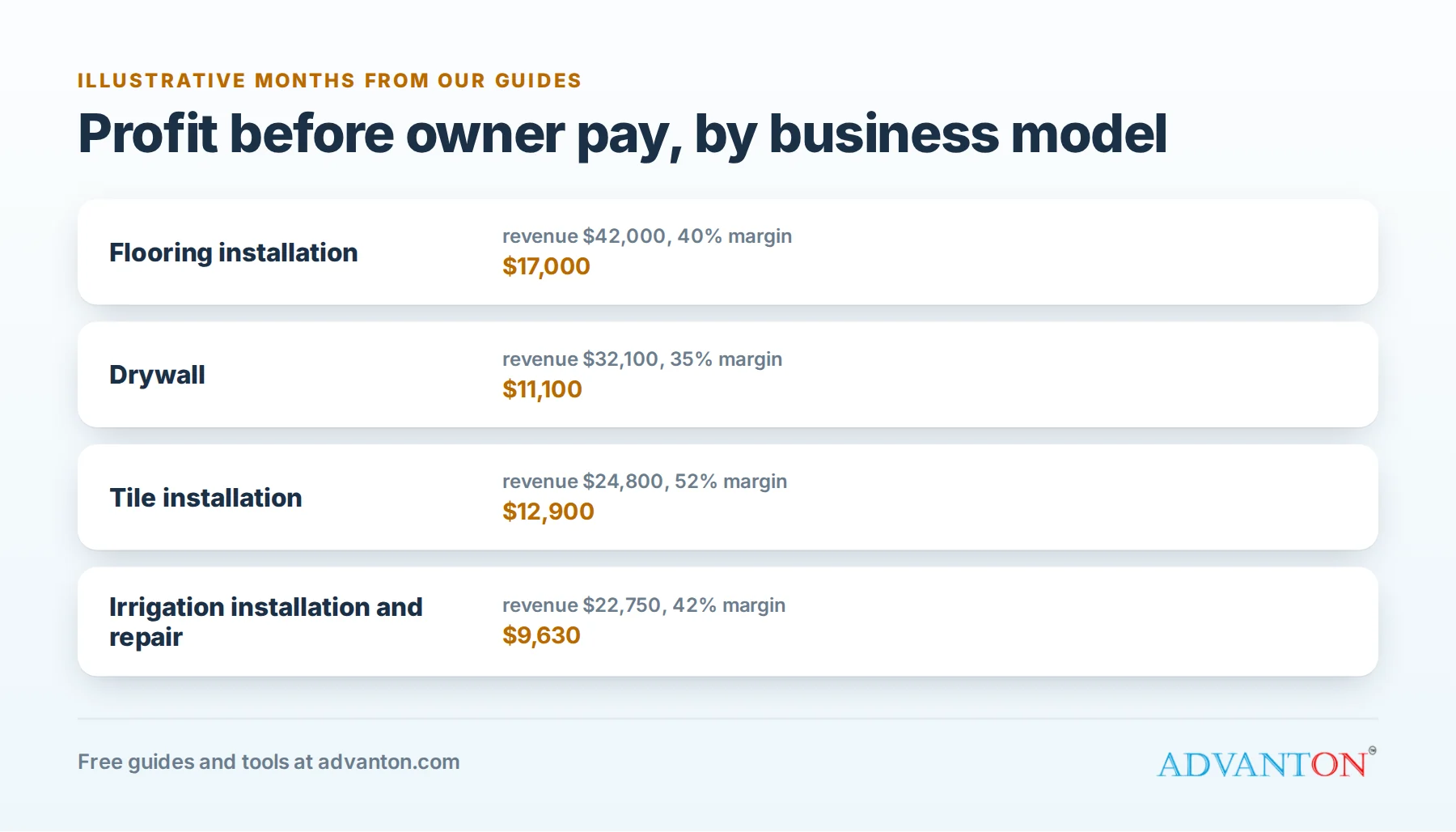
The figures below are illustrative months from our step-by-step guides, not industry averages. They show how revenue and costs typically fit together; your market, prices and costs will differ.
| Business model | Startup costs | Example monthly revenue | Costs | Profit before owner pay | Margin |
|---|---|---|---|---|---|
| Flooring installation (busy month) | Moderate: tools, vehicle, insurance | $42,000 | $25,000 | $17,000 | 40% |
| Drywall | Moderate: tools, lifts, vehicle, insurance | $32,100 | $21,000 | $11,100 | 35% |
| Tile installation (busy month) | Moderate: wet saw, tools, vehicle, insurance | $24,800 | $11,900 | $12,900 | 52% |
| Irrigation installation and repair (peak month) | Moderate: truck, parts, licensing | $22,750 | $13,120 | $9,630 | 42% |
Fixed and variable costs
For projections, the most useful split is between variable costs, which rise and fall with sales (materials, parts, hourly labor), and fixed costs, which you pay every month regardless (rent, salaried staff, insurance, loan payments).
| Business model | Variable costs (% of revenue) | Fixed costs per month | What it means |
|---|---|---|---|
| Flooring installation (busy month) | 51.7% | $3,300 | Mostly variable: profitable early, but watch cash flow |
| Drywall | 54.5% | $3,500 | Mostly variable: profitable early, but watch cash flow |
| Tile installation (busy month) | 37.5% | $2,600 | Mostly variable: profitable early, but watch cash flow |
| Irrigation installation and repair (peak month) | 48.9% | $2,000 | Mostly variable: profitable early, but watch cash flow |
What the numbers say
Costs are mostly variable. Materials and helper wages make up most costs, so trade businesses can be profitable quickly, as long as estimates are accurate. A mispriced job, not slow months, is the bigger danger.
Owners earn more than wages, by taking on business risk. BLS medians reflect employees. Owners also capture the profit on materials and helpers’ work, but take on estimating, marketing, insurance and cash flow.
Woodworking is shrinking, specialties are not. Woodworker employment is projected to decline 2% from 2024 to 2034, while custom, high-skill work such as cabinetry and finish carpentry continues to command good prices.
The four models in brief
Flooring installation. Strong revenue per job; materials are the largest cost, so deposits protect cash flow. See how to start a flooring installation business.
Drywall. Steady demand from builders, remodelers and repairs; crew labor is the largest cost and builder payment terms affect cash flow. See how to start a drywall business.
Tile installation. High-skill, high-value work such as custom showers; waterproofing quality protects your reputation. See how to start a tile installation business.
Irrigation installation and repair. Seasonal installs plus recurring service and maintenance plans; licensing is required in some states. See how to start an irrigation business.
Cost structure: flooring installation (busy month)
Each cost as a share of the example month’s revenue ($42,000):
| Cost | Monthly amount | Share of revenue | Type |
|---|---|---|---|
| Flooring materials | $16,000 | 38.1% | Variable |
| Helper | $4,800 | 11.4% | Variable |
| Truck and fuel | $1,200 | 2.9% | Fixed |
| Marketing | $1,200 | 2.9% | Fixed |
| Insurance | $900 | 2.1% | Fixed |
| Disposal | $500 | 1.2% | Variable |
| Tools and blades | $400 | 1.0% | Variable |
| Profit before owner pay | $17,000 | 40% |
A first-year projection: flooring installation (busy month)
New businesses rarely start at full speed. This projection assumes revenue ramps from 35% of the example month in month 1 to 100% by month 12, variable costs move with revenue, and fixed costs stay the same every month. It’s a planning illustration, not a forecast.
| Month | Revenue | Variable costs | Fixed costs | Profit | Cumulative |
|---|---|---|---|---|---|
| 1 | $14,700 | $7,595 | $3,300 | $3,805 | $3,805 |
| 2 | $18,900 | $9,765 | $3,300 | $5,835 | $9,640 |
| 3 | $23,100 | $11,935 | $3,300 | $7,865 | $17,505 |
| 4 | $26,040 | $13,454 | $3,300 | $9,286 | $26,791 |
| 5 | $29,400 | $15,190 | $3,300 | $10,910 | $37,701 |
| 6 | $31,920 | $16,492 | $3,300 | $12,128 | $49,829 |
| 7 | $34,440 | $17,794 | $3,300 | $13,346 | $63,175 |
| 8 | $36,540 | $18,879 | $3,300 | $14,361 | $77,536 |
| 9 | $38,220 | $19,747 | $3,300 | $15,173 | $92,709 |
| 10 | $39,900 | $20,615 | $3,300 | $15,985 | $108,694 |
| 11 | $41,160 | $21,266 | $3,300 | $16,594 | $125,288 |
| 12 | $42,000 | $21,700 | $3,300 | $17,000 | $142,288 |
Year one: revenue $376,320, profit before owner pay $142,288. The first profitable month is month 1. Cumulative results stay positive, so the main cash need is the startup investment itself.
Because most of a flooring business’s costs move with the work, even month 1 is slightly positive in this illustration. But the example month is a busy one, so a real year with slower months would be lower. The cash need comes from materials paid before customers pay, which is why deposits matter.
How trade businesses price
- Flooring labor is usually priced per square foot by material type, with separate prices for removal, subfloor work, stairs and trim; materials are often supplied with a markup.
- Drywall is priced per sheet or square foot on larger jobs, by project for remodels, and with minimum charges for repairs that need several visits.
- Tile combines per-square-foot pricing for floors and walls with project pricing for showers and backsplashes, plus extras for waterproofing, niches and large-format tile.
- Irrigation prices installs by zones and property size, with flat prices for seasonal start-ups and winterizations and annual maintenance plans.
Seasonality and demand patterns
Interior trades such as flooring, drywall and tile stay busy year-round, with remodeling peaks in spring and before the holidays. Irrigation is strongly seasonal in cold climates, with spring start-ups, summer repairs and fall winterizations. Builder work follows the housing market, while repairs and remodels for homeowners continue through slowdowns.
A startup checklist for specialty trades industry
- Check contractor licensing for your trade, state and project sizes.
- Get certified where required: EPA lead-safe certification for older homes, irrigation licenses, backflow testing.
- Arrange insurance: general liability, commercial auto, tools and equipment, workers’ comp once you hire.
- Build estimating templates that include waste, prep, removal and disposal.
- Set deposit and payment terms before ordering materials.
- Plan safety: silica dust controls, lifting, ladders and scaffolding.
- Line up work: retailers, builders, remodelers and direct homeowner marketing.
Questions to answer before starting in specialty trades industry
- What’s your real cost per job, including your own time?
- How many jobs a month do you need, and where will they come from?
- How will you handle slow seasons or gaps between jobs?
- Can you get paid fast enough to buy materials for the next job?
- When will you hire help, and can your prices support it?
Trades reward owners who estimate carefully, deliver clean work and keep a steady pipeline of customers.
Where the opportunities are
- Bathroom and kitchen remodels: high-value tile, flooring and drywall work for homeowners.
- Repairs and small jobs: water damage, patches and regrouting, often overlooked by larger contractors.
- Insurance restoration: steady work after leaks, floods and fires.
- Water-efficient landscapes: smart irrigation upgrades, often supported by utility rebates.
- Builder relationships: steady volume for crews that show up on schedule.
Key terms
| Term | Meaning |
|---|---|
| Waste factor | Extra material ordered to cover cuts and mistakes |
| Change order | A written agreement to change a job’s scope and price |
| Lead-safe (RRP) rule | EPA rules for work disturbing paint in homes built before 1978 |
| Finish level | How smooth a drywall finish is, agreed in advance |
| Retainage | Part of a payment held back by a general contractor until a project ends |
Cash flow and deposits
Trade businesses can be profitable on paper and still run short of cash, because materials and helpers are paid before customers pay. Protect cash flow by collecting deposits before ordering materials, invoicing promptly at milestones on larger jobs, agreeing on payment terms with builders in writing, and keeping a reserve for slow weeks. Learn your state’s mechanic’s lien rules, which can protect you if a client doesn’t pay, but have strict deadlines. Map the next few months with our cash flow forecast.
Growing beyond your own hands
Most trade businesses start with the owner doing the work. Growth means hiring helpers and crew leaders, documenting your methods so quality stays consistent, and spending more time estimating and selling. Before hiring, check the full cost of an employee with our hiring cost calculator, and make sure your prices support it.
Reputation is your growth engine
In the trades, most new work comes from referrals, reviews and contractors who trust you. Show up when you say you will, keep job sites clean, communicate clearly about schedules and costs, and photograph every finished project. Ask each happy customer for a review, and keep in touch with builders and remodelers who send you work. A strong local reputation lets you raise prices and choose better jobs over time, and it carries you through slow seasons when new customers are harder to find.
How to use these numbers for your own plan
- Start with the closest model above and its cost structure.
- Replace every price and cost with local quotes: rent, insurance, wages, materials and your expected prices.
- Estimate your ramp: how many customers, visits or jobs you can realistically win each month in year one.
- Separate fixed and variable costs, then calculate your break-even point with our free break-even calculator.
- Map cash month by month with our cash flow forecast, including startup costs and loan payments.
- Build the plan in our free Business Planner, which carries your numbers from startup costs through pricing, break-even and funding.
These industry figures will also feed a planned Advanton projection tool, so you’ll be able to start from an industry template and adjust it to your situation. Until then, a simple spreadsheet with your own numbers, reviewed with an accountant or a free SCORE mentor, is a strong start.
Licensing and rules
Contractor licensing varies by state, often above a project value (California has separate classifications for flooring, drywall and tile); irrigation licenses in Texas, New Jersey and other states; EPA lead-safe (RRP) certification for work disturbing paint in pre-1978 homes; OSHA silica standard for cutting tile, stone and concrete. Requirements change; confirm with your state and local agencies before you start.
Trends to watch
- Remodeling demand from aging housing and homeowners staying put.
- Labor shortages in skilled trades, supporting higher prices for reliable crews.
- Water efficiency: smart irrigation controllers and drip conversions.
- Large-format tile and luxury vinyl plank changing installation methods.
- Safety rules: silica dust controls and lead-safe practices in older homes.
Risks to plan for
- Estimating errors on materials, waste and labor.
- Seasonality and gaps between jobs.
- Licensing: contractor licenses vary by state and project value.
- Health and safety: silica dust, lifting, lead and asbestos in older buildings.
- Slow payment from builders and general contractors.
Frequently asked questions about specialty trades industry
What do drywall, flooring and tile installers earn?
In May 2024, drywall and ceiling tile installers’ median pay was $58,140, and flooring installers and tile and stone setters’ was $52,000, according to the BLS.
Do I need a license for trade work?
It depends on your state and often on project value. Some states have specific classifications for flooring, drywall, tile and irrigation.
Why can trade businesses be profitable quickly?
Most costs, such as materials and helpers, rise and fall with the work, so there’s less fixed overhead to cover in slow months.
What’s the biggest financial risk?
Underpricing jobs. Track actual hours and materials against every estimate.
Should I start with one trade or several?
Start with the trade you know best; add related services later once your systems and reputation are established.
Keep learning
- Flooring installation guide
- Drywall guide
- Tile installation guide
- Irrigation installation and repair guide
Sources
- U.S. Bureau of Labor Statistics, Drywall installers, ceiling tile installers and tapers
- U.S. Bureau of Labor Statistics, Flooring installers and tile and stone setters
- U.S. Bureau of Labor Statistics, Woodworkers
Last reviewed October 28, 2026. Startup costs are estimates; check local prices, licensing and tax rules before you commit money.
In India
MoSPI’s survey of unincorporated businesses doesn’t cover construction, so there are no comparable small-business figures for this trade. Demand follows housing, commercial building and infrastructure activity in your area.
Licences and registrations to expect
- Contractor registration with the PWD, municipality or other departments if you bid for government work.
- Registration and cess under the building and other construction workers rules for larger projects.
- A contractor licence if you engage contract workers above the threshold set by labour rules.
- Registration under your state’s Shops and Establishments Act if you have premises or employees.
- A trade licence from your municipal corporation or council for many shop and service businesses.
- GST registration once turnover crosses ₹40 lakh for goods or ₹20 lakh for services (lower in some special category states), or earlier if you sell goods to other states or through e-commerce marketplaces.
- Professional tax registration in states that levy it.
- Free Udyam (MSME) registration, which helps with loans, government schemes and delayed-payment protection.
Rules differ by state and city. Check with your municipal corporation, state departments and a chartered accountant before you start.
Run a business like this in India? List it free in the India Business Directory, with your hours, deals and GST registration.
Free tools for India: Make a GST invoice · Compare business credit cards
Build a market report for Specialty Trades Industry Data and Startup Projections (2026) in India Pick your state and see market size, earnings, competition and licences, from official data. Free, with a PDF download.
Sources: MoSPI, Annual Survey of Unincorporated Sector Enterprises (ASUSE) 2025, factsheet (survey period January to December 2025, released 24 March 2026). Licensing summary by Advanton, checked November 2026.