
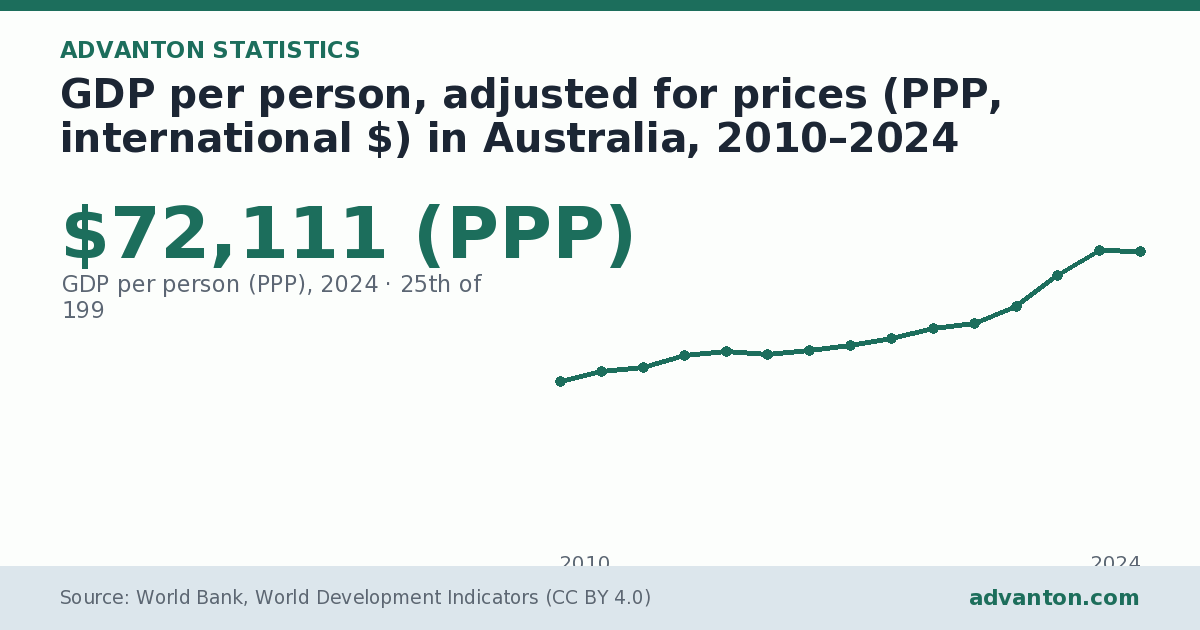
GDP per person, adjusted for prices in Australia: $72,111 (PPP) (GDP per person, PPP, 2024 · 25th of 199). GDP per person, adjusted for prices (PPP, international $) in Australia: $72,111 (PPP) in 2024, ranking 25th of 199 countries. In 2010 it was $39,504 (PPP).
Data last updated · Period: 2010–2024
Understanding the chart
The line chart above tracks GDP per person, adjusted for prices (PPP, international $) in Australia for each year from 2010 to 2024, 15 data points in all. Each dot is one year; the first and last years and the highest point are labelled with their values, and the vertical scale is in ppp, international $. All values in this period were above zero. The data table below the chart lists every value, and you can download the data, embed the chart or share it from the buttons above. The figures cover 2010–2024 and come from World Bank, World Development Indicators (CC BY 4.0).
Key insights
- Between 2010 and 2024, Australia's GDP per person (PPP) rose from $39,504 (PPP) to $72,111 (PPP), a change of 82.5% (about 4.4% a year on average).
- The highest value in this period was $72,273 (PPP) in 2023; the lowest was $39,504 (PPP) in 2010.
- Recently, the figure has moved up and down over the last three years (2023: $72,273 (PPP); 2024: $72,111 (PPP)).
- That is 2.9 times the world figure of $24,526 (PPP).
- Australia has the 25th-highest value of 199 countries with recent data.
Analysis
Averaged over periods, the figure was $43,579 (PPP) in 2010 to 2014, $49,147 (PPP) in 2015 to 2019 and $64,600 (PPP) in 2020 onwards. The value went up in 12 of the 14 year-to-year steps and down in 2. The biggest one-year rise came in 2022 (+$7,776 (PPP), or 13.3%). The biggest one-year fall came in 2015 (−$644 (PPP), or 1.4%). Across the period the values varied by about 20% around their average ($52,442 (PPP)), a moderate amount of change.
What it means
For businesses and investors, the figure is most useful alongside related measures for the same country, such as growth, inflation, population and incomes, and compared with similar countries. Compared with its neighbours in Australia and New Zealand, where the typical value is $63,831 (PPP), Australia is 13% higher than the regional median.
Related figures
- GDP per person, adjusted for prices (PPP, international $) by country, 2024: $155,941 (PPP) (highest: Luxembourg). GDP per person adjusted for differences in what money buys in each country (purchasing power parity).
- GDP per person, adjusted for prices (PPP, international $) in New Zealand, 2010–2024: $55,551 (PPP) (GDP per person (PPP), 2024 · 41st of 199). GDP per person, adjusted for prices (PPP, international $) in New Zealand: $55,551 (PPP) in 2024, ranking 41st of 199 countries.
- GDP of Australia, 2010–2025: $1.8 trillion (GDP, 2025 · 15th of 204). GDP of Australia: $1.8 trillion in 2025, ranking 15th of 204 countries.
About this statistic
GDP per person adjusted for differences in what money buys in each country (purchasing power parity). Better than the dollar figure for comparing living standards, because a dollar goes further where prices are lower.
For businesses, the size and growth of an economy shape demand: faster growth usually means rising incomes, more customers and more investment, while high inflation raises costs and makes planning harder. The figures come from the World Bank's World Development Indicators, which compile official national statistics in a consistent form so countries can be compared.
Questions and answers
What is the gDP per person, adjusted for prices (PPP, international $) in Australia?
$72,111 (PPP) (GDP per person (PPP), 2024 · 25th of 199). GDP per person, adjusted for prices (PPP, international $) in Australia: $72,111 (PPP) in 2024, ranking 25th of 199 countries. In 2010 it was $39,504 (PPP).
How has GDP per person (PPP) in Australia changed since 2010?
Between 2010 and 2024, Australia's GDP per person (PPP) rose from $39,504 (PPP) to $72,111 (PPP), a change of 82.5% (about 4.4% a year on average). The highest value in this period was $72,273 (PPP) in 2023; the lowest was $39,504 (PPP) in 2010.
Where does this data come from?
From World Bank, World Development Indicators (CC BY 4.0), covering 2010–2024. GDP per person adjusted for differences in what money buys in each country (purchasing power parity). Better than the dollar figure for comparing living standards, because a dollar goes further where prices are lower.
Data
| Year | GDP per person, adjusted for prices (PPP, international $) |
|---|---|
| 2010 | $39,504 (PPP) |
| 2011 | $42,153 (PPP) |
| 2012 | $43,007 (PPP) |
| 2013 | $46,123 (PPP) |
| 2014 | $47,109 (PPP) |
| 2015 | $46,465 (PPP) |
| 2016 | $47,446 (PPP) |
| 2017 | $48,565 (PPP) |
| 2018 | $50,371 (PPP) |
| 2019 | $52,886 (PPP) |
| 2020 | $54,184 (PPP) |
| 2021 | $58,327 (PPP) |
| 2022 | $66,103 (PPP) |
| 2023 | $72,273 (PPP) |
| 2024 | $72,111 (PPP) |
Source and notes
Source: World Bank, World Development Indicators (CC BY 4.0). Period: 2010–2024. Coverage: Australia.
GDP per person adjusted for differences in what money buys in each country (purchasing power parity). Better than the dollar figure for comparing living standards, because a dollar goes further where prices are lower.
Cite this statistic
Please also credit the original source: World Bank, World Development Indicators (CC BY 4.0).Related statistics
- GDP per person, adjusted for prices (PPP, international $) by country, 2024
- GDP per person, adjusted for prices (PPP, international $) in New Zealand, 2010–2024
- GDP of Australia, 2010–2025
- Economic growth (GDP growth) in Australia, 2010–2025
- GDP per person in Australia, 2010–2025
- Income per person (GNI, Atlas method, US$) in Australia, 2010–2025
- Inflation rate in Australia, 2010–2025
- Agriculture, forestry and fishing (% of GDP) in Australia, 2010–2025
- Industry, including construction (% of GDP) in Australia, 2010–2025
All Australia data: economy, people, jobs and digital in one place
Need more detail? Build a free India market report for any business and state.
Last reviewed November 9, 2026. Startup costs are estimates; check local prices, licensing and tax rules before you commit money.

