
Dropshipping lets a store sell products without holding inventory: when a customer orders, a supplier ships directly to them. Online sales keep growing, reaching 17.1% of U.S. retail sales and $340.2 billion in the second quarter of 2026, according to the Census Bureau. Low startup costs, however, mean intense competition, thin margins and heavy reliance on advertising.
Successful dropshippers pick focused niches, vet suppliers carefully, set honest shipping expectations and build brands customers return to. Even without inventory, the seller is responsible for the customer’s experience and legal obligations.
The workforce
| Occupation | Jobs (2024) | Median pay (May 2024) | Projected growth, 2024 to 2034 |
|---|---|---|---|
| Hand laborers and material movers (fulfillment workforce) | about 7.0 million | $37,680 | +4% |
Source: U.S. Bureau of Labor Statistics, Occupational Outlook Handbook and Occupational Employment and Wage Statistics.
Market data
| Measure | Value |
|---|---|
| U.S. retail e-commerce sales, Q2 2026 (Census) | $340.2 billion |
| E-commerce share of total retail sales, Q2 2026 | 17.1% |
| Year-over-year e-commerce growth, Q2 2026 | 12.2% |
Business models compared
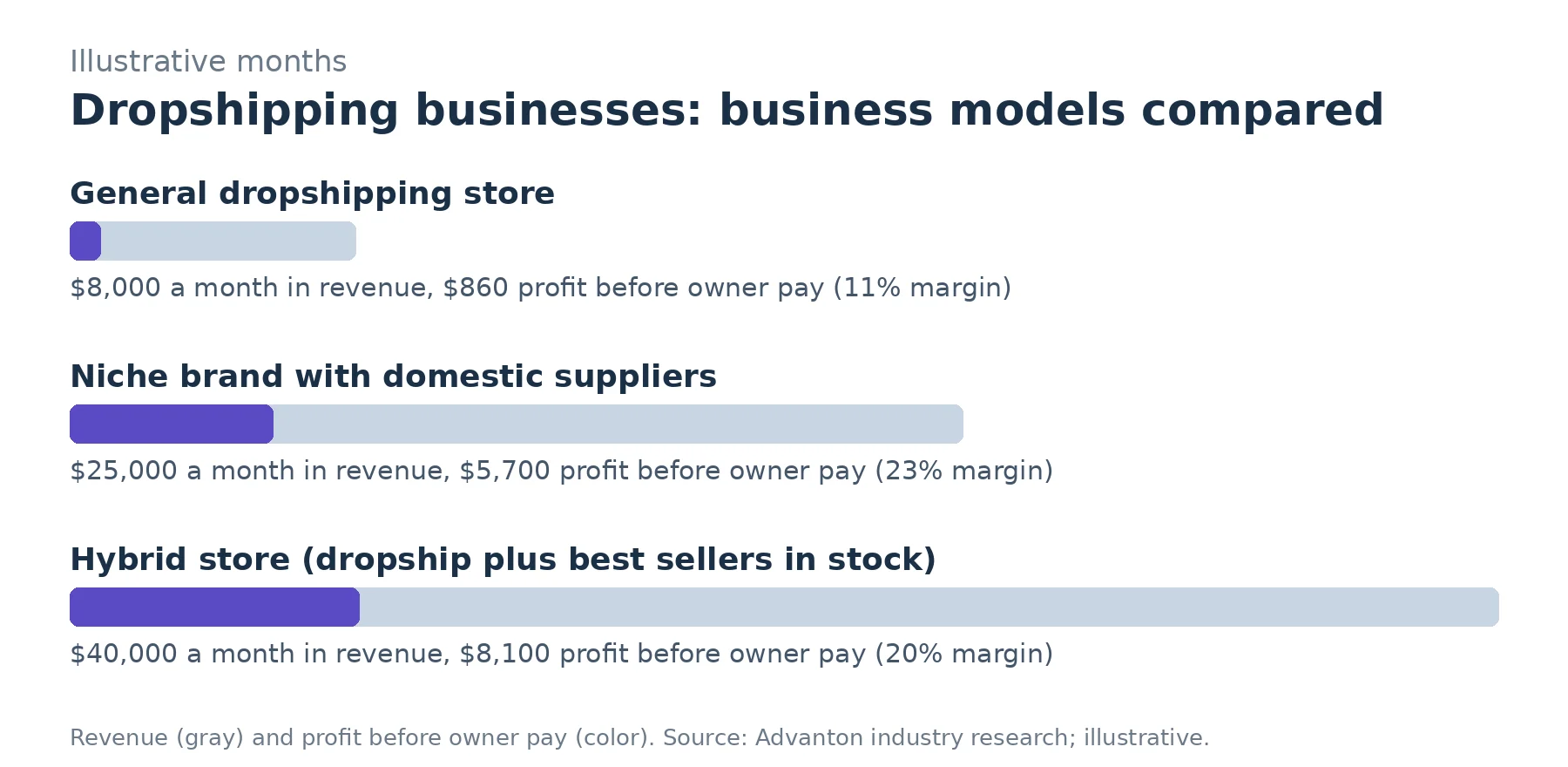
The figures below are illustrative months from our research, not industry averages. They show how revenue and costs typically fit together; your market, prices and costs will differ.
| Business model | Startup costs | Example monthly revenue | Costs | Profit before owner pay | Margin |
|---|---|---|---|---|---|
| General dropshipping store | Low: store platform, apps, ad testing budget | $8,000 | $7,140 | $860 | 11% |
| Niche brand with domestic suppliers | Low to moderate: samples, branding, content, ads | $25,000 | $19,300 | $5,700 | 23% |
| Hybrid store (dropship plus best sellers in stock) | Moderate: inventory for best sellers, fulfillment | $40,000 | $31,900 | $8,100 | 20% |
Fixed and variable costs
For projections, the most useful split is between variable costs, which rise and fall with sales (materials, supplies, hourly labor, fees), and fixed costs, which you pay every month regardless (rent, salaried staff, insurance, loan payments).
| Business model | Variable costs (% of revenue) | Fixed costs per month | What it means |
|---|---|---|---|
| General dropshipping store | 86.9% | $190 | Mostly variable: profitable early, but watch cash flow |
| Niche brand with domestic suppliers | 70.0% | $1,800 | Mostly variable: profitable early, but watch cash flow |
| Hybrid store (dropship plus best sellers in stock) | 72.5% | $2,900 | Mostly variable: profitable early, but watch cash flow |
What the numbers say
Product cost and ads take most of each sale, so margins depend on pricing and ad efficiency.
General stores struggle with trust and returns; niche brands build loyalty and lower ad costs over time.
Hybrid stores improve shipping speed and margins by stocking best sellers, with inventory risk.
The three models in brief
General dropshipping store. Many unrelated products tested with ads. See e-commerce data.
Niche brand with domestic suppliers. Focused products, faster shipping and a real brand.
Hybrid store. Dropshipping new products while stocking proven best sellers. See Amazon sellers data.
Cost structure: niche brand with domestic suppliers
Each cost as a share of the example month’s revenue ($25,000):
| Cost | Monthly amount | Share of revenue | Type |
|---|---|---|---|
| Product and supplier shipping | $11,250 | 45.0% | Variable |
| Ads | $5,000 | 20.0% | Variable |
| Customer service help | $800 | 3.2% | Fixed |
| Payment fees | $750 | 3.0% | Variable |
| Content and photography | $600 | 2.4% | Fixed |
| Returns | $500 | 2.0% | Variable |
| Store platform and apps | $250 | 1.0% | Fixed |
| Email and SMS | $150 | 0.6% | Fixed |
| Profit before owner pay | $5,700 | 23% |
A first-year projection: niche brand with domestic suppliers
New businesses rarely start at full speed. This projection assumes revenue ramps from 35% of the example month in month 1 to 100% by month 12, variable costs move with revenue, and fixed costs stay the same every month. It’s a planning illustration, not a forecast.
| Month | Revenue | Variable costs | Fixed costs | Profit | Cumulative |
|---|---|---|---|---|---|
| 1 | $8,750 | $6,125 | $1,800 | $825 | $825 |
| 2 | $11,250 | $7,875 | $1,800 | $1,575 | $2,400 |
| 3 | $13,750 | $9,625 | $1,800 | $2,325 | $4,725 |
| 4 | $15,500 | $10,850 | $1,800 | $2,850 | $7,575 |
| 5 | $17,500 | $12,250 | $1,800 | $3,450 | $11,025 |
| 6 | $19,000 | $13,300 | $1,800 | $3,900 | $14,925 |
| 7 | $20,500 | $14,350 | $1,800 | $4,350 | $19,275 |
| 8 | $21,750 | $15,225 | $1,800 | $4,725 | $24,000 |
| 9 | $22,750 | $15,925 | $1,800 | $5,025 | $29,025 |
| 10 | $23,750 | $16,625 | $1,800 | $5,325 | $34,350 |
| 11 | $24,500 | $17,150 | $1,800 | $5,550 | $39,900 |
| 12 | $25,000 | $17,500 | $1,800 | $5,700 | $45,600 |
Year one: revenue $224,000, profit before owner pay $45,600. The first profitable month is month 1. Cumulative results stay positive from the start, before any startup costs.
Product costs and ads move with sales and fixed costs are tiny, so this niche brand illustration is profitable from month 1 on paper. The real risk is ad spend: tests that don’t convert can burn cash quickly, so set strict budgets for each product test.
How dropshippers earn
- Margin between retail price and supplier cost.
- Bundles and upsells.
- Email and repeat purchases.
- Private label once products prove demand.
- Wholesale or B2B sales in some niches.
Supplier vetting
Your supplier ships your customer’s order. Order samples, test shipping times, check product quality and confirm return policies before selling. Domestic suppliers usually ship faster and handle returns more easily, though products cost more.
Shipping promises and the law
The FTC Mail Order Rule requires you to have a reasonable basis for shipping claims, ship on time and notify customers of delays with the option to cancel. Unrealistic shipping promises are one of the most common sources of complaints and chargebacks.
A startup checklist for dropshipping
- Choose a niche you understand.
- Vet suppliers with samples and test orders.
- Set realistic shipping times and clear return policies.
- Register for sales tax where required.
- Budget ad tests with stop-loss limits.
Advertising economics
Know your break-even cost per purchase before running ads. Track profit after product cost, shipping, fees, returns and ads, and pause anything that loses money.
Where the opportunities are
- Niche hobbies and communities.
- Domestic suppliers with fast shipping.
- Bundled solutions rather than single gadgets.
- B2B supplies for small businesses.
- Brands that move to private label.
Key terms
| Term | Meaning |
|---|---|
| Dropshipping | Selling products shipped directly by suppliers |
| Chargeback | A payment reversal disputed by a customer |
| Break-even CPA | Maximum ad cost per sale before losing money |
| Private label | Products made under your own brand |
Customer service
You own the customer relationship even when suppliers ship. Respond quickly, track orders proactively and resolve problems generously to protect reviews and payment accounts.
Key numbers to track
Track profit per order, conversion rate, cost per purchase, refund and chargeback rates, shipping times and repeat customers.
Common mistakes
- Unrealistic shipping promises.
- Unvetted suppliers.
- Selling infringing or unsafe products.
- Unprofitable ads.
- Ignoring customer service.
Marketing a dropshipping store
Content marketing, social video, influencers, email and SEO reduce reliance on paid ads. See e-commerce data.
Payment risk
High refund and chargeback rates can freeze payment accounts. Accurate descriptions and fast service keep rates low.
Product photos and descriptions
Use accurate photos and honest descriptions; exaggerated listings cause returns and complaints.
Building a real brand
Branded packaging, consistent quality and community turn a store into a business customers trust.
Moving to inventory
When products prove demand, buying inventory can improve margins and shipping speed.
Returns
Clear return policies and supplier agreements on returns prevent costly surprises.
Testing products
Test new products with small ad budgets and clear success criteria, such as a target cost per purchase and margin after returns. Most tests fail, so treat them as experiments, kill losers quickly and put more budget behind proven winners.
Scams and courses
Be skeptical of courses promising easy income; test small and learn from real data.
Test these numbers with your own plan
Open this industry in our free Business Idea Reality Check to start from any model above, change prices, costs, startup budget and your own pay, and see your break-even month, the cash you’d need, three scenarios and how new businesses in this sector survive in your state.
- Start with the closest model and its cost structure.
- Replace every price and cost with local quotes.
- Estimate your ramp: how fast customers will realistically come in year one.
- Map cash month by month with the free Cash & Payroll Planner.
- Build the full plan in the free Business Planner.
About this data
Workforce figures come from the U.S. Bureau of Labor Statistics (Occupational Outlook Handbook and Occupational Employment and Wage Statistics, May 2024 wages and the 2024 to 2034 projections, unless noted). Market figures cite their sources above. Business model figures are illustrative months built from typical prices and costs to show how revenue, fixed costs and variable costs fit together; they are not industry averages or guarantees. We review these profiles when new government data is released, at least once a year, and the same figures power the Business Idea Reality Check.
Licensing and rules
Register the business and collect sales tax where required (marketplaces may collect it for you, but your own store may need state registration once you meet thresholds); the FTC Mail Order Rule requires a reasonable basis for shipping time claims, shipping within the time stated (or 30 days if none is stated), and notifying customers and offering refunds when delays occur; advertising and reviews must be truthful; products must meet U.S. safety rules (especially children’s products and electronics); never sell counterfeit or infringing goods. Requirements change; confirm with your state and local agencies before you start.
Frequently asked questions about dropshipping
Is dropshipping profitable?
It can be, with niche focus, reliable suppliers and profitable advertising, but margins are thin.
Is dropshipping legal?
Yes, when you follow consumer protection, tax, safety and intellectual property rules.
What is the FTC Mail Order Rule?
A rule requiring sellers to ship within stated times (or 30 days) and notify customers of delays.
Do dropshippers need to collect sales tax?
Often yes, depending on where you sell and your sales volume.
How do I find good suppliers?
Order samples, test shipping and check quality and return policies.
How much money do I need to start?
Little for the store itself, but budget for samples and ad testing.
Should I use domestic suppliers?
They usually ship faster with easier returns, though products cost more.
How can I test these numbers?
Open dropshipping in the Business Idea Reality Check and enter your own prices and costs.
Keep learning
Sources
- U.S. Census Bureau, Quarterly Retail E-Commerce Sales (Q2 2026)
- U.S. Bureau of Labor Statistics, Hand laborers and material movers
Last reviewed November 1, 2026. Startup costs are estimates; check local prices, licensing and tax rules before you commit money.
In India
Small businesses like this in India
In MoSPI’s survey of unincorporated businesses (proprietorships, partnerships and similar firms), this falls under Retail trade. In 2023-24 India had 1.99 crore such establishments employing 3.31 crore workers, and 87.5% were run without hired workers. Across the wider trade group, the number of establishments grew 6.18% between 2023-24 and 2025.
| Urban | Rural | All India | |
|---|---|---|---|
| Value added per business a year | ₹3,13,011 | ₹1,61,621 | ₹2,34,248 |
| Value added per worker a year | ₹1,72,641 | ₹1,05,489 | ₹1,40,529 |
| Pay per hired worker a year | ₹1,34,040 | ₹1,14,058 | ₹1,30,041 |
Running it alone or with staff: businesses with no hired workers added about ₹1,60,797 a year on average, while those with hired workers added about ₹7,46,950 (all India).
Where these businesses are: the states with the most small trade businesses are Uttar Pradesh (15.2%), Maharashtra (9.8%), West Bengal (9.0%), Bihar (6.4%), Madhya Pradesh (6.3%) of the national total (2023-24).
Value added is what a business produces minus what it spends on materials and other inputs, before paying its workers and owner, so it’s a rough guide to the income a typical small business generates. These figures cover the whole activity, which can be broader than this one business type. Across all small businesses, average fixed assets such as equipment, furniture and vehicles were ₹3,42,242 per establishment in 2025.
Licences and registrations to expect
- Registration under your state’s Shops and Establishments Act if you have premises or employees.
- A trade licence from your municipal corporation or council for many shop and service businesses.
- GST registration once turnover crosses ₹40 lakh for goods or ₹20 lakh for services (lower in some special category states), or earlier if you sell goods to other states or through e-commerce marketplaces.
- Professional tax registration in states that levy it.
- Free Udyam (MSME) registration, which helps with loans, government schemes and delayed-payment protection.
Rules differ by state and city. Check with your municipal corporation, state departments and a chartered accountant before you start.
Run a business like this in India? List it free in the India Business Directory, with your hours, deals and GST registration.
Free tools for India: Make a GST invoice · Compare business credit cards
Build a market report for Dropshipping in India Pick your state and see market size, earnings, competition and licences, from official data. Free, with a PDF download.
Sources: MoSPI, Annual Survey of Unincorporated Sector Enterprises (ASUSE) 2023-24, full report, Appendix A Tables 4, 29, 33, 35 and 37 (survey period October 2023 to September 2024); MoSPI, Annual Survey of Unincorporated Sector Enterprises (ASUSE) 2025, factsheet (survey period January to December 2025, released 24 March 2026). Licensing summary by Advanton, checked November 2026.