
Remodels, redevelopment, storm damage and aging buildings all start with demolition, from gutting a kitchen to bringing down a commercial building. Demolition looks simple but is tightly regulated because of asbestos, lead, utilities and structural hazards. Construction laborers and helpers, about 1.65 million workers, earned a median of $46,050 in May 2024 with 7% projected growth, and equipment operators earned $58,320, according to the Bureau of Labor Statistics. Below is the key industry data on demolition contractors, with costs, business models and a first-year projection.
Businesses range from interior demolition crews working for remodelers to residential demolition companies tearing down houses and commercial contractors handling large structures.
The workforce
| Occupation | Jobs (2024) | Median pay (May 2024) | Projected growth, 2024 to 2034 |
|---|---|---|---|
| Construction laborers and helpers | about 1.6 million | $46,050 | +7% |
| Construction equipment operators | n/a | $58,320 | n/a |
Source: U.S. Bureau of Labor Statistics, Occupational Outlook Handbook and Occupational Employment and Wage Statistics.
Business models compared
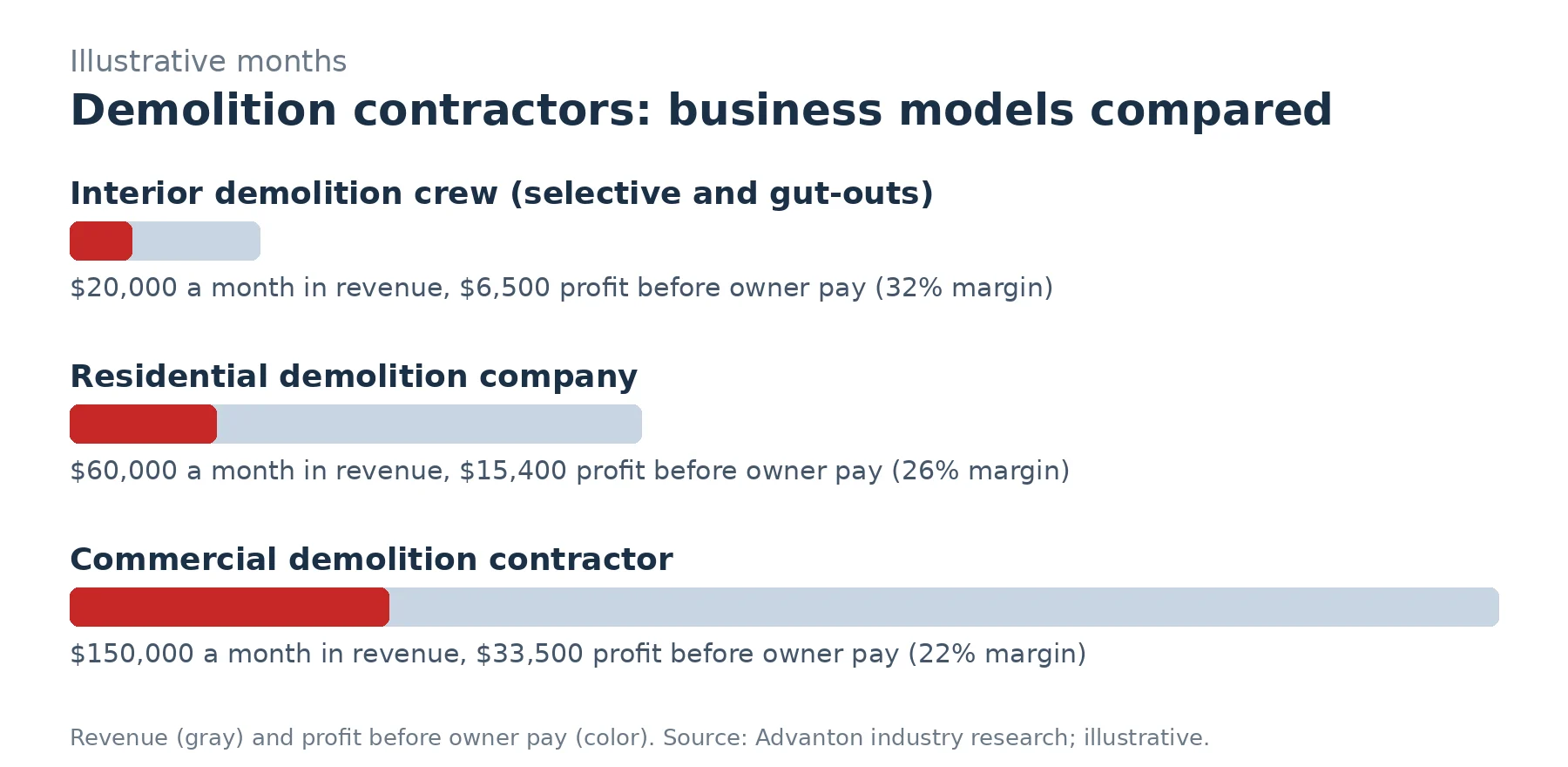
The figures below are illustrative months from our research, not industry averages. They show how revenue and costs typically fit together; your market, prices and costs will differ.
| Business model | Startup costs | Example monthly revenue | Costs | Profit before owner pay | Margin |
|---|---|---|---|---|---|
| Interior demolition crew (selective and gut-outs) | Low: hand and power tools, trailer, insurance | $20,000 | $13,500 | $6,500 | 32% |
| Residential demolition company | High: excavator, dump truck, permits, insurance | $60,000 | $44,600 | $15,400 | 26% |
| Commercial demolition contractor | Very high: heavy equipment fleet, engineers, bonding | $150,000 | $116,500 | $33,500 | 22% |
Fixed and variable costs
For projections, the most useful split is between variable costs, which rise and fall with sales (materials, supplies, hourly labor, fees), and fixed costs, which you pay every month regardless (rent, salaried staff, insurance, loan payments).
| Business model | Variable costs (% of revenue) | Fixed costs per month | What it means |
|---|---|---|---|
| Interior demolition crew (selective and gut-outs) | 55.0% | $2,500 | Mostly variable: profitable early, but watch cash flow |
| Residential demolition company | 53.5% | $12,500 | Mostly variable: profitable early, but watch cash flow |
| Commercial demolition contractor | 54.3% | $35,000 | Mostly variable: profitable early, but watch cash flow |
What the numbers say
Disposal and crew costs dominate, so estimating debris volume and recycling decide margins.
Interior crews start lean with low equipment costs.
Commercial demolition is equipment- and risk-heavy, requiring bonding, engineering and experienced crews.
The three models in brief
Interior demolition crew. Gut-outs and selective demolition for remodelers. See remodeling data.
Residential demolition company. Houses, garages and outbuildings, often with site clearing. See excavation and site work data.
Commercial demolition contractor. Larger structures by bid. See how to win commercial contracting jobs.
Cost structure: residential demolition company
Each cost as a share of the example month’s revenue ($60,000):
| Cost | Monthly amount | Share of revenue | Type |
|---|---|---|---|
| Crew pay | $12,000 | 20.0% | Variable |
| Disposal and tipping fees | $10,000 | 16.7% | Variable |
| Equipment payments | $6,000 | 10.0% | Fixed |
| Asbestos surveys and abatement subs | $4,000 | 6.7% | Variable |
| Fuel and hauling | $3,500 | 5.8% | Variable |
| Payroll taxes and workers’ comp | $2,600 | 4.3% | Variable |
| Insurance | $2,500 | 4.2% | Fixed |
| Estimating and office | $2,500 | 4.2% | Fixed |
| Maintenance | $1,500 | 2.5% | Fixed |
| Profit before owner pay | $15,400 | 26% |
A first-year projection: residential demolition company
New businesses rarely start at full speed. This projection assumes revenue ramps from 35% of the example month in month 1 to 100% by month 12, variable costs move with revenue, and fixed costs stay the same every month. It’s a planning illustration, not a forecast.
| Month | Revenue | Variable costs | Fixed costs | Profit | Cumulative |
|---|---|---|---|---|---|
| 1 | $21,000 | $11,235 | $12,500 | -$2,735 | -$2,735 |
| 2 | $27,000 | $14,445 | $12,500 | $55 | -$2,680 |
| 3 | $33,000 | $17,655 | $12,500 | $2,845 | $165 |
| 4 | $37,200 | $19,902 | $12,500 | $4,798 | $4,963 |
| 5 | $42,000 | $22,470 | $12,500 | $7,030 | $11,993 |
| 6 | $45,600 | $24,396 | $12,500 | $8,704 | $20,697 |
| 7 | $49,200 | $26,322 | $12,500 | $10,378 | $31,075 |
| 8 | $52,200 | $27,927 | $12,500 | $11,773 | $42,848 |
| 9 | $54,600 | $29,211 | $12,500 | $12,889 | $55,737 |
| 10 | $57,000 | $30,495 | $12,500 | $14,005 | $69,742 |
| 11 | $58,800 | $31,458 | $12,500 | $14,842 | $84,584 |
| 12 | $60,000 | $32,100 | $12,500 | $15,400 | $99,984 |
Year one: revenue $537,600, profit before owner pay $99,984. The first profitable month is month 2. Cumulative results bottom out at -$2,735, which is the minimum cash cushion this plan would need, before any startup costs.
Equipment payments, insurance and estimating start before the schedule fills, so this residential demolition illustration turns profitable in month 2, with a cumulative low of about $2,700, before equipment purchases.
How demolition contractors earn
- Interior gut-outs for remodelers.
- Whole-house and structure demolition.
- Site clearing and grading.
- Salvage and recycling of metals and materials.
- Emergency demolition after fires or storms.
Asbestos and hazardous materials
Federal rules require asbestos inspections before demolishing most buildings and advance notice to regulators. Asbestos must be removed by licensed abatement contractors before demolition. Lead paint, mercury and other hazardous materials also need proper handling.
Permits and utilities
Local permits, utility disconnections and sometimes historic reviews are required before work begins. Skipping steps can bring fines, stop-work orders or dangerous gas and electrical hazards.
A startup checklist for demolition contractors
- Check contractor and demolition licensing.
- Learn asbestos inspection and notification rules.
- Insure the business with appropriate liability coverage.
- Arrange disposal and recycling outlets.
- Train crews on OSHA demolition safety.
Disposal and recycling
Tipping fees can be one of the largest job costs. Separating metals, concrete and wood for recycling reduces disposal costs and may earn salvage revenue.
Where the opportunities are
- Interior demolition for remodelers.
- Teardowns for infill housing.
- Storm and fire damage demolition.
- Selective demolition in occupied buildings.
- Concrete crushing and recycling.
Key terms
| Term | Meaning |
|---|---|
| NESHAP | Federal air toxics rules, including asbestos demolition requirements |
| Engineering survey | OSHA-required assessment before demolition |
| Tipping fee | Charge to dispose of debris |
| Selective demolition | Removing parts of a structure while preserving others |
Safety
Structural collapse, falling debris and equipment hazards make demolition dangerous. Engineering surveys, exclusion zones, fall protection and experienced supervisors protect crews.
Key numbers to track
Track revenue per crew day, disposal cost per job, salvage revenue, estimate accuracy and safety incidents.
Common mistakes
- Demolishing before asbestos inspection.
- Underestimating disposal costs.
- Skipping utility disconnections.
- Weak safety planning.
- Underpricing hauling.
Marketing a demolition business
Remodelers, builders, developers, insurance adjusters and property managers send most work. See remodeling data.
Estimating
Estimate debris volume, crew days, equipment, disposal and hazardous material work separately, then add contingency.
Equipment
Rent heavy equipment before buying; mini excavators and skid steers suit many residential jobs and keep costs low until volume justifies purchases.
Dust and noise
Water suppression, barriers and scheduled work hours reduce dust, noise and neighbor complaints.
Insurance and bonding
Demolition carries higher risk, so insurance costs are significant; bonds may be required for public work.
Salvage
Architectural salvage and scrap metal can add revenue, reduce waste and lower disposal costs.
Soft-strip and deconstruction
Removing reusable fixtures, cabinets, lumber and metals before demolition (soft-stripping) reduces disposal costs and can earn salvage revenue. Some owners and cities value deconstruction for sustainability, and it can set your company apart.
Emergency demolition
Fires, storms and structural failures create urgent demolition needs. Contractors who respond quickly, work with insurers and adjusters and secure dangerous sites become trusted partners for emergency work.
Job site protection
Fencing, signage, dust control and protection for neighboring property prevent accidents and complaints. Document the condition of nearby structures before starting work.
Working with abatement contractors
Partner with licensed abatement firms and schedule removal before demolition.
Test these numbers with your own plan
Open this industry in our free Business Idea Reality Check to start from any model above, change prices, costs, startup budget and your own pay, and see your break-even month, the cash you’d need, three scenarios and how new businesses in this sector survive in your state.
- Start with the closest model and its cost structure.
- Replace every price and cost with local quotes.
- Estimate your ramp: how fast customers will realistically come in year one.
- Map cash month by month with the free Cash & Payroll Planner.
- Build the full plan in the free Business Planner.
About this data
Workforce figures come from the U.S. Bureau of Labor Statistics (Occupational Outlook Handbook and Occupational Employment and Wage Statistics, May 2024 wages and the 2024 to 2034 projections, unless noted). Market figures cite their sources above. Business model figures are illustrative months built from typical prices and costs to show how revenue, fixed costs and variable costs fit together; they are not industry averages or guarantees. We review these profiles when new government data is released, at least once a year, and the same figures power the Business Idea Reality Check.
Licensing and rules
Demolition usually requires local permits and utility disconnections; the federal asbestos NESHAP requires inspecting for asbestos before demolition of most buildings and notifying the state or EPA at least 10 working days before demolition, with removal by licensed abatement contractors; lead-safe rules apply to renovation and demolition in older buildings; OSHA demolition standards require an engineering survey before work and govern fall protection and structural hazards; many states license demolition or require contractor licensing; disposal must go to permitted facilities, and some areas require recycling. Requirements change; confirm with your state and local agencies before you start.
Frequently asked questions about demolition contractors
Do I need a permit to demolish a building?
Usually yes, plus utility disconnections and other approvals.
What are asbestos rules for demolition?
Most buildings must be inspected for asbestos, and regulators notified at least 10 working days before demolition.
What do demolition workers earn?
Construction laborers earned a median of $46,050 in May 2024, according to BLS.
Is demolition profitable?
It can be, with accurate estimates, controlled disposal costs and strong safety.
Can I start with interior demolition?
Yes; interior work needs less equipment and serves remodelers.
What happens to demolition debris?
It goes to permitted disposal or recycling facilities.
Who removes asbestos before demolition?
Licensed abatement contractors, before demolition begins.
Do demolition contractors need special insurance?
Yes; demolition carries higher risk and insurers price coverage accordingly.
How can I test these numbers?
Open demolition contractors in the Business Idea Reality Check and enter your own prices and costs.
Keep learning
Sources
- U.S. Bureau of Labor Statistics, Construction laborers and helpers
- U.S. Bureau of Labor Statistics, Construction equipment operators
Last reviewed November 1, 2026. Startup costs are estimates; check local prices, licensing and tax rules before you commit money.
In India
MoSPI’s survey of unincorporated businesses doesn’t cover construction, so there are no comparable small-business figures for this trade. Demand follows housing, commercial building and infrastructure activity in your area.
Licences and registrations to expect
- Contractor registration with the PWD, municipality or other departments if you bid for government work.
- Registration and cess under the building and other construction workers rules for larger projects.
- A contractor licence if you engage contract workers above the threshold set by labour rules.
- Registration under your state’s Shops and Establishments Act if you have premises or employees.
- A trade licence from your municipal corporation or council for many shop and service businesses.
- GST registration once turnover crosses ₹40 lakh for goods or ₹20 lakh for services (lower in some special category states), or earlier if you sell goods to other states or through e-commerce marketplaces.
- Professional tax registration in states that levy it.
- Free Udyam (MSME) registration, which helps with loans, government schemes and delayed-payment protection.
Rules differ by state and city. Check with your municipal corporation, state departments and a chartered accountant before you start.
Run a business like this in India? List it free in the India Business Directory, with your hours, deals and GST registration.
Free tools for India: Make a GST invoice · Compare business credit cards
Build a market report for Demolition Contractors in India Pick your state and see market size, earnings, competition and licences, from official data. Free, with a PDF download.
Sources: MoSPI, Annual Survey of Unincorporated Sector Enterprises (ASUSE) 2025, factsheet (survey period January to December 2025, released 24 March 2026). Licensing summary by Advanton, checked November 2026.