
A micro market is a small self-checkout store inside a workplace or building: open shelves, coolers with fresh food and drinks and a kiosk or phone app for payment. Micro markets offer far more variety than vending machines, including salads, sandwiches, fresh fruit and hot food, and they are popular in offices, warehouses, hospitals and apartment buildings. This guide explains how to start a micro market business, from licensing and startup costs to pricing and finding customers.
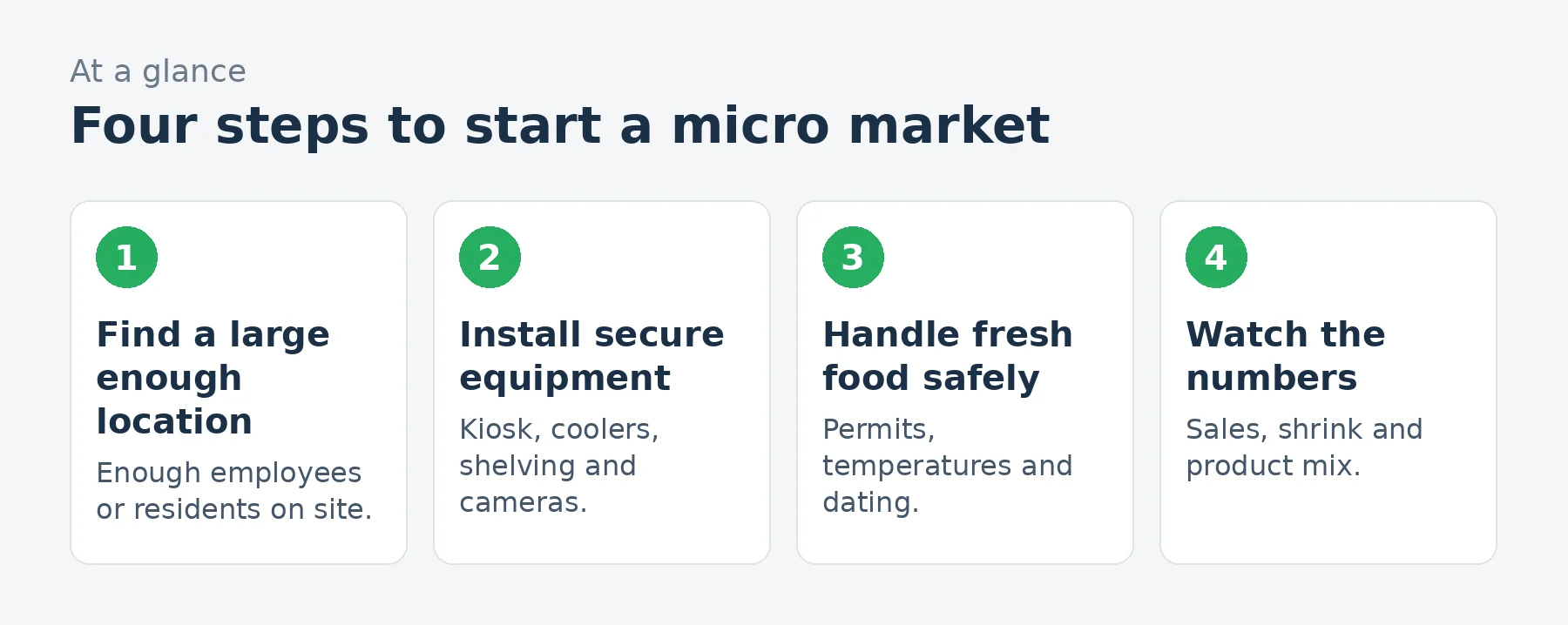
Micro markets need enough people on site to support sales, secure kiosks and cameras to manage shrink (losses from theft or errors), careful food safety for fresh items and, in many areas, health department approval. Advanton’s vending data shows a median pay of $37,130 for driver/sales workers (May 2024), the closest occupation to route operators. Owners earn the profit after product costs, location commissions, equipment and route time. This guide covers locations, equipment, food rules, security, pricing, a worked example and a 90-day plan.
A micro market business at a glance
Table of Contents
| Topic | What to expect |
|---|---|
| Startup cost | Moderate per location: kiosk, coolers, shelving, cameras, initial inventory and installation |
| Ideal locations | Workplaces and buildings with enough people on site, often 100 or more, and secure, semi-private space |
| Key rules | Health permits and food safety for fresh food, allergen labeling, calorie disclosure where required and payment card security |
| How you earn | Product sales minus product cost, shrink and any location commission |
| Best for | Vending operators and food entrepreneurs who manage inventory and logistics well |
Who micro markets suit
They suit organized operators who manage inventory, fresh food and data well. Many vending operators add micro markets to win larger accounts, since workplaces increasingly prefer them as an employee amenity.
Finding locations
Micro markets need enough customers: often workplaces with 100 or more employees on site, or busy apartment and dormitory buildings. The space should be accessible only to employees or residents, not the public, to reduce theft. Employers sometimes subsidize prices as a benefit.
Equipment
- Self-checkout kiosk with card, mobile and account payments.
- Coolers for drinks and fresh food, with temperature monitoring.
- Open shelving for snacks and household items.
- Security cameras connected to the kiosk system.
- Freezers and coffee equipment as options.
Micro market providers sell kiosk systems with inventory and sales software.
Food safety and permits
Fresh and perishable foods raise food safety requirements. Many health departments regulate micro markets as retail food operations, requiring permits, temperature control, safe sourcing from approved suppliers and inspections, following state codes based on the FDA Food Code. Label foods with ingredients and allergens (including sesame, now a major allergen), use dates and rotate stock.
Labeling and disclosures
Packaged products carry manufacturer labels, but fresh items you prepare or source need proper labels. FDA calorie disclosure rules may apply depending on how foods are sold and your number of machines or locations, so check requirements for your setup.
Shrink and security
Shrink includes theft, scanning errors and damaged goods. Choose locations with limited access, place cameras that clearly show the kiosk, display security notices, reconcile inventory regularly and talk with the location contact if losses rise. Most markets accept some shrink, but high losses mean a location is not working.
Payment security
Kiosks handle card payments and sometimes stored accounts. Use providers that follow payment card security standards, keep software updated and protect customer account information.
Startup costs for a micro market business
| Item | What to budget for |
|---|---|
| Kiosk and software | Self-checkout hardware and subscriptions |
| Coolers and shelving | Refrigerated and dry display |
| Cameras | Security system tied to kiosk |
| Inventory | Snacks, drinks and fresh food |
| Permits | Health department approvals where required |
| Vehicle | Refrigerated or insulated transport for fresh food |
Use our startup cost calculator for your total.
Pricing and product mix
Offer a broad mix: fresh meals, salads, fruit, snacks, drinks, coffee and some healthy options. Use kiosk sales data to adjust, and price to cover product cost, shrink, spoilage, fees and commissions. Use our pricing calculator.
A worked example: six micro markets
These are illustrative assumptions for an operator running six micro markets, not predictions.
| Assumption | Monthly | |
|---|---|---|
| Micro market sales | 6 markets averaging $3,500 | $21,000 |
| Revenue | $21,000 | |
| Product cost | About 50% of sales, including fresh food | $(10,500) |
| Shrink and spoilage | About 4% of sales | $(840) |
| Location commissions | $(600) | |
| Kiosk software and payment fees | $(1,500) | |
| Equipment loan payments | $(1,800) | |
| Route driver | With payroll costs | $(2,800) |
| Vehicle, insurance and supplies | $(900) | |
| Profit before owner pay and taxes | $2,060 |
That leaves about $2,060 a month before the owner’s pay and taxes, on about $21,000 of revenue. Shrink and spoilage can quietly erase profit, so watch them every week.
Loading the calculator…
Servicing markets
Fresh food needs frequent service, often several times a week. Use kiosk data to plan deliveries, rotate stock, remove expired items, clean coolers and shelves and keep the market looking full and appealing.
Winning accounts
- HR and facilities managers who want employee perks.
- Warehouses and plants with multiple shifts.
- Hospitals and clinics for staff break rooms.
- Apartment and student housing managers.
- Existing vending accounts ready to upgrade.
Employer subsidies
Some employers subsidize micro market purchases as a benefit, either by lowering prices, funding a monthly credit for employees or paying for free items. Subsidies increase sales and make your service more valuable to the employer.
Fresh food partnerships
Partner with commissaries, local kitchens or food manufacturers that hold the required licenses and provide labeled, dated products. Reliable fresh food sets micro markets apart from vending, but it must come from approved sources.
Technology and reporting
Micro market software tracks sales, inventory, shrink and customer accounts, and can run promotions and loyalty programs. Share simple reports with location contacts showing usage and popular items, which supports renewals.
Upgrading from vending
Vending operators can offer micro markets to their larger accounts as an upgrade: more variety, fresh food and a modern break room. Upgrades often bring longer agreements and higher sales.
Coffee and beverage services
Many micro markets add office coffee service, filtered water and specialty drinks. Coffee programs increase daily visits, can be subsidized by employers and create additional recurring revenue.
Merchandising and layout
Arrange markets like small stores: fresh items at eye level, clear categories, attractive displays and full shelves. Signs for new items and promotions encourage purchases.
Staffing and service schedules
Fresh food needs service several times a week, and busy markets may need daily visits. Plan routes so drivers stock, clean and check temperatures efficiently, and track service time per location to price accounts correctly.
Location agreements
Micro market agreements should cover the space, power and network access, service frequency, commissions or subsidies, security responsibilities, shrink thresholds, insurance and term. Clear terms help when losses rise or the employer’s needs change.
Choosing a kiosk provider
Compare kiosk providers on hardware reliability, software features, payment fees, inventory tools, shrink reporting and support. Good software makes ordering, pricing and reporting much easier.
Common mistakes to avoid when starting a micro market business
- Locations with too few people.
- Public access that invites theft.
- Weak fresh food handling.
- Ignoring shrink reports.
- Stale product mix.
Your first 90 days as a micro market business owner
- Days 1-30: research health department rules, choose a kiosk provider and identify large workplaces.
- Days 31-60: sign a first location, install equipment and line up approved food suppliers.
- Days 61-90: track sales and shrink weekly, refine the product mix and pitch more accounts.
Frequently asked questions about starting a micro market business
What is a micro market?
A small self-checkout store with open shelves, coolers and a kiosk, usually inside a workplace or building.
How many employees does a micro market need?
Often 100 or more people on site, though it depends on hours and the employer.
Do micro markets need health permits?
Many health departments require permits, especially for fresh and perishable foods.
What is shrink?
Losses from theft, errors and damaged or expired products.
How do micro markets prevent theft?
With limited access, cameras, kiosk security and regular inventory reconciliation.
Are micro markets better than vending machines?
For larger workplaces, they offer more variety and often higher sales, but need more service and security.
How much does it cost to open a micro market?
Each location requires a kiosk, coolers, shelving, cameras and inventory; costs vary by size.
Can micro markets sell hot food?
Some do with ovens or hot food systems, subject to health department rules.
What insurance does a micro market need?
General and product liability, coverage for equipment and commercial auto for service vehicles.
Can I run a micro market part-time?
It is harder than vending because fresh food needs frequent service, but small operators can start with one or two markets.
Do micro markets need employees on site?
No. They are unattended, with self-checkout kiosks and cameras.
How much do micro markets earn?
It depends on the number of people on site, prices and subsidies; larger workplaces can support strong sales.
What products sell best in micro markets?
Fresh meals, salads, sandwiches, snacks, cold drinks and coffee, adjusted using kiosk sales data.
Do micro markets need calorie labels?
Depending on how foods are sold and the operator’s size, FDA calorie disclosure rules may apply; check requirements for your setup.
Keep learning
- Vending industry data
- How to start a vending machine business
- How to start a healthy vending business
- Pricing calculator
Sources
- NAMA (National Automatic Merchandising Association)
- FDA, Food Code
- FDA, Calorie labeling for articles of food sold from vending machines
- FDA, Food allergies and allergen labeling (including sesame)
- PCI Security Standards Council, Payment card data security
- US Bureau of Labor Statistics, Delivery truck drivers and driver/sales workers
Last reviewed November 3, 2026. Startup costs are estimates; check local prices, licensing and tax rules before you commit money.

