
Labor-only movers load and unload trucks, containers and storage units that customers rent themselves. You bring the muscle, skill and equipment; the customer handles the vehicle and the driving. It is one of the lowest-cost ways to start in moving because you do not need a truck.
Demand comes from the many people who rent trucks or portable containers to save money but cannot lift everything themselves. MoveBuddha’s 2026 cost data shows labor-only crews charging roughly $59 to $80 per mover per hour, often with a two-hour minimum. This guide covers pricing, crews, insurance, a worked example and how to get steady bookings.
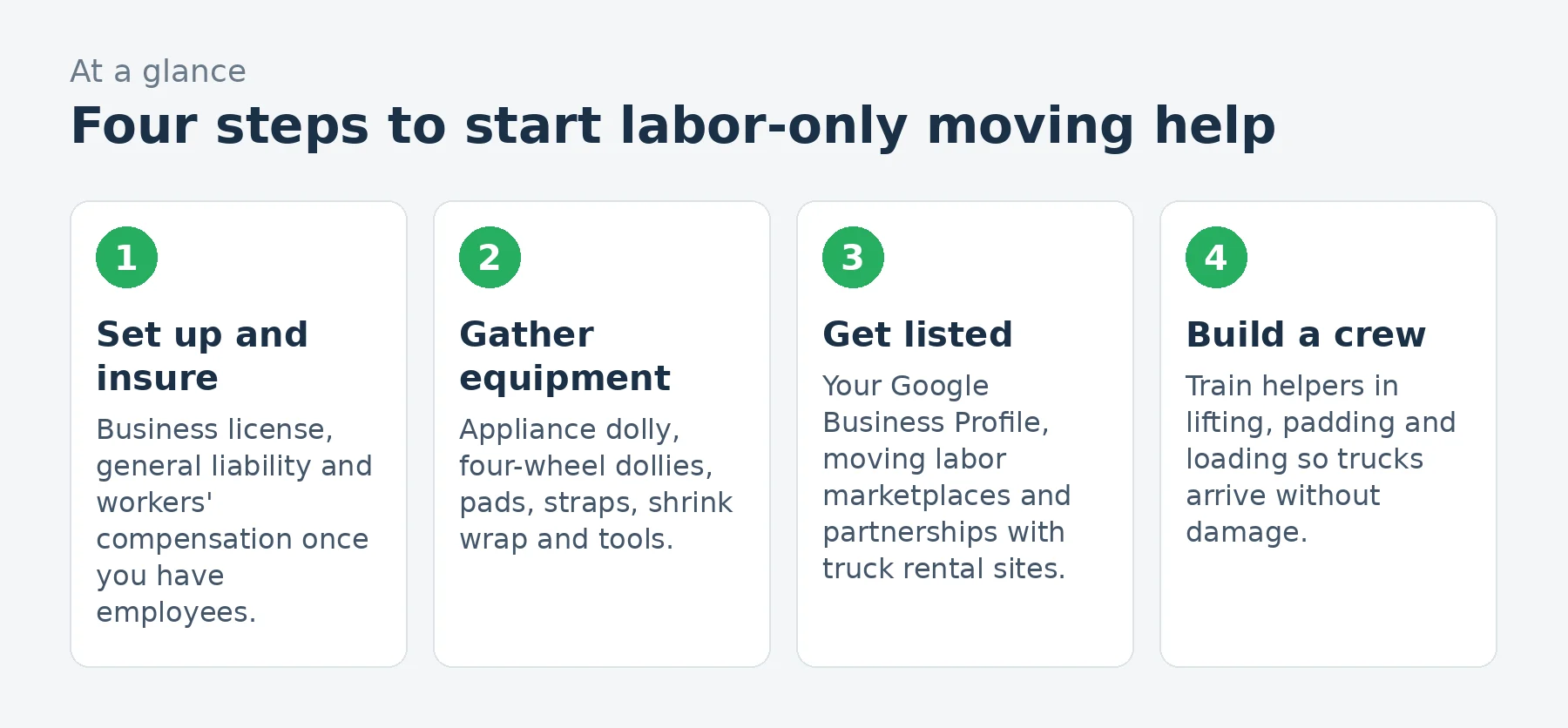
A labor-only moving help business at a glance
Table of Contents
| Topic | What to expect |
|---|---|
| Startup cost | Low: dollies, pads, straps, tools, a vehicle to reach jobs, insurance and marketing |
| Licenses | A business license; some states regulate movers, so check whether labor-only work is covered |
| What customers pay | Roughly $59 to $80 per mover per hour, often with a two-hour minimum (MoveBuddha, 2026) |
| Typical jobs | Loading rental trucks and containers, unloading, rearranging furniture, storage unit moves |
| Best for | Strong, reliable people who want a low-cost start in moving and can build a crew |
Who it suits
Labor-only moving suits fit, dependable people who enjoy physical work and want to run a business without buying a truck. It is a common starting point for future moving companies: you learn packing and loading, build reviews and save money for a truck.
The Bureau of Labor Statistics groups this work with hand laborers and material movers, with a median pay of $37,680 in May 2024. As an owner, you earn the margin between your hourly rate per mover and your crew’s wages and costs.
What labor-only movers do
- Loading rental trucks, trailers and portable storage containers, packed tightly so nothing shifts.
- Unloading at the new home, placing furniture and boxes in the right rooms.
- Storage unit moves in and out of self-storage.
- In-home moves: rearranging furniture or moving items between floors.
- Add-ons: furniture disassembly and reassembly, packing, and hauling items to donation or the dump (where permitted).
Because you do not drive the customer’s goods for hire, labor-only work usually avoids the federal rules for carriers. Some states regulate moving services more broadly, so confirm your state’s rules before you advertise.
Insurance and protecting customers’ belongings
Carry general liability insurance in case you damage a home or property. Once you hire helpers, workers’ compensation is required in most states and is essential for such physical work. Ask your agent about coverage for damage to items you handle; customers will ask what happens if something breaks, and a clear answer builds trust.
Startup costs to plan for
| Item | What to budget for |
|---|---|
| Equipment | Appliance dolly, four-wheel dollies, hand truck, furniture pads, straps, shrink wrap, tools |
| Vehicle | A car, SUV or pickup to get the crew and gear to jobs |
| Insurance | General liability and workers’ compensation |
| Business setup | LLC or registration, business license |
| Marketing | Website, Google Business Profile, marketplace profiles |
Use our startup cost calculator for your total.
Pricing your work
| Pricing | Typical 2026 figures |
|---|---|
| Labor-only, per mover per hour | About $59 to $79 in New York and $61 to $80 in Ohio (MoveBuddha) |
| Minimums | Two hours is common |
| Full-service comparison | Two movers and a truck about $120 to $180 an hour (Bellhop) |
Quote per mover per hour with a clear minimum, and add charges for heavy items (safes, pianos, pool tables), long walks and stairs where your market allows. Estimate time honestly: customers are comparing your total with the cost of a full-service mover, and labor-only should still save them money.
Loading a truck the right way
- Load heavy appliances and furniture first, against the front wall of the truck.
- Build tight tiers from floor to ceiling, heavy at the bottom and light on top.
- Pad every piece of furniture and protect corners.
- Strap each tier so loads do not shift on the road.
- Fill gaps with soft items and boxes so nothing can move.
- Walk the customer through the load before closing the door.
A well-loaded truck is your best advertisement: customers notice when everything arrives undamaged.
Running a job from booking to finish
- Booking: confirm the address, truck or container size, number of rooms, stairs, heavy items and parking.
- Day before: text the customer an arrival window and a checklist (boxes taped, drawers emptied, a parking spot saved).
- On arrival: walk through, agree the plan and note any existing damage.
- Work: pad and wrap furniture, disassemble what must come apart and load the truck in tight, strapped tiers.
- Finish: walk the customer through the load, collect payment and ask for a review the same day.
A short, consistent process makes crews faster and reduces the small misunderstandings that turn into complaints.
Handling seasonality
Moving demand peaks from late spring through summer and at the end of each month. Use busy months to build cash and reviews, and fill quiet months with storage unit moves, furniture rearranging, office moves, and loading for estate sales and donations. Keep a small, reliable core crew and add trained part-time helpers in summer rather than hiring untrained day labor.
A worked example: two-person crews
These are illustrative assumptions, not predictions.
| Assumption | Monthly | |
|---|---|---|
| Moving labor jobs | 70 jobs a month, 2 movers, average 3 hours at $70 per mover hour | $29,400 |
| Revenue | $29,400 | |
| Crew wages and payroll costs | Helpers paid hourly plus payroll taxes | $(12,300) |
| Marketplace fees and advertising | Fees on bookings from platforms plus ads | $(3,900) |
| Insurance | General liability and workers’ compensation | $(1,600) |
| Vehicle costs | Getting crews to jobs | $(1,500) |
| Equipment and supplies | Pads, wrap, straps and replacements | $(400) |
| Phone, software and payments | $(350) | |
| Profit before owner pay and taxes | $9,350 |
That leaves about $9,350 a month before the owner’s pay and taxes, on about $29,400 of revenue with two-person crews running most days. Marketplace fees can be significant, so many owners work to move repeat customers and referrals to direct bookings.
Specialty items: when to say no
Some items need equipment and training that a general labor crew may not have: pianos, gun safes, pool tables, hot tubs, large aquariums and very heavy exercise machines. Ask about these when customers book. If you cannot handle an item safely, say so and refer a specialist, such as a piano mover. Turning down one item protects your crew from injury and your business from a claim that could cost far more than the job pays. As you grow, you can add specialty equipment and training and charge accordingly.
How to get bookings
- Google Business Profile and reviews for searches like "moving help near me".
- Moving labor marketplaces where customers book help alongside truck and container rentals.
- Apartment complexes, storage facilities and real estate agents who see moves every week.
- Repeat and referral customers, with a discount for referrals.
List your business in the Advanton business directory too.
Common mistakes to avoid
- Working without insurance, or without workers’ compensation once you hire.
- Underestimating job time and losing money on minimums.
- Poorly loaded trucks that lead to damage claims.
- Relying on one marketplace for every booking.
- Taking on specialty items, such as pianos, without the right equipment.
Your first 90 days
- Days 1-30: register your business, check state mover rules, buy insurance and equipment and set your pricing.
- Days 31-60: create your Google Business Profile and marketplace listings, and hire and train one reliable helper.
- Days 61-90: complete jobs, ask every customer for a review and introduce yourself to local apartment and storage managers.
Frequently asked questions
How much do labor-only movers charge?
MoveBuddha’s 2026 data shows roughly $59 to $80 per mover per hour, often with a two-hour minimum.
Do I need a license for labor-only moving?
Usually a business license. Federal carrier rules generally apply to transporting goods, not just loading them, but some states regulate moving services, so check your state.
Do I need a truck?
No. Labor-only movers load and unload trucks and containers that customers rent. You need a vehicle to get your crew and equipment to jobs.
What insurance do I need?
General liability, and workers’ compensation once you have employees. Ask about coverage for customers’ items you handle.
Can this grow into a full moving company?
Yes. Many moving companies start with labor-only work, build reviews and add a truck once demand is steady.
How many movers should I send?
Two is standard for most apartments and small homes; larger homes, heavy items and long carries may need three or four. Sending too few slows the job and raises injury risk.
Is loading a portable storage container different from loading a truck?
The principles are the same: heavy items first, tight tiers and straps. Containers are often shorter and may be moved by forklift or lifted onto a trailer, so loads must be especially tight and balanced, with weight spread evenly and nothing able to tip when the container is moved.
Keep learning
- Moving and storage industry data
- How to start a moving company
- Add your business to the directory
- Startup cost calculator
Sources
- MoveBuddha, Moving cost calculator (labor-only rates)
- Bellhop, Average cost of local movers in 2026
- LawnStarter, How much do movers cost in 2026?
- US Bureau of Labor Statistics, Hand laborers and material movers
- FMCSA, Protect your move (household goods)
Last reviewed November 2, 2026. Startup costs are estimates; check local prices, licensing and tax rules before you commit money.

