
A custom packaging business designs, produces or sources branded packaging for other businesses: printed mailer boxes, product boxes, rigid gift boxes, labels, bags, tissue, inserts and food packaging. E-commerce brands, food producers, cosmetics companies and retailers want packaging that protects products and builds their brand.
Packaging is shaped by regulation more than many people expect: food contact materials must meet FDA requirements, many states limit heavy metals and PFAS in packaging, recyclability and compostability claims must be truthful and some states now have extended producer responsibility (EPR) laws for packaging. Advanton’s manufacturing data shows a median pay of $48,660 for metal and plastic machine workers and $43,720 for woodworkers (May 2024). Shop owners earn the profit after machines, materials, labor and overhead. This guide covers models, products, compliance, green claims, pricing, a worked example and a 90-day plan.
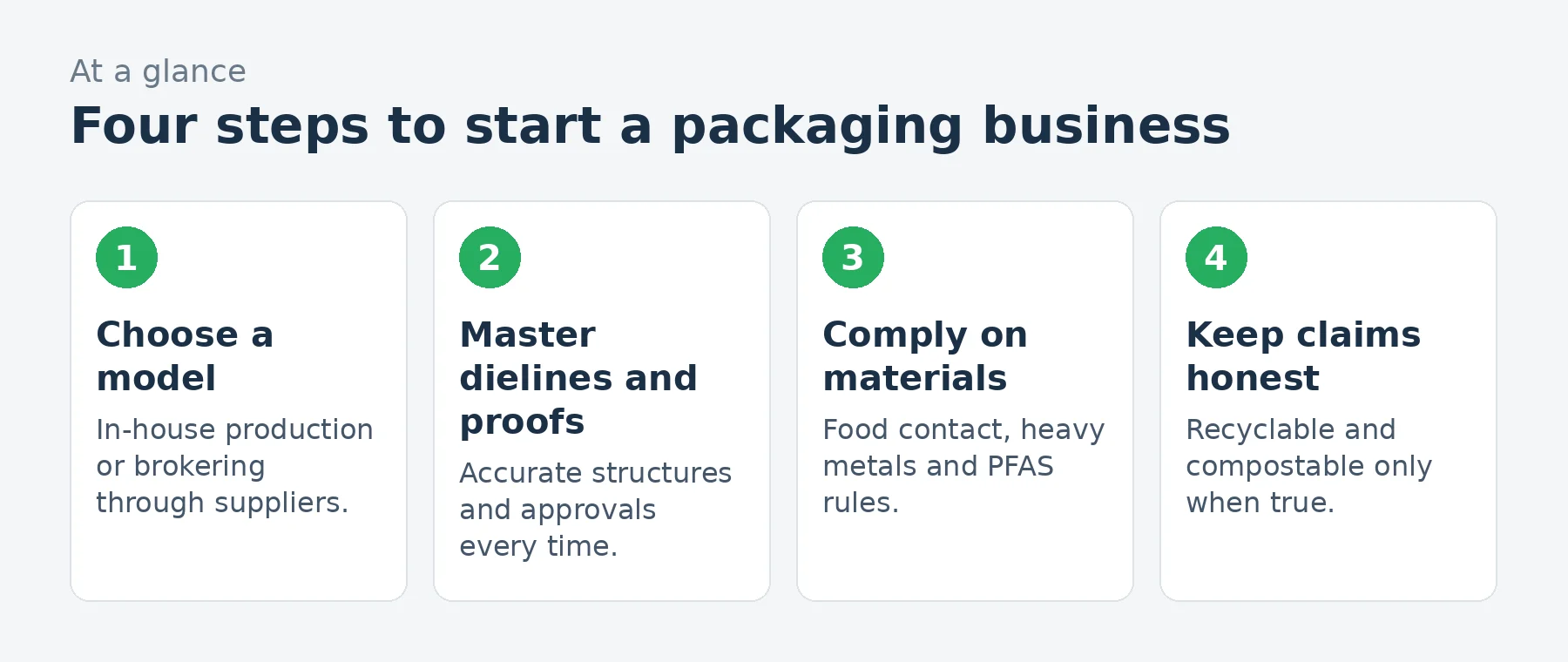
A custom packaging business at a glance
Table of Contents
| Topic | What to expect |
|---|---|
| Startup cost | Low for a brokerage model (design tools, samples, marketing); moderate to high for printing and converting equipment |
| Key rules | FDA food contact requirements, state toxics-in-packaging and PFAS laws, truthful green claims and state EPR programs |
| Models | In-house production with digital printers and cutters, or brokering production through manufacturers |
| How you charge | Per-unit prices by quantity, plus design, tooling, plates and shipping |
| Best for | Detail-oriented people who understand design, materials and supply chains |
Who packaging suits
It suits detail-oriented people who enjoy design, materials and logistics, and can manage proofs, production timelines and supplier relationships. Packaging errors are costly, so precision matters.
Business models
- In-house production: digital printers for boxes and labels, cutting tables for short runs and prototypes.
- Brokerage: designing and selling packaging produced by manufacturers, often overseas or regional plants for larger runs.
- Hybrid: short runs in-house, large orders through partners.
Brokerage lowers startup costs; in-house production offers speed and control for small orders.
Products to offer
- Printed mailer boxes and shipping cartons.
- Folding cartons for retail products.
- Rigid gift and presentation boxes.
- Labels and stickers.
- Bags, pouches and tissue paper.
- Inserts, sleeves and protective packaging.
- Food packaging, with appropriate materials.
Dielines, proofs and samples
Every structure starts with a dieline (the flat template), sized for the product with correct tolerances. Send digital proofs and physical samples for approval before production, confirm colors and finishes and keep approved files for reorders. Clear approvals prevent costly reprints.
Food contact rules
Packaging that touches food must be made of substances permitted for food contact under FDA rules, such as authorized food contact substances, prior sanctioned or generally recognized as safe materials, used under their conditions of use. Ask suppliers for compliance documentation for papers, coatings, inks and adhesives used in food packaging.
Heavy metals and PFAS
About 19 states have toxics-in-packaging laws limiting lead, mercury, cadmium and hexavalent chromium in packaging and components, based on a model law. A growing number of states have banned intentionally added PFAS in food packaging and, in some states, other packaging. Get supplier certifications and track the states where your customers sell.
Green claims and recyclability labels
Claims such as recyclable, compostable or made from recycled content must be truthful and qualified under the FTC’s Green Guides. California’s SB 343 restricts using recycling symbols or recyclable claims unless materials meet state criteria for being collected and recycled. Help clients make accurate claims rather than vague ones.
EPR packaging laws
States including Maine, Oregon, Colorado, California and Minnesota have enacted extended producer responsibility laws requiring producers of packaging to join programs and pay fees based on packaging materials. Brands will increasingly ask packaging suppliers for material data and lighter, recyclable designs, which is an opportunity for knowledgeable suppliers.
Startup costs to plan for
| Item | What to budget for |
|---|---|
| Design tools | Structural design and graphics software |
| Samples | Sample kits of structures and materials |
| Equipment | Digital printer, cutting table (for in-house production) |
| Supplier relationships | Manufacturer vetting and compliance documents |
| Space | Production and storage space |
| Website | Quote forms and portfolio |
Use our startup cost calculator for your total.
Pricing
Packaging is priced per unit by quantity, with steep discounts at higher volumes, plus charges for design, structural samples, printing plates or dies and shipping. Be clear about minimum order quantities, lead times and freight. Use our pricing calculator.
A worked example: a hybrid packaging business
These are illustrative assumptions for a packaging business combining digital short runs and brokered larger orders, not predictions.
| Assumption | Monthly | |
|---|---|---|
| Digital short-run packaging | Mailers and boxes produced in-house | $14,000 |
| Brokered large orders | Margin-inclusive sales | $18,000 |
| Design and structural services | $2,000 | |
| Revenue | $34,000 | |
| Materials and production costs | Board, ink and supplier invoices | $(17,500) |
| Production staff wages | With payroll costs | $(5,500) |
| Equipment payments and maintenance | Digital printer and cutting table | $(2,200) |
| Rent and utilities | $(2,500) | |
| Shipping, samples and software | $(1,500) | |
| Marketing and sales | $(1,200) | |
| Profit before owner pay and taxes | $3,600 |
That leaves about $3,600 a month before the owner’s pay and taxes, on about $34,000 of revenue. Repeat orders from growing brands are the foundation, since packaging is reordered constantly.
Loading the calculator…
Finding clients
- E-commerce brands wanting branded unboxing.
- Food and beverage producers needing compliant packaging.
- Cosmetics and wellness brands.
- Subscription box companies.
- Retailers and corporate gifting companies.
Lead times and supply chain
Large brokered runs can take weeks plus shipping time, and freight costs and tariffs can change. Plan production calendars with clients around product launches and holidays, and keep short-run digital production as a fast option.
Sustainable materials
Brands increasingly want recycled-content board, plastic-free mailers, water-based inks and right-sized boxes that reduce waste and shipping costs. Know which materials are widely recyclable, compostable or reusable, and explain trade-offs honestly.
Designing the unboxing experience
For e-commerce brands, packaging is a marketing tool: printed interiors, inserts that hold products securely, thank-you cards and branded tape. Combine good structure with memorable design while keeping costs and sustainability in mind.
Inventory and reorder programs
Growing brands run out of packaging at the worst times. Offer stocking programs, scheduled reorders and storage for larger runs, which builds loyalty and steady revenue.
Quality control
Inspect color accuracy, print registration, cutting, folding and gluing on every run. Keep approved samples as standards for reorders, and resolve problems before shipping to clients.
Working with overseas manufacturers
Overseas packaging plants can offer low unit costs for large runs. Vet suppliers carefully, request samples, confirm material compliance documents, plan for longer lead times and factor in freight, duties and tariffs, which have changed frequently.
Packaging for shipping performance
E-commerce packaging must survive shipping networks. Test designs with drop tests, choose board strength appropriately and right-size boxes to reduce damage and dimensional weight charges.
Serving small brands
Small and new brands often need low minimums, design help and fast turnaround. Digital short-run production and template structures serve them well, and they can become larger clients as they grow.
Common mistakes to avoid
- Production before proofs and samples are approved.
- Food packaging without compliance documentation.
- Ignoring PFAS and heavy metal laws.
- Unsupported recyclable or compostable claims.
- Unclear minimums and lead times.
Your first 90 days
- Days 1-30: choose a model, vet suppliers and gather compliance documents.
- Days 31-60: build sample kits, dieline templates and pricing tables.
- Days 61-90: pitch e-commerce and food brands and deliver first orders on time.
Frequently asked questions
Do I need equipment to start a packaging business?
Not necessarily; many start by brokering production through manufacturers and add short-run equipment later.
What rules apply to food packaging?
Materials that contact food must be permitted for food contact under FDA rules, with supplier documentation.
Are PFAS allowed in packaging?
A growing number of states ban intentionally added PFAS in food packaging and, in some states, other packaging.
Can I label packaging recyclable?
Only when claims are truthful under the FTC Green Guides and meet state rules such as California’s SB 343.
What are EPR laws?
Extended producer responsibility laws requiring packaging producers to fund recycling programs, enacted in several states.
How is custom packaging priced?
Per unit by quantity, plus design, tooling and shipping, with minimum order quantities.
What is a dieline?
A flat template showing the cuts, folds and dimensions of a package, used for design and production.
What minimum order quantities are typical?
Digital short runs can be small, while offset printing and larger structures often require higher minimums.
Do I need FDA approval for food packaging?
Packaging materials must be permitted for food contact; suppliers should provide compliance documentation for their materials.
Can packaging businesses help brands with EPR compliance?
Yes. Providing accurate material data and lighter, recyclable designs helps brands meet EPR reporting and fees.
How long does custom packaging take?
Digital short runs may take days, while larger brokered runs can take weeks plus shipping.
What packaging sells best to e-commerce brands?
Printed mailer boxes, right-sized shipping boxes, inserts and branded tissue are common requests.
Do I need to know structural design?
Basic structural design and dieline skills help greatly; suppliers can assist with complex structures.
Is custom packaging profitable?
It can be, especially with repeat orders from growing brands and efficient short-run production.
Keep learning
- Small manufacturing industry data
- How to start a recycling business
- How to start a sourcing agent business
- Pricing calculator
Sources
- FDA, Packaging and food contact substances
- Toxics in Packaging Clearinghouse, State toxics in packaging laws
- FTC, Green Guides for environmental marketing claims
- CalRecycle, SB 343 recyclability claims and labeling
- EPA, Circular economy and packaging policy
- US Bureau of Labor Statistics, Metal and plastic machine workers
Last reviewed November 3, 2026. Startup costs are estimates; check local prices, licensing and tax rules before you commit money.

