
A 3D printing business turns digital designs into physical objects: prototypes for engineers and inventors, replacement parts, custom products, architectural models, cosplay and props, jigs and fixtures for manufacturers and short production runs. Some businesses offer design services; others sell their own printed products online.
Starting is affordable with desktop printers, but competition is wide, so successful printers specialize: engineering-grade parts, a product niche or design expertise. Legal issues matter too: intellectual property in designs and strict rules on firearms and firearm parts. Advanton’s manufacturing data shows a median pay of $48,660 for metal and plastic machine workers and $43,720 for woodworkers (May 2024). Shop owners earn the profit after machines, materials, labor and overhead. This guide covers equipment, services, IP, prohibited items, safety, pricing, a worked example and a 90-day plan.
A 3D printing business at a glance
Table of Contents
| Topic | What to expect |
|---|---|
| Startup cost | Low to moderate: desktop printers and materials; much more for industrial machines |
| Key rules | Respect patents, trademarks and copyrights in designs; do not print firearms or firearm parts without full legal compliance |
| Safety | Ventilation and emission controls for printers, resin handling and fire safety |
| How you charge | Material plus machine time, setup and finishing; design fees; product prices |
| Best for | Technical, detail-oriented makers who enjoy design and problem-solving |
Who 3D printing suits
It suits technical makers who understand design, materials and troubleshooting, and who are patient with print failures and finishing work. CAD skills greatly increase earning potential.
Printers and materials
- FDM (filament) printers: affordable, versatile, good for prototypes and functional parts.
- Resin (SLA/MSLA) printers: fine detail for miniatures, jewelry models and dental and visual models.
- Industrial technologies such as powder bed fusion for strong, production-quality parts, at much higher cost.
- Materials: PLA, PETG, ABS, nylon, carbon-fiber blends, TPU and engineering resins.
Start with machines that match your niche, and add capacity as demand grows.
Services to offer
- Rapid prototypes for engineers, startups and inventors.
- Replacement and custom parts.
- Jigs, fixtures and tools for manufacturers.
- Architectural and product models.
- Custom gifts, signs and personalized products.
- 3D design and modeling, and 3D scanning.
Intellectual property
Many designs online are protected: copyright covers creative models, trademarks cover brand names and logos and patents may cover functional inventions. Only print and sell designs you created, licensed for commercial use or that are clearly free for commercial use, and do not print branded characters or logos without permission. Ask clients to confirm they have rights to files they send, in your terms.
Firearms and prohibited items
Federal rules treat certain partially complete frames and receivers as firearms, and the Supreme Court upheld the ATF’s rule on these items in 2025. Manufacturing firearms for sale requires a federal firearms license, and several states ban or restrict 3D-printed guns and parts. Many print services simply refuse all firearm and weapon parts. Also decline items that are illegal or dangerous, and protect yourself with clear terms.
Safety and emissions
Printers can emit ultrafine particles and volatile organic compounds, especially with some plastics and resins. Ventilate print rooms, use enclosures and filters, handle resins with gloves and eye protection and never leave printers running unmonitored without fire safety measures, since printers can overheat.
Food contact and product claims
Most printed parts are not safe for repeated food contact because layers trap bacteria and many materials and colorants are not food-grade. Avoid food-safe claims unless materials and processes genuinely support them. For children’s products, federal safety rules apply.
Startup costs to plan for
| Item | What to budget for |
|---|---|
| Printers | FDM and resin printers for your niche |
| Materials | Filament, resin, supports |
| Software | CAD, slicing and print management |
| Finishing tools | Sanding, painting, curing stations |
| Safety | Ventilation, enclosures, fire extinguisher |
| Website and marketplace | Quote forms, product listings |
Use our startup cost calculator for your total.
Pricing
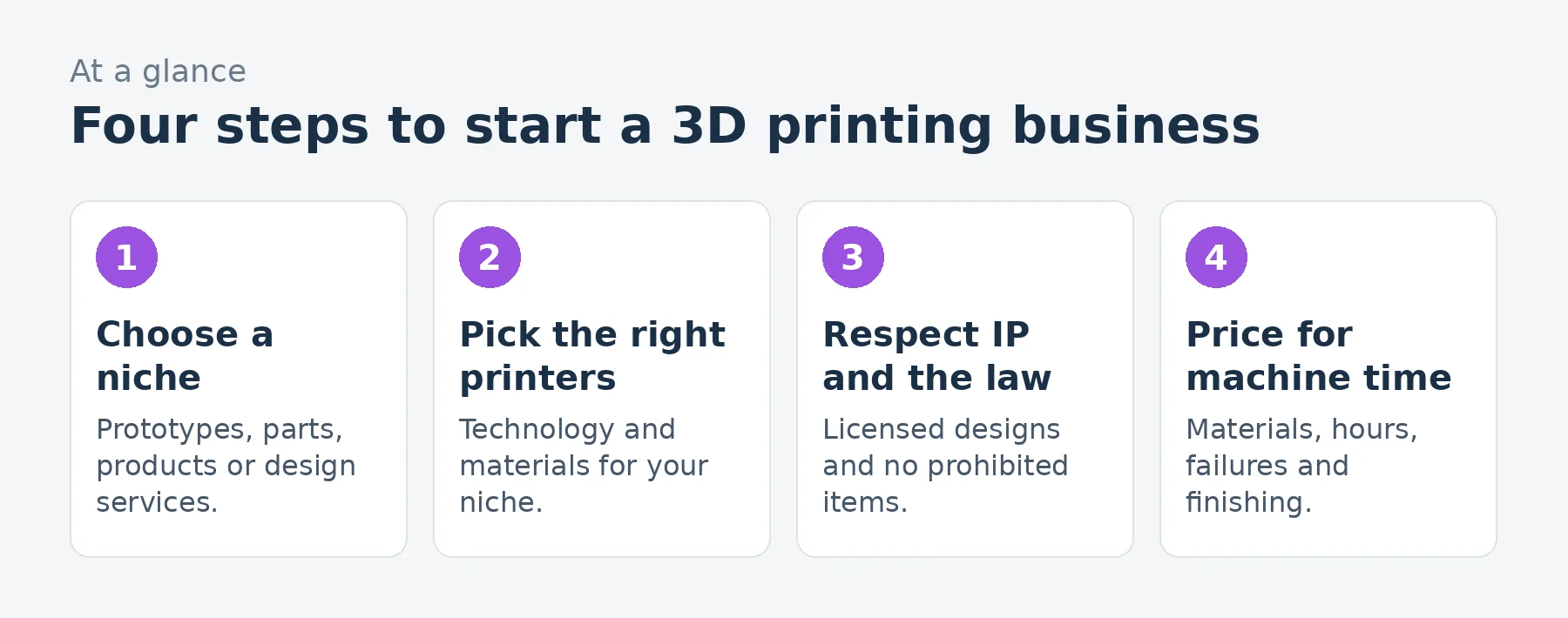
Price by material used plus machine time, adding setup, failure risk, post-processing, design time and margin. Engineering materials and tight tolerances cost more. Set minimum order charges for small jobs. Use our pricing calculator.
A worked example: a small print service
These are illustrative assumptions for a small print service with six printers, not predictions.
| Assumption | Monthly | |
|---|---|---|
| Prototype and parts printing | Engineers and businesses | $5,200 |
| Product sales | Original designs sold online and locally | $2,800 |
| Design and modeling services | 15 hours at $65 | $975 |
| Revenue | $8,975 | |
| Materials | Filament and resin | $(900) |
| Printer maintenance and replacement parts | $(300) | |
| Software and marketplace fees | $(450) | |
| Shipping and packaging | $(350) | |
| Rent, power and insurance | Small studio | $(1,100) |
| Marketing | $(300) | |
| Profit before owner pay and taxes | $5,575 |
That leaves about $5,575 a month before the owner’s pay and taxes, on about $8,975 of revenue. Design skills and engineering materials earn more than printing simple files for low prices.
Loading the calculator…
Selling products
Original printed products, such as organizers, planters, lighting, accessories for hobbies and replacement parts for popular devices, can sell online and at markets. Design your own products or license designs for commercial use, and test durability before selling.
Finding clients
- Engineers, startups and inventors needing prototypes.
- Local manufacturers needing fixtures and parts.
- Architects and designers needing models.
- Schools and makerspaces.
- Online marketplaces for custom printing.
Design services
Many customers have ideas but no files. CAD modeling, reverse engineering from samples and design for printability let you charge for expertise rather than just machine time. 3D scanning adds capability for replacement parts and custom fits.
Running a print farm
Multiple printers running in parallel increase capacity for production orders. Standardize printer models and settings, use print management software, monitor jobs remotely and schedule maintenance to keep failure rates low.
Engineering materials
Functional parts often need strong, heat-resistant or flexible materials such as nylon, carbon-fiber composites, polycarbonate or engineering resins. These require tuned printers and drying equipment but command higher prices from engineering clients.
Education and workshops
Schools, libraries and makerspaces may pay for 3D printing workshops, curriculum support and printer setup. Teaching builds your reputation and brings design clients.
Terms of service
Clear terms protect you: customers confirm they have rights to files, you refuse prohibited items, tolerances and material properties are stated and liability for how parts are used is limited. Include turnaround times and rush fees.
Quality and post-processing
Support removal, sanding, priming, painting, vapor smoothing and resin curing affect quality and time. Price post-processing separately and show examples so customers know what to expect.
Serving manufacturers
Factories use printed jigs, fixtures, gauges and replacement parts to save time and money. Visiting local manufacturers with examples can lead to steady orders, since printed tooling often costs far less than machined alternatives.
Scaling production
When orders reach hundreds or thousands of identical parts, compare printing with injection molding or other methods. Advising customers honestly about the best process builds trust, even if the answer is not printing.
Common mistakes to avoid
- Selling copies of copyrighted or trademarked designs.
- Printing firearm parts.
- Poor ventilation.
- Pricing by material only and ignoring machine time.
- Making food-safe claims without basis.
Your first 90 days
- Days 1-30: choose a niche, buy printers and set up a ventilated workspace.
- Days 31-60: build a portfolio, write terms covering IP and prohibited items and set pricing.
- Days 61-90: market to engineers, businesses and makers, and launch a product line or design service.
Frequently asked questions
Is a 3D printing business profitable?
It can be with a niche, design skills and pricing that covers machine time, rather than competing on cheap prints.
Can I sell items printed from online designs?
Only if the design’s license allows commercial use or you have permission.
Can I 3D print gun parts?
Federal and state laws strictly regulate firearms and their frames and receivers; most print services refuse all firearm parts.
Are 3D printers safe indoors?
They emit particles and fumes, so use ventilation, enclosures and filters.
How do I price 3D printing?
Material plus machine time, setup, finishing, design and margin.
Are 3D printed parts food safe?
Usually not for repeated food contact; avoid food-safe claims unless materials and processes support them.
Which 3D printer should I start with?
It depends on your niche; reliable FDM printers suit functional parts, while resin printers suit fine detail.
Can I run a 3D printing business from home?
Many do, with good ventilation, fire safety and zoning that allows home businesses.
How long does 3D printing take?
Small parts may print in hours, while large or detailed parts can take a day or more, plus post-processing.
What do 3D printing services charge?
Prices vary by material, size, machine time and finishing; many services set minimum order charges.
What materials are best for functional parts?
PETG, nylon, ABS and carbon-fiber blends are common for strength and durability, depending on the part.
Do I need CAD skills?
They are very valuable; design work lets you serve customers without files and charge for expertise.
Can I sell 3D printed products online?
Yes, if you own or have commercial rights to the designs and follow marketplace rules.
Keep learning
- 3D printing industry data
- How to start a CNC machining shop
- How to start a woodworking business
- Pricing calculator
Sources
- US Bureau of Labor Statistics, Metal and plastic machine workers
- USPTO, Patent and trademark basics
- US Copyright Office, Copyright basics
- ATF, Definition of frame or receiver and identification of firearms (final rule)
- EPA and NIOSH, Emissions and safety guidance for 3D printers
Last reviewed November 3, 2026. Startup costs are estimates; check local prices, licensing and tax rules before you commit money.

