
Hot shot truckers haul time-sensitive and smaller loads, such as equipment, machinery, building materials and oilfield supplies, using heavy-duty pickups and flatbed or gooseneck trailers. It’s a lower-cost entry into trucking than a semi, but it carries the same federal safety rules once trucks cross weight thresholds or state lines. Heavy and tractor-trailer truck drivers earned a median of $57,440 in May 2024, and the Bureau of Labor Statistics counted about 2.24 million of them, with 4% projected growth.
Businesses range from non-CDL hot shots running lighter combinations to CDL owner-operators and small fleets with several trucks. Rates, fuel, insurance and deadhead miles decide profits.
The workforce
| Occupation | Jobs (2024) | Median pay (May 2024) | Projected growth, 2024 to 2034 |
|---|---|---|---|
| Heavy and tractor-trailer truck drivers | about 2.2 million | $57,440 | +4% |
| Light truck drivers | about 1.1 million | $44,140 | n/a |
Source: U.S. Bureau of Labor Statistics, Occupational Outlook Handbook and Occupational Employment and Wage Statistics.
Market data
| Measure | Value |
|---|---|
| Projected heavy truck driver job change, 2024 to 2034 | 89,300 |
Business models compared
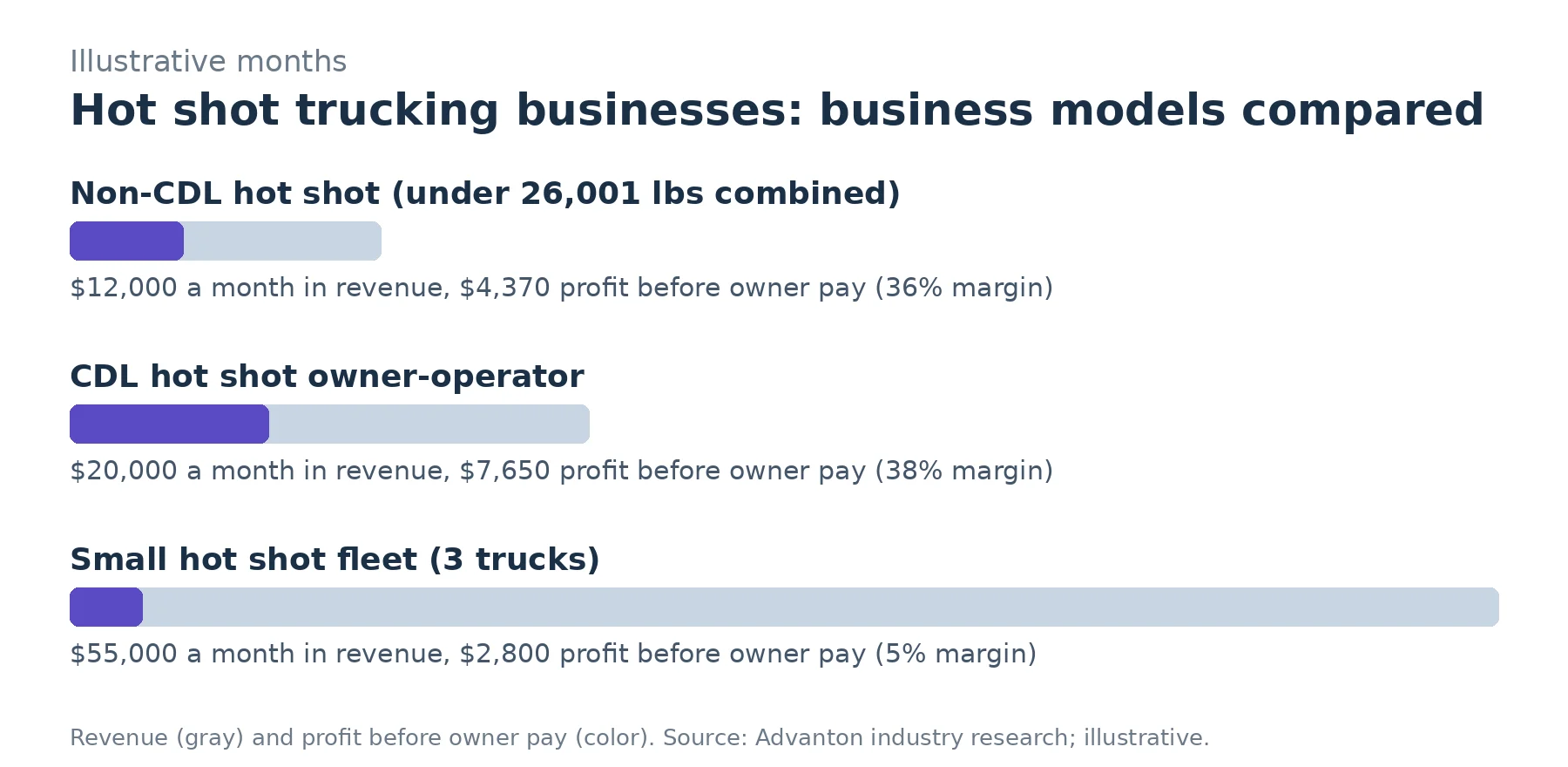
The figures below are illustrative months from our research, not industry averages. They show how revenue and costs typically fit together; your market, prices and costs will differ.
| Business model | Startup costs | Example monthly revenue | Costs | Profit before owner pay | Margin |
|---|---|---|---|---|---|
| Non-CDL hot shot (under 26,001 lbs combined) | Moderate: heavy-duty pickup, trailer, authority, insurance | $12,000 | $7,630 | $4,370 | 36% |
| CDL hot shot owner-operator | High: one-ton truck, gooseneck trailer, CDL, authority | $20,000 | $12,350 | $7,650 | 38% |
| Small hot shot fleet (3 trucks) | Very high: trucks, trailers, drivers, compliance systems | $55,000 | $52,200 | $2,800 | 5% |
Fixed and variable costs
For projections, the most useful split is between variable costs, which rise and fall with sales (materials, supplies, hourly labor, fees), and fixed costs, which you pay every month regardless (rent, salaried staff, insurance, loan payments).
| Business model | Variable costs (% of revenue) | Fixed costs per month | What it means |
|---|---|---|---|
| Non-CDL hot shot (under 26,001 lbs combined) | 38.3% | $3,030 | Balanced: margins improve as volume grows |
| CDL hot shot owner-operator | 40.5% | $4,250 | Balanced: margins improve as volume grows |
| Small hot shot fleet (3 trucks) | 67.1% | $15,300 | Mostly variable: profitable early, but watch cash flow |
What the numbers say
Fuel is the largest variable cost, so rates per mile and deadhead miles decide margins.
Insurance and truck payments are heavy fixed costs even when trucks sit idle.
Small fleets add revenue with driver pay, dispatch and compliance costs.
The three models in brief
Non-CDL hot shot. Lighter combinations that don’t require a CDL, with lower capacity. See trucking and logistics data.
CDL hot shot owner-operator. Heavier gooseneck setups hauling more freight.
Small hot shot fleet. Several trucks with hired drivers and dispatch. See freight brokers data.
Cost structure: cDL hot shot owner-operator
Each cost as a share of the example month’s revenue ($20,000):
| Cost | Monthly amount | Share of revenue | Type |
|---|---|---|---|
| Fuel | $5,500 | 27.5% | Variable |
| Truck and trailer payments | $2,400 | 12.0% | Fixed |
| Maintenance and tires | $1,400 | 7.0% | Variable |
| Insurance | $1,400 | 7.0% | Fixed |
| Dispatch and factoring fees | $1,200 | 6.0% | Variable |
| IFTA, IRP and permits | $250 | 1.2% | Fixed |
| ELD and compliance | $100 | 0.5% | Fixed |
| Phone and software | $100 | 0.5% | Fixed |
| Profit before owner pay | $7,650 | 38% |
A first-year projection: cDL hot shot owner-operator
New businesses rarely start at full speed. This projection assumes revenue ramps from 35% of the example month in month 1 to 100% by month 12, variable costs move with revenue, and fixed costs stay the same every month. It’s a planning illustration, not a forecast.
| Month | Revenue | Variable costs | Fixed costs | Profit | Cumulative |
|---|---|---|---|---|---|
| 1 | $7,000 | $2,835 | $4,250 | -$85 | -$85 |
| 2 | $9,000 | $3,645 | $4,250 | $1,105 | $1,020 |
| 3 | $11,000 | $4,455 | $4,250 | $2,295 | $3,315 |
| 4 | $12,400 | $5,022 | $4,250 | $3,128 | $6,443 |
| 5 | $14,000 | $5,670 | $4,250 | $4,080 | $10,523 |
| 6 | $15,200 | $6,156 | $4,250 | $4,794 | $15,317 |
| 7 | $16,400 | $6,642 | $4,250 | $5,508 | $20,825 |
| 8 | $17,400 | $7,047 | $4,250 | $6,103 | $26,928 |
| 9 | $18,200 | $7,371 | $4,250 | $6,579 | $33,507 |
| 10 | $19,000 | $7,695 | $4,250 | $7,055 | $40,562 |
| 11 | $19,600 | $7,938 | $4,250 | $7,412 | $47,974 |
| 12 | $20,000 | $8,100 | $4,250 | $7,650 | $55,624 |
Year one: revenue $179,200, profit before owner pay $55,624. The first profitable month is month 2. Cumulative results bottom out at -$85, which is the minimum cash cushion this plan would need, before any startup costs.
Truck payments, insurance and compliance start before regular lanes and customers build, so this owner-operator illustration turns profitable in month 2, with a cumulative low of about $100, before truck and trailer down payments.
How hot shot truckers earn
- Per-mile or flat rates for expedited loads.
- Dedicated runs for regular customers.
- Oilfield, construction and agriculture loads.
- Equipment and vehicle transport.
- Detention and accessorial charges.
Authority and compliance
Before hauling for hire, register for a USDOT number and, for interstate for-hire work, operating authority, then meet insurance and process agent requirements. Compliance continues daily with logs, inspections, maintenance records and drug and alcohol programs for CDL drivers.
CDL or non-CDL?
Staying under 26,001 pounds combined avoids the CDL requirement but limits load size and earnings. A CDL setup hauls more freight and earns more per load, with higher equipment costs and stricter rules.
A startup checklist for hot shot trucking
- Get a USDOT number and operating authority.
- Choose truck and trailer for your target freight.
- Secure insurance meeting federal minimums and shipper requirements.
- Set up ELD, IFTA and IRP as required.
- Line up loads through brokers, load boards and direct shippers.
Rates and deadhead
Empty miles cost fuel and time without pay. Plan return loads, know your cost per mile and decline loads that don’t cover costs.
Where the opportunities are
- Oilfield and energy equipment.
- Construction materials and machinery.
- Agricultural equipment.
- Expedited parts for manufacturers.
- Vehicle and RV transport.
Key terms
| Term | Meaning |
|---|---|
| Hot shot | Expedited loads hauled with heavy-duty pickups and trailers |
| GCWR | Gross combination weight rating of truck and trailer |
| Deadhead | Miles driven without a paying load |
| ELD | Electronic logging device for hours of service |
Cash flow and factoring
Brokers may pay in 30 days or more. Factoring advances cash for a fee, while quick-pay options and direct customers improve cash flow.
Key numbers to track
Track revenue per mile, cost per mile, deadhead percentage, loads per week, fuel economy and days to payment.
Common mistakes
- Not knowing your cost per mile.
- Hauling without proper authority or insurance.
- Overloading or improper securement.
- Too much deadhead.
- Ignoring maintenance.
Marketing a hot shot business
Direct relationships with shippers, equipment dealers and contractors bring better rates than load boards alone. See freight brokers data.
Cargo securement
Federal cargo securement rules require proper chains, straps and binders; roadside inspections check them closely.
Maintenance
Heavy loads stress pickups; follow maintenance schedules and track repair costs.
Safety and fatigue
Hours-of-service rules limit driving time; fatigue causes serious crashes.
Insurance
Shippers and brokers often require coverage above federal minimums.
Growing a fleet
Hire safe drivers, standardize equipment and build compliance systems before adding trucks.
Getting your first loads
New authorities can face limits from brokers who require months of operating history. Many new carriers start through brokers that work with new authorities, lease onto an established carrier or build direct relationships with local contractors and dealers.
Taxes
Track fuel, mileage and expenses carefully for IFTA, income taxes and deductions.
Test these numbers with your own plan
Open this industry in our free Business Idea Reality Check to start from any model above, change prices, costs, startup budget and your own pay, and see your break-even month, the cash you’d need, three scenarios and how new businesses in this sector survive in your state.
- Start with the closest model and its cost structure.
- Replace every price and cost with local quotes.
- Estimate your ramp: how fast customers will realistically come in year one.
- Map cash month by month with the free Cash & Payroll Planner.
- Build the full plan in the free Business Planner.
About this data
Workforce figures come from the U.S. Bureau of Labor Statistics (Occupational Outlook Handbook and Occupational Employment and Wage Statistics, May 2024 wages and the 2024 to 2034 projections, unless noted). Market figures cite their sources above. Business model figures are illustrative months built from typical prices and costs to show how revenue, fixed costs and variable costs fit together; they are not industry averages or guarantees. We review these profiles when new government data is released, at least once a year, and the same figures power the Business Idea Reality Check.
Licensing and rules
For-hire carriers generally need a USDOT number and, for interstate for-hire hauling, operating authority (an MC number) from FMCSA, plus a BOC-3 process agent filing; drivers need a commercial driver’s license when the gross combination weight rating is 26,001 pounds or more (with a towed unit over 10,000 pounds); commercial vehicles over 10,001 pounds in interstate commerce must follow FMCSA rules on medical cards, hours of service, electronic logging devices, inspections and drug and alcohol testing (for CDL drivers); federal insurance minimums apply; IFTA fuel tax and IRP registration apply to qualifying interstate vehicles. Requirements change; confirm with your state and local agencies before you start.
Frequently asked questions about hot shot trucking
Do I need a CDL for hot shot trucking?
You need a CDL when your truck and trailer combination is rated 26,001 pounds or more with a towed unit over 10,000 pounds.
What authority do hot shot carriers need?
A USDOT number and, for interstate for-hire hauling, operating authority from FMCSA.
Do hot shot trucks need ELDs?
Commercial vehicles subject to hours-of-service rules generally need ELDs, with some exceptions.
Is hot shot trucking profitable?
It can be, with good rates, low deadhead and controlled costs.
What do truck drivers earn?
BLS reported a median of $57,440 for heavy truck drivers in May 2024.
How do hot shot truckers find loads?
Load boards, brokers and direct shipper relationships.
How can I test these numbers?
Open hot shot trucking in the Business Idea Reality Check and enter your own rates and costs.
Keep learning
Sources
- U.S. Bureau of Labor Statistics, Heavy and tractor-trailer truck drivers
- U.S. Bureau of Labor Statistics, Delivery truck drivers and driver/sales workers
Last reviewed November 2, 2026. Startup costs are estimates; check local prices, licensing and tax rules before you commit money.
In India
This business type isn’t common in India. Hot shot trucking isn’t a distinct business type.
Looking for a business to start in India? Browse industries that fit well, such as interior design, coaching classes, cloud kitchens, salons and beauty parlours, AC service, and the India-only industries like tiffin services and mehendi artists.