
America is aging, and most older adults want to stay in their own homes and communities. That’s driving one of the strongest growth stories in the economy. The Bureau of Labor Statistics projects home health and personal care aides will add about 739,800 jobs from 2024 to 2034, a 17% increase and more new jobs than any other occupation. Below is the key industry data on senior care industry, with costs, business models and a first-year projection.
Senior care businesses range from home care agencies and adult day centers to transportation services and move managers. They share strong demand and a deep responsibility for vulnerable clients, and they differ greatly in startup costs, regulation and economics. This page gathers the key numbers, compares four business models and shows how a first year might unfold.
The workforce
| Occupation | Jobs (2024) | Median pay (May 2024) | Projected growth, 2024 to 2034 |
|---|---|---|---|
| Home health and personal care aides | about 4.3 million | $34,900 | +17% |
Source: U.S. Bureau of Labor Statistics, Occupational Outlook Handbook.
Market data
| Measure | Value |
|---|---|
| New home health and personal care aide jobs projected, 2024-2034 | 739,800 |
| Rank among all occupations for new jobs, 2024-2034 | 1st |
| Adult day services centers (2025) | 4,448 |
| Adult day services participants (2025) | about 227,000 |
Business models compared
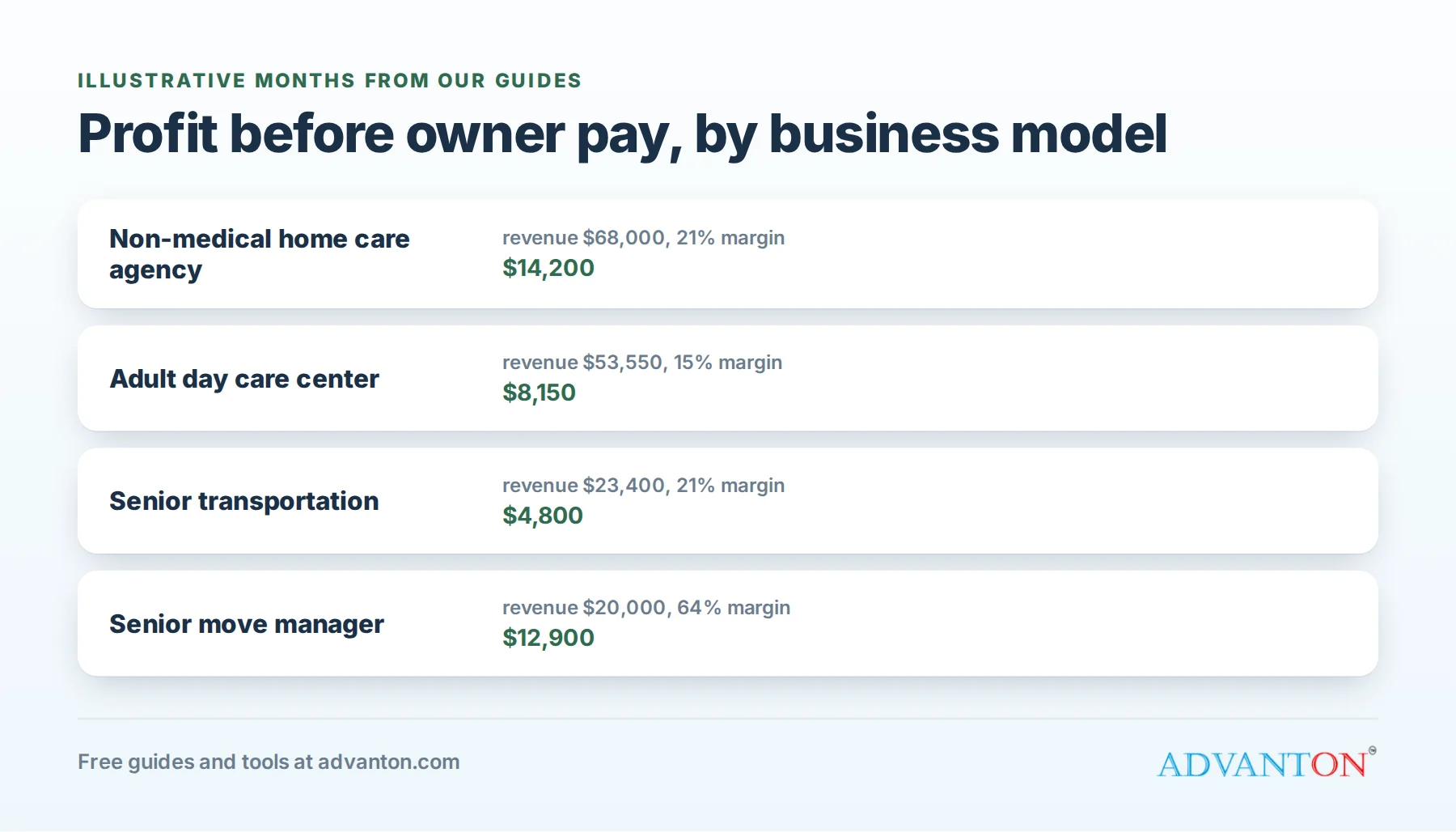
The figures below are illustrative months from our step-by-step guides, not industry averages. They show how revenue and costs typically fit together; your market, prices and costs will differ.
| Business model | Startup costs | Example monthly revenue | Costs | Profit before owner pay | Margin |
|---|---|---|---|---|---|
| Non-medical home care agency | Moderate: licensing, insurance, software, working capital | $68,000 | $53,800 | $14,200 | 21% |
| Adult day care center (30 participants) | High: licensed facility, build-out, staff, working capital | $53,550 | $45,400 | $8,150 | 15% |
| Senior transportation (2 vans) | Moderate to high: vehicles, commercial insurance, permits | $23,400 | $18,600 | $4,800 | 21% |
| Senior move manager | Low: supplies, software, insurance | $20,000 | $7,100 | $12,900 | 64% |
Fixed and variable costs
For projections, the most useful split is between variable costs, which rise and fall with sales (materials, parts, hourly labor), and fixed costs, which you pay every month regardless (rent, salaried staff, insurance, loan payments).
| Business model | Variable costs (% of revenue) | Fixed costs per month | What it means |
|---|---|---|---|
| Non-medical home care agency | 62.1% | $11,600 | Mostly variable: profitable early, but watch cash flow |
| Adult day care center (30 participants) | 17.4% | $36,100 | Mostly fixed: slow start-up months are expensive |
| Senior transportation (2 vans) | 55.6% | $5,600 | Mostly variable: profitable early, but watch cash flow |
| Senior move manager | 30.0% | $1,100 | Low costs overall: time is the main constraint |
What the numbers say
Demand is not the constraint; staffing is. With 739,800 new aide jobs projected and a median wage of $34,900, recruiting and keeping caregivers is the central challenge for home care agencies. Agencies that pay fairly, offer consistent hours and treat caregivers well grow fastest.
Adult day services serve a large, underused market. The CDC counted 4,448 adult day centers serving about 227,000 participants in 2025. Centers offer families respite and help older adults stay at home, but they carry heavy fixed costs.
Payment sources shape everything. Private pay, long-term care insurance, Medicaid programs and veterans’ programs each come with different rates and paperwork. Medicare generally doesn’t pay for non-medical home care or adult day services.
The four models in brief
Non-medical home care agency. Revenue is billed care hours; most of each dollar goes to caregiver wages and payroll costs, so margins are modest and efficient scheduling matters. See how to start a non-medical home care agency.
Adult day care center. High fixed costs for staff and a licensed facility; profitability depends on steady daily attendance. See how to start an adult day care center.
Senior transportation. Vehicles, drivers and commercial insurance; efficient routing and contracts with senior communities and clinics drive results. See how to start a senior transportation service.
Senior move manager. Low startup costs and high margins, but revenue depends on the owner’s own time and a steady flow of referrals. See how to start a senior move manager business.
Cost structure: adult day care center (30 participants)
Each cost as a share of the example month’s revenue ($53,550):
| Cost | Monthly amount | Share of revenue | Type |
|---|---|---|---|
| Staff | $26,000 | 48.6% | Fixed |
| Rent | $6,000 | 11.2% | Fixed |
| Meals and snacks | $4,500 | 8.4% | Variable |
| Transportation | $4,000 | 7.5% | Variable |
| Insurance | $1,500 | 2.8% | Fixed |
| Utilities | $1,200 | 2.2% | Fixed |
| Activities and supplies | $800 | 1.5% | Variable |
| Admin and software | $800 | 1.5% | Fixed |
| Marketing | $600 | 1.1% | Fixed |
| Profit before owner pay | $8,150 | 15% |
A first-year projection: adult day care center (30 participants)
New businesses rarely start at full speed. This projection assumes revenue ramps from 35% of the example month in month 1 to 100% by month 12, variable costs move with revenue, and fixed costs stay the same every month. It’s a planning illustration, not a forecast.
| Month | Revenue | Variable costs | Fixed costs | Profit | Cumulative |
|---|---|---|---|---|---|
| 1 | $18,742 | $3,255 | $36,100 | -$20,613 | -$20,613 |
| 2 | $24,098 | $4,185 | $36,100 | -$16,187 | -$36,800 |
| 3 | $29,453 | $5,115 | $36,100 | -$11,762 | -$48,562 |
| 4 | $33,201 | $5,766 | $36,100 | -$8,665 | -$57,227 |
| 5 | $37,485 | $6,510 | $36,100 | -$5,125 | -$62,352 |
| 6 | $40,698 | $7,068 | $36,100 | -$2,470 | -$64,822 |
| 7 | $43,911 | $7,626 | $36,100 | $185 | -$64,637 |
| 8 | $46,588 | $8,091 | $36,100 | $2,397 | -$62,240 |
| 9 | $48,730 | $8,463 | $36,100 | $4,167 | -$58,073 |
| 10 | $50,872 | $8,835 | $36,100 | $5,937 | -$52,136 |
| 11 | $52,479 | $9,114 | $36,100 | $7,265 | -$44,871 |
| 12 | $53,550 | $9,300 | $36,100 | $8,150 | -$36,721 |
Year one: revenue $479,807, profit before owner pay -$36,721. The first profitable month is month 7. Cumulative results bottom out at -$64,822, which is the minimum cash cushion this plan would need, before any startup costs.
An adult day center pays for staff, rent and its licensed facility from the first day, whether 10 or 30 participants attend. That’s why this projection shows six months of losses before the first profitable month, and why the plan needs a cash cushion of roughly $65,000 on top of startup costs. Building referrals before opening, and offering free trial days, shortens that gap.
How senior care businesses price
- Home care agencies bill an hourly rate, often with minimum shift lengths and higher rates for weekends, holidays, overnight and live-in care. Medicaid programs set their own rates.
- Adult day centers charge a daily rate for a full or half day, sometimes with separate fees for transportation, bathing or specialized care.
- Senior transportation services charge per ride, often with mileage, wait-time and wheelchair fees, plus contract rates for communities and clinics.
- Move managers charge hourly or by project, with third-party services such as movers billed directly to the client.
Demand patterns
Senior care demand is steady and growing rather than seasonal. Spikes come from life events: hospital discharges, falls, a spouse’s illness or a family caregiver’s burnout. That’s why relationships with discharge planners, doctors and senior communities matter so much: they’re where urgent needs first appear.
A startup checklist for senior care industry
- Research state licensing for your service and how long approval takes.
- Decide on payment sources: private pay, long-term care insurance, Medicaid programs or veterans’ programs.
- Plan caregiver recruiting, training and background checks.
- Arrange insurance: professional and general liability, workers’ comp, and coverage for abuse and molestation claims.
- Choose software for scheduling, care notes and, for Medicaid clients, electronic visit verification.
- Build referral relationships before opening.
- Model cash flow, including payment delays from insurers and Medicaid.
Questions to answer before starting in senior care industry
- Which licenses do you need, and how long will they take?
- Who will pay for most of your services, and at what rates?
- Can you recruit enough reliable caregivers at the wages your prices support?
- How will you handle call-offs and emergencies at night and on weekends?
- How many months of costs can you cover while clients and referrals build?
Senior care rewards owners who plan carefully and put clients’ safety and dignity first.
Where the opportunities are
- Dementia care: specialized home care and memory care programs are in high demand.
- Respite care: short, flexible help for family caregivers is an accessible entry point.
- Rural and underserved areas: many communities have few providers.
- Transportation partnerships: adult day centers, clinics and senior communities need reliable rides.
- Move management and downsizing: growing as older adults move to smaller homes and communities.
Key terms
| Term | Meaning |
|---|---|
| Activities of daily living | Basic tasks such as bathing, dressing and eating that caregivers help with |
| Respite care | Short-term care that gives family caregivers a break |
| Home and community-based services | Medicaid programs that pay for care at home and in the community |
| Electronic visit verification | Required recording of time, place and services for Medicaid personal care visits |
| Social vs medical model | Adult day centers focused on activities vs those adding nursing and health services |
Hiring and keeping caregivers
Caregivers are the product in senior care, and turnover is costly: every departure means recruiting, background checks, training and disruption for clients who rely on familiar faces. Agencies that keep caregivers tend to offer competitive and on-time pay, consistent schedules, thorough training (especially in dementia care), clear support from a supervisor who answers the phone, and respect. Track turnover monthly and ask departing caregivers why they left. Many owners find that a modest increase in pay or guaranteed hours costs less than constant rehiring. Federal minimum wage and overtime rules generally apply to caregivers employed by agencies, and many states add their own rules; build them into your pricing. See our hiring cost calculator to estimate the full cost of each caregiver.
How to use these numbers for your own plan
- Start with the closest model above and its cost structure.
- Replace every price and cost with local quotes: rent, insurance, wages, materials and your expected prices.
- Estimate your ramp: how many customers, visits or jobs you can realistically win each month in year one.
- Separate fixed and variable costs, then calculate your break-even point with our free break-even calculator.
- Map cash month by month with our cash flow forecast, including startup costs and loan payments.
- Build the plan in our free Business Planner, which carries your numbers from startup costs through pricing, break-even and funding.
These industry figures will also feed a planned Advanton projection tool, so you’ll be able to start from an industry template and adjust it to your situation. Until then, a simple spreadsheet with your own numbers, reviewed with an accountant or a free SCORE mentor, is a strong start.
Licensing and rules
Non-medical home care licensing varies by state; adult day centers are licensed by most states, with stricter rules for adult day health; Medicaid enrollment and electronic visit verification for Medicaid personal care; passenger transport permits vary by state and city. Requirements change; confirm with your state and local agencies before you start.
Trends to watch
- Aging in place: more older adults choosing care at home and in the community.
- Caregiver workforce pressure: wages and benefits rising to attract staff.
- Medicaid home and community-based services: growing, with electronic visit verification required for Medicaid personal care.
- Dementia care: rising demand for specialized, well-trained services.
- Technology: scheduling, family communication and remote monitoring tools.
Risks to plan for
- Caregiver turnover and call-offs.
- Licensing and compliance that vary by state.
- Payment delays from insurance and Medicaid programs.
- Liability when caring for vulnerable adults.
- High fixed costs for facility-based models like adult day centers.
Frequently asked questions about senior care industry
How fast is home care growing?
The BLS projects home health and personal care aide jobs to grow 17% from 2024 to 2034, adding about 739,800 jobs, more than any other occupation.
How many adult day centers are there?
The CDC counted 4,448 adult day services centers in 2025, serving about 227,000 participants.
Does Medicare pay for home care or adult day care?
Generally not for non-medical home care or adult day services. Private pay, long-term care insurance, Medicaid programs and veterans’ programs are the main sources.
Which senior care business is cheapest to start?
Senior move management typically needs the least investment; adult day centers need the most.
Can I start a senior care business part-time?
Some models, such as move management or a small transportation service, can start part-time. Licensed home care and adult day centers usually need full-time management from the start.
Keep learning
- Non-medical home care agency guide
- Adult day care center guide
- Senior transportation guide
- Senior move manager guide
Sources
- U.S. Bureau of Labor Statistics, Home health and personal care aides
- U.S. Bureau of Labor Statistics, Employment projections overview 2024-34
- CDC National Center for Health Statistics, 2025 NPALS adult day services centers
Last reviewed October 28, 2026. Startup costs are estimates; check local prices, licensing and tax rules before you commit money.
In India
Small businesses like this in India
In MoSPI’s survey of unincorporated businesses (proprietorships, partnerships and similar firms), this falls under Health and social work. In 2023-24 India had 12.8 lakh such establishments employing 30.5 lakh workers, and 66.9% were run without hired workers. Across the wider other services group, the number of establishments grew 10.29% between 2023-24 and 2025.
| Urban | Rural | All India | |
|---|---|---|---|
| Value added per business a year | ₹8,87,384 | ₹2,35,935 | ₹5,86,558 |
| Value added per worker a year | ₹2,79,630 | ₹1,65,488 | ₹2,47,874 |
| Pay per hired worker a year | ₹1,72,418 | ₹1,30,226 | ₹1,66,828 |
Running it alone or with staff: businesses with no hired workers added about ₹1,94,768 a year on average, while those with hired workers added about ₹13,87,950 (all India).
Where these businesses are: the states with the most small other services businesses are West Bengal (13.1%), Uttar Pradesh (11.6%), Maharashtra (8.8%), Tamil Nadu (6.2%), Gujarat (6.0%) of the national total (2023-24).
Value added is what a business produces minus what it spends on materials and other inputs, before paying its workers and owner, so it’s a rough guide to the income a typical small business generates. These figures cover the whole activity, which can be broader than this one business type. Across all small businesses, average fixed assets such as equipment, furniture and vehicles were ₹3,42,242 per establishment in 2025.
Licences and registrations to expect
- Registration under your state’s Shops and Establishments Act if you have premises or employees.
- A trade licence from your municipal corporation or council for many shop and service businesses.
- GST registration once turnover crosses ₹40 lakh for goods or ₹20 lakh for services (lower in some special category states), or earlier if you sell goods to other states or through e-commerce marketplaces.
- Professional tax registration in states that levy it.
- Free Udyam (MSME) registration, which helps with loans, government schemes and delayed-payment protection.
Rules differ by state and city. Check with your municipal corporation, state departments and a chartered accountant before you start.
Run a business like this in India? List it free in the India Business Directory, with your hours, deals and GST registration.
Free tools for India: Make a GST invoice · Compare business credit cards
Build a market report for Senior Care Industry Data and Startup Projections (2026) in India Pick your state and see market size, earnings, competition and licences, from official data. Free, with a PDF download.
Sources: MoSPI, Annual Survey of Unincorporated Sector Enterprises (ASUSE) 2023-24, full report, Appendix A Tables 4, 29, 33, 35 and 37 (survey period October 2023 to September 2024); MoSPI, Annual Survey of Unincorporated Sector Enterprises (ASUSE) 2025, factsheet (survey period January to December 2025, released 24 March 2026). Licensing summary by Advanton, checked November 2026.