
Key figures
- 16 states raise their minimum wage on January 1, 2027. The biggest increase is in Michigan (+$1.27, to $15.00), followed by Rhode Island (+$1.00, to $17.00) and Virginia (+$0.98, to $13.75).
- Highest: District of Columbia $18.40, then Washington $17.73, Connecticut $17.48 and California $17.40 from January 2027.
- 20 states still pay the federal minimum of $7.25, unchanged since July 2009: $15,080 a year for full-time work.
- 19 states and DC will have a minimum wage of $15 or more from January 2027.
Sixteen states raise their minimum wage on January 1, 2027, lifting the highest statewide rate to $17.73 in Washington, while 20 states remain at the federal minimum of $7.25. The District of Columbia has the highest rate in the country, $18.40 an hour.
Data: U.S. Department of Labor, state minimum wage table (rates in effect July 1, 2026), Florida’s increase of September 30, 2026, and 2027 rates announced by state labor departments or set in state law, cross-checked against payroll and employment-law trackers. Compiled by Advanton, November 18, 2026.
Highest state minimum wages, 2027
Table of Contents
The 15 highest state minimum wages from January 1, 2027
Hourly minimum wage from January 1, 2027

Federal minimum wage: $7.25
Statewide rates; some cities and counties set higher rates. New York: $17.00 in New York City, Long Island and Westchester.
Increases on January 1, 2027
Minimum wage increases on January 1, 2027
Increase in the hourly minimum wage, dollars, in the 16 states raising it on January 1, 2027
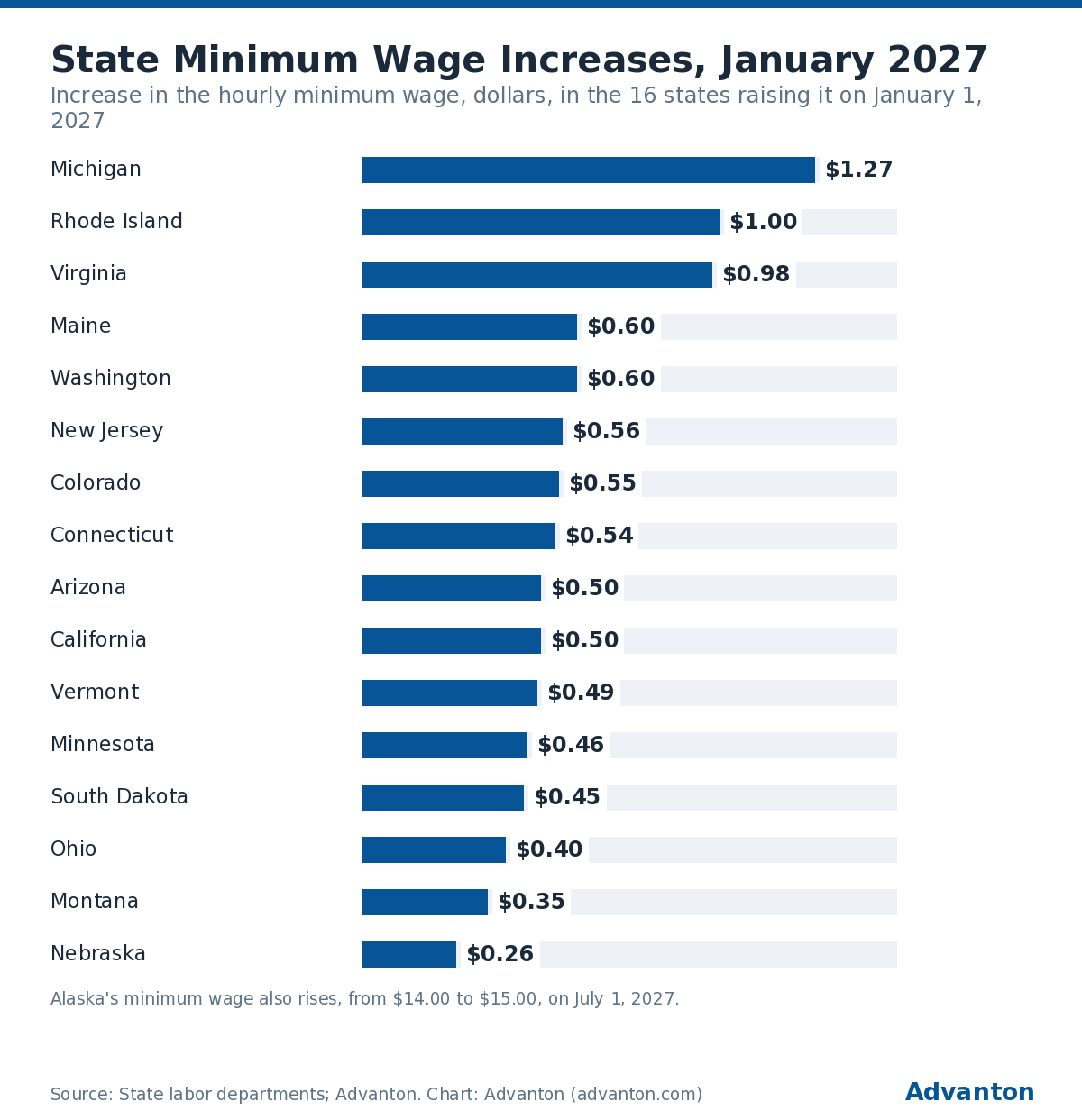
Alaska's minimum wage also rises, from $14.00 to $15.00, on July 1, 2027.
Minimum wage in every state
| State | Now (November 2026) | From January 1, 2027 | Full-time pay a year, 2027* | Later changes |
|---|---|---|---|---|
| Alabama | $7.25 (federal) | No change | $15,080 | |
| Alaska | $14.00 | No change | $29,120 | $15.00 on July 1, 2027 |
| Arizona | $15.15 | $15.65 | $32,552 | |
| Arkansas | $11.00 | No change | $22,880 | |
| California | $16.90 | $17.40 | $36,192 | |
| Colorado | $15.16 | $15.71 | $32,677 | |
| Connecticut | $16.94 | $17.48 | $36,358 | |
| Delaware | $15.00 | No change | $31,200 | |
| District of Columbia | $18.40 | No change | $38,272 | Inflation update on July 1, 2027 |
| Florida | $15.00 | No change | $31,200 | Inflation update on January 1, 2028 |
| Georgia | $7.25 (federal) | No change | $15,080 | |
| Hawaii | $16.00 | No change | $33,280 | $18.00 on January 1, 2028 |
| Idaho | $7.25 (federal) | No change | $15,080 | |
| Illinois | $15.00 | No change | $31,200 | |
| Indiana | $7.25 (federal) | No change | $15,080 | |
| Iowa | $7.25 (federal) | No change | $15,080 | |
| Kansas | $7.25 (federal) | No change | $15,080 | |
| Kentucky | $7.25 (federal) | No change | $15,080 | |
| Louisiana | $7.25 (federal) | No change | $15,080 | |
| Maine | $15.10 | $15.70 | $32,656 | |
| Maryland | $15.00 | No change | $31,200 | |
| Massachusetts | $15.00 | No change | $31,200 | |
| Michigan | $13.73 | $15.00 | $31,200 | |
| Minnesota | $11.41 | $11.87 | $24,690 | |
| Mississippi | $7.25 (federal) | No change | $15,080 | |
| Missouri | $15.00 | No change | $31,200 | |
| Montana | $10.85 | $11.20 | $23,296 | |
| Nebraska | $15.00 | $15.26 | $31,741 | |
| Nevada | $12.00 | No change | $24,960 | |
| New Hampshire | $7.25 (federal) | No change | $15,080 | |
| New Jersey | $15.92 | $16.48 | $34,278 | |
| New Mexico | $12.00 | No change | $24,960 | |
| New York | $16.00 | No change | $33,280 | |
| North Carolina | $7.25 (federal) | No change | $15,080 | |
| North Dakota | $7.25 (federal) | No change | $15,080 | |
| Ohio | $11.00 | $11.40 | $23,712 | |
| Oklahoma | $7.25 (federal) | No change | $15,080 | |
| Oregon | $15.55 | No change | $32,344 | Inflation update on July 1, 2027 |
| Pennsylvania | $7.25 (federal) | No change | $15,080 | |
| Rhode Island | $16.00 | $17.00 | $35,360 | |
| South Carolina | $7.25 (federal) | No change | $15,080 | |
| South Dakota | $11.85 | $12.30 | $25,584 | |
| Tennessee | $7.25 (federal) | No change | $15,080 | |
| Texas | $7.25 (federal) | No change | $15,080 | |
| Utah | $7.25 (federal) | No change | $15,080 | |
| Vermont | $14.42 | $14.91 | $31,013 | |
| Virginia | $12.77 | $13.75 | $28,600 | $15.00 on January 1, 2028 |
| Washington | $17.13 | $17.73 | $36,878 | |
| West Virginia | $8.75 | No change | $18,200 | |
| Wisconsin | $7.25 (federal) | No change | $15,080 | |
| Wyoming | $7.25 (federal) | No change | $15,080 | |
| Federal | $7.25 | No change | $15,080 |
The hourly rate × 2,080 hours (40 hours a week, 52 weeks), before tax.
What the numbers show
Two minimum-wage Americas
From January 2027, 19 states and DC pay $15 or more, while 20 states pay $7.25. A full-time worker earns $36,878 a year at Washington’s rate, against $15,080 at the federal minimum: 2.4 times as much.
Where the federal minimum applies
Alabama, Georgia, Idaho, Indiana, Iowa, Kansas, Kentucky, Louisiana, Mississippi, New Hampshire, North Carolina, North Dakota, Oklahoma, Pennsylvania, South Carolina, Tennessee, Texas, Utah, Wisconsin and Wyoming use the federal $7.25. Alabama, Louisiana, Mississippi, South Carolina and Tennessee have no state minimum wage law, and Georgia and Wyoming set rates below $7.25, so the federal rate applies to most workers there.
Why rates change every January
Many states, including Arizona, California, Colorado, Maine, Minnesota, Montana, New Jersey, Ohio, South Dakota, Vermont and Washington, raise their minimum wage each year in line with inflation. Others, such as Michigan, Rhode Island and Virginia, follow increases set in law.
Understanding the numbers
- Statewide rates only. Many cities and counties set higher minimum wages, for example in parts of California, Washington, Colorado, Illinois, Maryland, Minnesota and New Mexico. Employers must pay the highest rate that applies.
- The federal minimum of $7.25 applies to most employers in every state. Where a state rate is higher, workers get the higher rate.
- Tipped workers, young workers and small employers can have different rates in some states. This page shows the standard rate for most employees.
- What the minimum wage pays for: see how many hours at the minimum wage it takes to rent a home in each state in Hours of work needed to pay rent.
State notes
- Alabama: No state minimum wage law; the federal $7.25 applies.
- Florida: Rose from $14.00 on September 30, 2026.
- Georgia: State rate below $7.25; the federal $7.25 applies to most employers.
- Louisiana: No state minimum wage law; the federal $7.25 applies.
- Mississippi: No state minimum wage law; the federal $7.25 applies.
- Montana: Businesses not covered by federal law with sales of $110,000 or less may pay $4.00.
- New Jersey: Most employers; seasonal workers and employers with fewer than 6 employees have a lower rate ($15.23 in 2026).
- New York: $17.00 in New York City, Long Island and Westchester. No increase on January 1, 2027; a March 2027 increase has been proposed but not passed.
- Ohio: Employers with gross receipts under $419,000 (2027) may pay $7.25.
- Oregon: Standard rate; $16.80 in the Portland metro area and $14.55 in non-urban counties.
- South Carolina: No state minimum wage law; the federal $7.25 applies.
- Tennessee: No state minimum wage law; the federal $7.25 applies.
- Wyoming: State rate below $7.25; the federal $7.25 applies to most employers.
What this means
- Employers: update pay rates and posters before January 1, 2027 in the 16 states raising their minimum wage, and check city and county rates. See our payroll software guide.
- Workers: check your state’s rate in the table; if your city has its own minimum wage, the higher rate applies.
- Compare pay: see typical pay for 20 jobs in How much do jobs pay?.
Frequently asked questions
Which state has the highest minimum wage?
Washington has the highest state minimum wage, $17.73 from January 1, 2027. The District of Columbia is higher still, at $18.40.
Which states have a $7.25 minimum wage?
20 states: Alabama, Georgia, Idaho, Indiana, Iowa, Kansas, Kentucky, Louisiana, Mississippi, New Hampshire, North Carolina, North Dakota, Oklahoma, Pennsylvania, South Carolina, Tennessee, Texas, Utah, Wisconsin and Wyoming.
Which states raise the minimum wage on January 1, 2027?
Arizona (to $15.65), California (to $17.40), Colorado (to $15.71), Connecticut (to $17.48), Maine (to $15.70), Michigan (to $15.00), Minnesota (to $11.87), Montana (to $11.20), Nebraska (to $15.26), New Jersey (to $16.48), Ohio (to $11.40), Rhode Island (to $17.00), South Dakota (to $12.30), Vermont (to $14.91), Virginia (to $13.75) and Washington (to $17.73).
Is the federal minimum wage going up?
No increase has been passed. The federal minimum wage has been $7.25 an hour since July 24, 2009.
About the data
- Current rates: U.S. Department of Labor, Wage and Hour Division, consolidated state minimum wage table (rates in effect July 1, 2026), plus Florida’s increase to $15.00 on September 30, 2026.
- 2027 rates: state labor department announcements and state laws (checked directly for Washington, California and Ohio), cross-checked against Workforce.com (November 13, 2026), StartBusinessByState (November 13, 2026) and Experian Employer Services (October 9, 2026), which agree for every state.
- Checked: November 18, 2026. We’ll update this page as states announce changes.
Use this chart
Cite, embed or download the charts free with the buttons above them. Please keep the credit link.
Last reviewed November 18, 2026. Startup costs are estimates; check local prices, licensing and tax rules before you commit money.
Advanton presents official data as easy-to-read charts and figures. The figures on this page come from the sources named with each statistic and chart, and those sources may revise them. This page is general information, not financial or investment advice. See our disclaimer.