
Updated October 2026
Advertising works best when it’s built on a solid foundation and aimed at the places your customers already look. This guide explains the main ways to advertise a small business, how to choose between them, how to tell what’s working, and how to avoid the common traps that waste money. It’s written for owners doing their own marketing, whether you’re just opening or ready to grow.
Start with the free foundations
Before you pay for any advertising, make sure people who hear about you can find you, trust you and contact you. Paid ads send people to look you up, so these basics decide whether that money turns into customers.
- A complete Google Business Profile. It’s free, and for local businesses it’s often the first thing customers see in search and on Maps. Add your hours, services, photos and a link to your website.
- Recent, genuine reviews. Most people check reviews before contacting a business. Our free review request kit gives you ready-to-send messages and printable QR cards.
- Consistent business listings. Use exactly the same business name, address and phone number everywhere. You can add your business to the Advanton directory for free.
- A simple website on your own domain. See our small business website guide.
Not sure where you stand? Our free online presence checkup scores your setup and gives you a prioritized to-do list. For the bigger picture, read our guide to building an online presence.
The main ways to advertise
| Channel | Works well for | How you usually pay |
|---|---|---|
| Search ads (Google Ads, Microsoft Advertising) | Reaching people actively searching for what you sell | Per click |
| Local Services Ads (Google) | Home and professional services that take calls and bookings | Per lead |
| Social media ads (Facebook, Instagram and others) | Building awareness, promoting events and offers, reaching people by interest and location | Per impression or per click |
| Local platforms (Nextdoor, Yelp and similar) | Neighborhood services, restaurants and retail | Varies by platform |
| Email and text marketing | Bringing past customers back | Mainly your time and software |
| Print and local (flyers, direct mail, local papers, sponsorships) | Reaching a neighborhood, older customers and community-minded buyers | Per piece or per placement |
| Sponsored content | Explaining a product or service in depth to a relevant audience | Per placement |
Search ads
Search ads appear when someone searches for words you choose, such as "emergency plumber near me." Because people are already looking, search ads often bring the most ready-to-buy customers. Start small: a handful of specific search phrases, a tight service area, and an ad that sends people to a page about that exact service, not your homepage.
Local Services Ads
For many home and professional services, Google offers Local Services Ads, which appear at the top of local searches. Businesses go through a screening process and typically pay when a customer contacts them, rather than per click. Check whether your category and area are covered.
Social media ads
Social ads are better at creating demand than catching it. They work well for visual businesses, events, new openings, seasonal offers and building a local following. Use real photos of your work, a clear offer and a simple next step.
Local platforms
Neighborhood platforms and review sites can put you in front of nearby customers who are comparing options. Keep your free profile complete and respond to reviews before paying to promote it.
Email and text marketing
Your existing customers are your cheapest source of new sales. A short, useful email or text with a reason to come back, such as a seasonal reminder, a new product or a loyalty reward, often outperforms paid ads. Only contact people who’ve agreed to hear from you (see the rules below). Our free loyalty card maker helps turn first visits into repeat visits.
Print and local advertising
Print still works, especially close to home. Flyers on community boards, door hangers, direct mail to nearby streets, local event sponsorships and school or sports program ads all build local recognition. Make flyers with tear-off tabs in our free flyer maker, hand out business cards, and sell gift certificates that bring in new customers through your existing ones.
Sponsored content
Sponsored articles, newsletters and videos place your message alongside content your audience already reads. They work best when the content is genuinely useful. Sponsored content must be clearly labeled as advertising (see below).
For more ideas, see our advertising ideas for small businesses, free marketing tools for home businesses and how to promote your website for free.
How to choose the right channel
- Start where your customers look. If people search when they need you (repairs, legal help, urgent care), start with search and Local Services Ads. If they discover you by browsing (food, fashion, gifts, fitness), start with social media and local visibility.
- Pick one channel and do it well. Spreading a small budget across five channels makes it impossible to tell what’s working.
- Match the message to the moment. Someone searching "AC repair today" wants speed and availability; someone scrolling wants a reason to remember you.
- Send people somewhere useful. Every ad should lead to a page or profile that answers the obvious questions and makes it easy to call, book or buy.
- Run a test, then decide. Give a campaign long enough to collect real results, then keep, adjust or stop it.
How to set an advertising budget
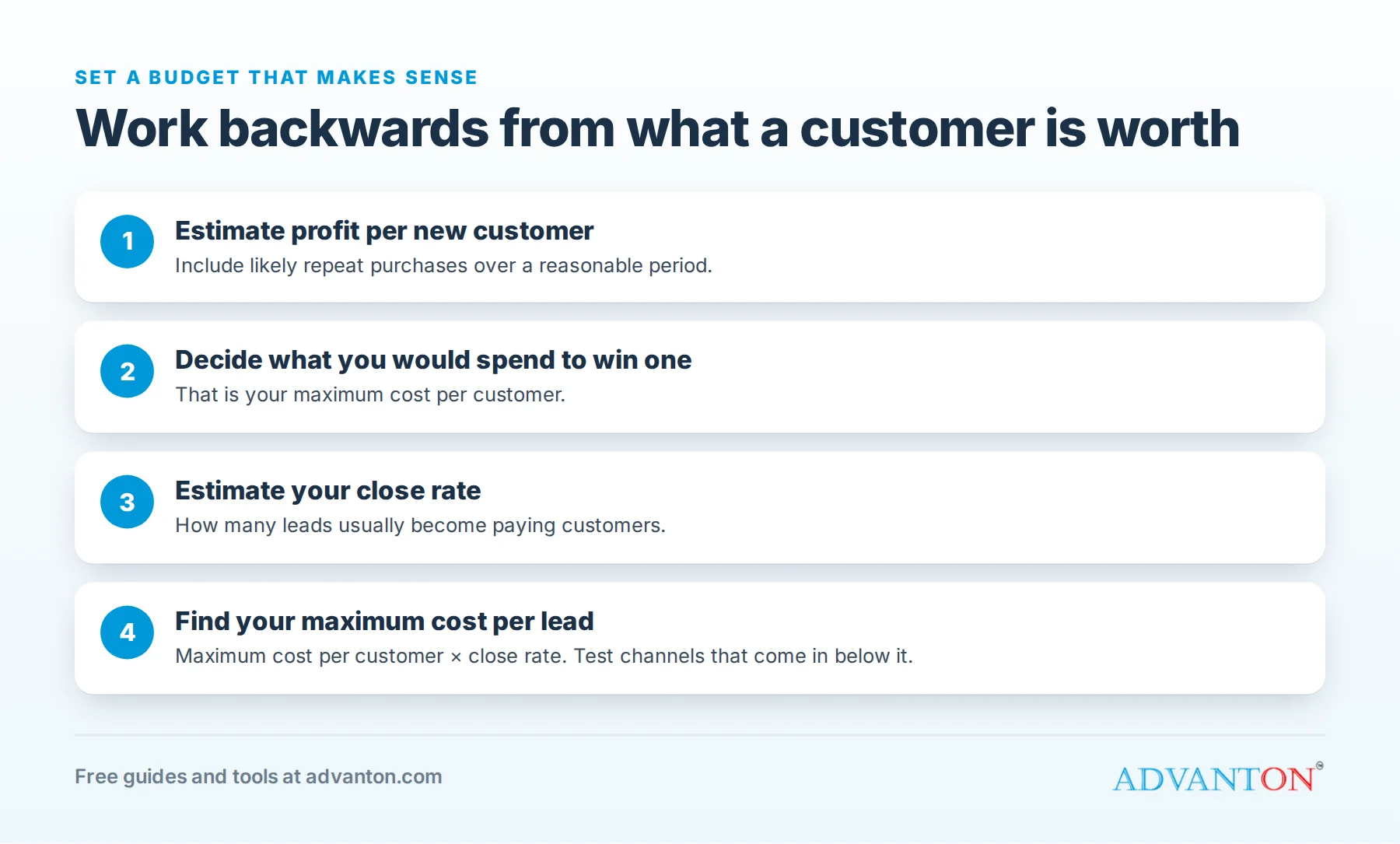
Instead of guessing, work backwards from what a customer is worth:
- Estimate the gross profit from a typical new customer, including likely repeat purchases over a reasonable period.
- Decide how much of that profit you’re willing to spend to win the customer. That’s your maximum cost per customer.
- Estimate how many leads become customers (your close rate).
- Multiply your maximum cost per customer by your close rate to get the most you can afford to pay per lead.
If a channel can deliver leads below that number, it’s worth testing. If not, improve your offer, your close rate or your landing page first. Our free pricing calculator and break-even calculator help you work out your margins.
How to measure what’s working
- Ask every new customer how they heard about you, and write it down.
- Use a separate landing page or tracking link for each campaign, so you can see where visits come from.
- Track calls, for example with a dedicated phone number for a campaign.
- Watch the numbers that matter: cost per lead, how many leads become customers, cost per customer, and revenue compared with ad spend.
- Review monthly. Shift money toward what brings customers and away from what only brings clicks.
How to avoid wasting money on advertising
Be cautious with any advertising offer, from any company, that:
- Guarantees rankings or results, such as "page one on Google" or a fixed number of sales.
- Quotes traffic or audience figures you can’t verify. Ask where numbers come from and how many visitors are actually in your area.
- Locks you into a long contract with heavy cancellation fees.
- Keeps control of your accounts. You should own your ad accounts, your website, your domain and your customer list.
- Sells leads without explaining where they come from, or sells the same lead to many businesses without saying so.
Ask for references from businesses like yours, start with a short trial, and get the terms in writing.
The rules to follow
Advertising rules protect your customers and your reputation. In the US, key ones include:
- Truth in advertising. Claims must be truthful and not misleading, and you need evidence to back them up. The FTC’s advertising and marketing guidance covers the basics.
- Reviews and endorsements. Never post or buy fake reviews, and disclose any payment, free product or relationship behind an endorsement or influencer post.
- Email. Commercial emails must identify you, include your physical address and offer a working way to unsubscribe. See the FTC’s CAN-SPAM compliance guide.
- Text messages and calls. Get clear consent before sending marketing texts or making marketing calls with automated tools.
- Sponsored content. Content that looks like editorial content but is paid for must be clearly labeled as advertising. The FTC’s native advertising guide explains how.
This is general information, not legal advice. Rules vary by state and industry, so check with a professional if you’re unsure.
Sponsorships and partnerships with Advanton
Advanton is a free information hub for small business owners: practical guides, free tools and a free business directory. To keep it free, we welcome a limited number of sponsors whose products or services genuinely help small businesses, such as banking, insurance, software and training.
Our standards for any sponsorship:
- Clearly labeled. Sponsored content is marked as sponsored, and paid links are marked as sponsored in line with Google’s link guidelines.
- Independent. Sponsors don’t influence our guides, tools or directory listings.
- Relevant and honest. We only work with offers that suit our readers, and we don’t publish claims we can’t support.
If you’d like to discuss a sponsorship, contact us. Listing your business in our business directory is free.
Frequently asked questions
What’s the best way to advertise a small business with no budget?
Complete your Google Business Profile, ask every happy customer for a review, list your business in free directories, post consistently where your customers spend time, and use flyers and business cards locally. These cost time rather than money and make any future paid advertising work better.
Should I start with Google or social media ads?
Start with search if customers look for your service when they need it. Start with social media if customers discover businesses like yours by browsing, or if you’re promoting an event, opening or offer.
How long should I test a campaign before deciding?
Long enough to collect enough leads or sales to judge it, often several weeks. Decide in advance what result would make you continue, adjust or stop.
Do I need an agency?
Not to get started. Many owners run simple search, social and local campaigns themselves. If you hire help, keep ownership of your accounts and ask for clear monthly reporting.
Keep learning
- Marketing success stories
- Business ideas for entrepreneurs
- Building your online presence
- Local online marketing
- Getting leads for contractors
- Keeping customers coming back
- Free small business tools
Sources
- FTC, Native Advertising: A Guide for Businesses
- FTC, Advertising and Marketing basics
- FTC, CAN-SPAM Act: A Compliance Guide for Business
- Google Search Central, Qualify your outbound links
Last reviewed October 22, 2026. Startup costs are estimates; check local prices, licensing and tax rules before you commit money.

